
Legislative Encounters as Political Theatre: A Workshop for Higher Education Leaders
INTRODUCTION
Higher education is often imagined as distinct from political influence; its role is frequently romanticized as a place separated from the machinations of politics.1 Political conditions today are often considered uniquely threatening to that presumed independence,2 yet higher education and the political world have consistently been mutually engaged. The current political landscape should be viewed, therefore, not merely as something unprecedented in legislative/campus relations, but instead as a new chapter in an ongoing story. Given the essential and ongoing relationship between higher education and legislatures, it is imperative that those representing colleges and universities not only understand how to best engage with their legislative representatives, but what communication strategies will be most efficacious in those interactions. We argue here that successful legislative engagement requires a conscious strategic deployment of rhetorical strategies and tactics to best advocate for higher education in a variety of legislative situations.
We cannot overemphasize the reliance of institutions of higher education on legislative actions. At the most basic level, both public and private institutions depend on federal funding to operate. Federal financial aid, distributed directly to students to cover educational expenses, totaled close to $135 billion in fiscal 2025.3 Federal grants and contracts, which include funding for research and institutional support, totaled $60 billion in 2025.4 Each of these streams of revenue require institutions to adapt, if not conform, to prevailing political conditions. Recipients of federal student aid, whether public or private, must also comply with the Code of Federal Regulations Title 34,5 which establishes institutional eligibility requirements, including the role of accreditors in enforcing standards tied to student success.6 Public institutions face even more legislative scrutiny as they rely heavily on state appropriations to provide operational costs and additional student aid. State institutions must always, therefore, operate within the bounds of their state legislatures, both in terms of funding7 and operational constraints.8
The range of higher education institutions, including technical and community colleges, four-year public and private colleges, regional comprehensive universities, and public and private advanced research universities, complicates legislative relations even further, as different institutions have different missions and different challenges and opportunities for legislative engagement, given those missions. Different institutions also enjoy varying levels of resources, including those that support legislative engagement, which we categorize as informational, relational, and communicative. Well-funded institutions may have a large communication staff, lobbyists,9 government relations specialists, and chiefs of staff, while less resourced institutions may have no specific staff member whose responsibility is directly tied to legislative relations. Given such divergences and inequities, it is imperative that leaders of all institutions, particularly presidents and chancellors,10 have nuanced advocacy skills to deploy in legislative engagement.
The diverse legislative environments faced by university leaders are complex. In addition to available institutional resources and the political makeup of state legislatures, other important variables influence the ability of college and university leaders to build relationships and engage in effective communication, including whether their legislative bodies are working with a supermajority, controlling all branches of government, and if the state has a trifecta in its government.11 Complicating the legislative environment further, some states have professional legislatures well supported by staff and research resources, while others are citizen legislatures whose membership has little time or support to investigate a wide range of highly complex issues. Following basic rhetorical principles, which require advocates to adapt their messages as audiences and circumstances vary, we can assume that ideal rhetorical strategies will be different in each setting.
Here, in what follows, we provide strategies for higher education leaders to more effectively engage in legislative encounters. To accomplish that goal, we first summarize our initial research on the FORUM Act, where we analyzed testimony before state legislators by university leaders. The findings from that research led us to investigate how college leaders described their experiences working with legislators. In light of the responses we gathered from these leaders, we constructed a theoretical framework for analyzing these variable educational and legislative environments, concluding with a workshop outline for more productive legislative engagement. This framework should provide college leaders with both rhetorical strategies and tactics that will allow them to engage in variable legislative environments. Our initial research project focused on understanding how higher education was characterized by state legislatures in debates about the FORUM Act, or the “Forming Open and Robust University Minds” Act.12 We observed that university leaders employed very limited types of arguments in public testimony in defense of their institutions, often with disappointing results. A review of our findings from that initial work is warranted to set the stage for our current project.
THE FORUM ACT AND UNIVERSITY TESTIMONY IN STATE LEGISLATURES
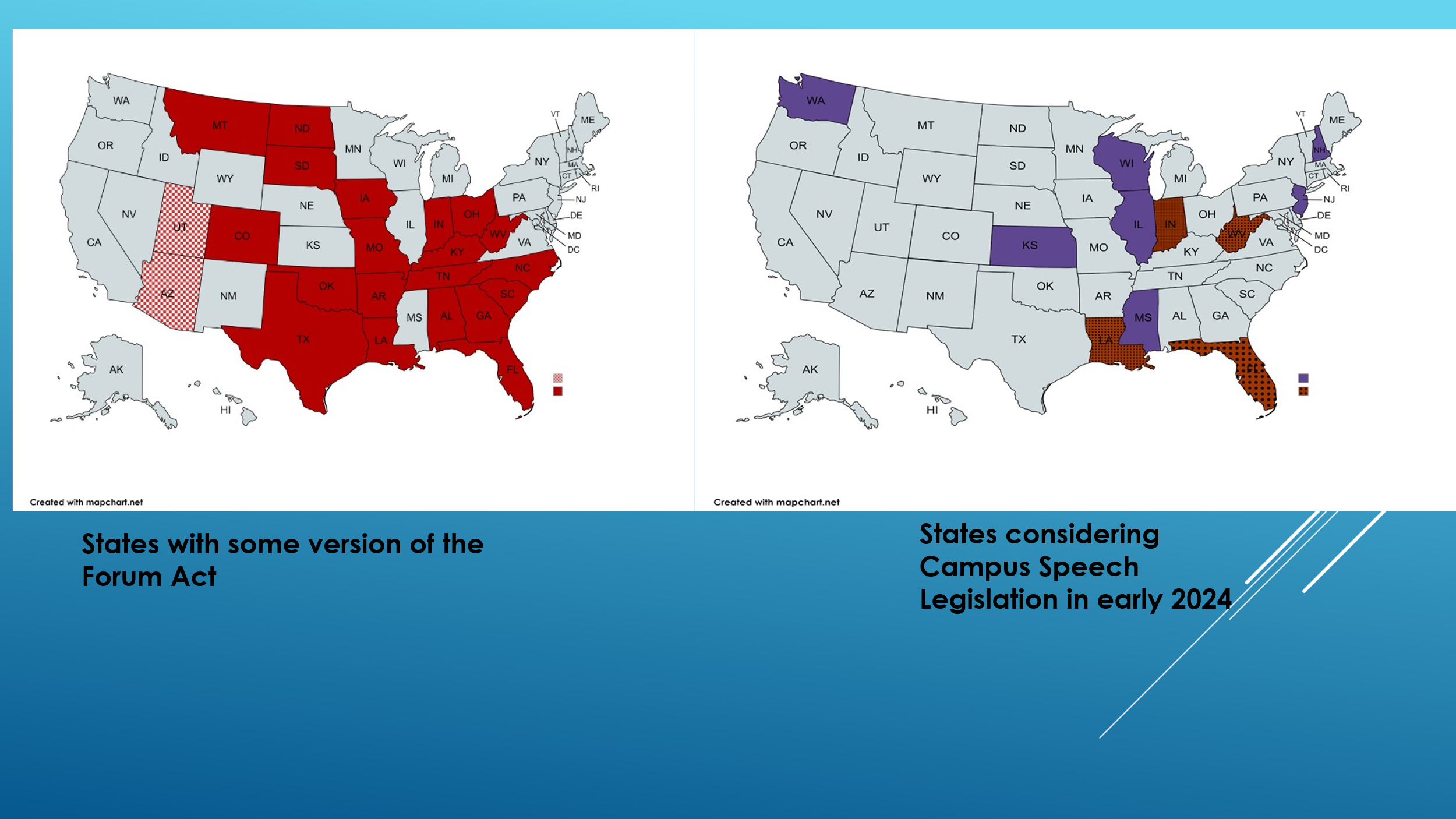
The FORUM Act, which began sweeping through state legislatures in 2018, is an example of “model legislation,” or a model of legislative action promoted by some group that can be modified as needed for different legislative settings.13 Originated by the American Legislative Exchange Council, the FORUM Act seeks to better protect purportedly threatened conservative voices on U.S. campuses.14 Exemplifying how legislation can quickly transform the landscape of higher education, by the end of 2023 the FORUM Act had been introduced in twenty-five states, with a dozen more considering similar legislation in upcoming sessions (Figure 1).15
To analyze how university leaders interacted with their state legislatures during formal testimony, we identified five states with different political valencies for our study (Figure 2): Maryland, Texas, Louisiana, Ohio, and Kentucky. The makeup of these state governments included blue and red states with supermajorities, some with trifectas, and pink and purple states with balances of power leaning right or left.
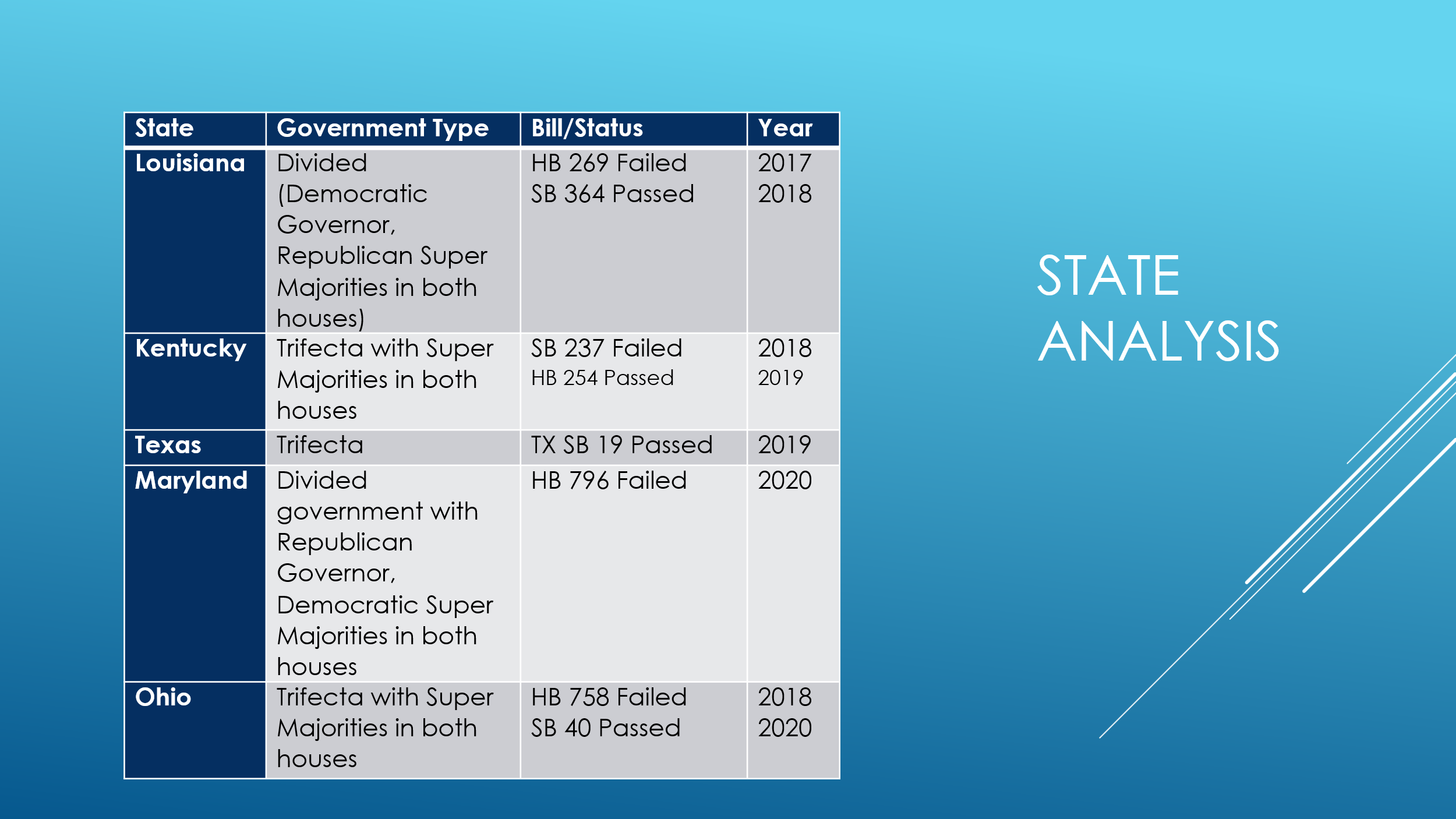
| State | Government Type | Bill/Status | Year |
|---|---|---|---|
| Louisiana | Divided (Democratic Governor, Republican Super Majorities in both houses) | HB 269 Failed SB 364 Passed | 2017 2018 |
| Kentucky | Trifecta with Super Majorities in both houses | SB 237 Failed HB 254 Passed | 2018 2019 |
| Texas | Trifecta | TX SB 19 Passed | 2019 |
| Maryland | Divided government with Republican Governor, Democratic Super Majorities in both houses | HB 796 Failed | 2020 |
| Ohio | Trifecta with Super Majorities in both houses | HB 758 Failed SB 40 Passed | 2018 2020 |
Maryland, with a government divided between a Republican governor and Democratic supermajorities in both houses of the legislature, refused the model legislation outright, without substantive debate. Conversely, Texas, without any checks and balances provided by divided government, with both a Republican supermajority in the state house and senate and a trifecta, passed the legislation without significant opposition. Louisiana (a divided pink state without a trifecta), Kentucky (undivided red and with a trifecta), and Ohio (undivided red and with a trifecta) went through two legislative rounds before passing the FORUM Act in slightly different forms.
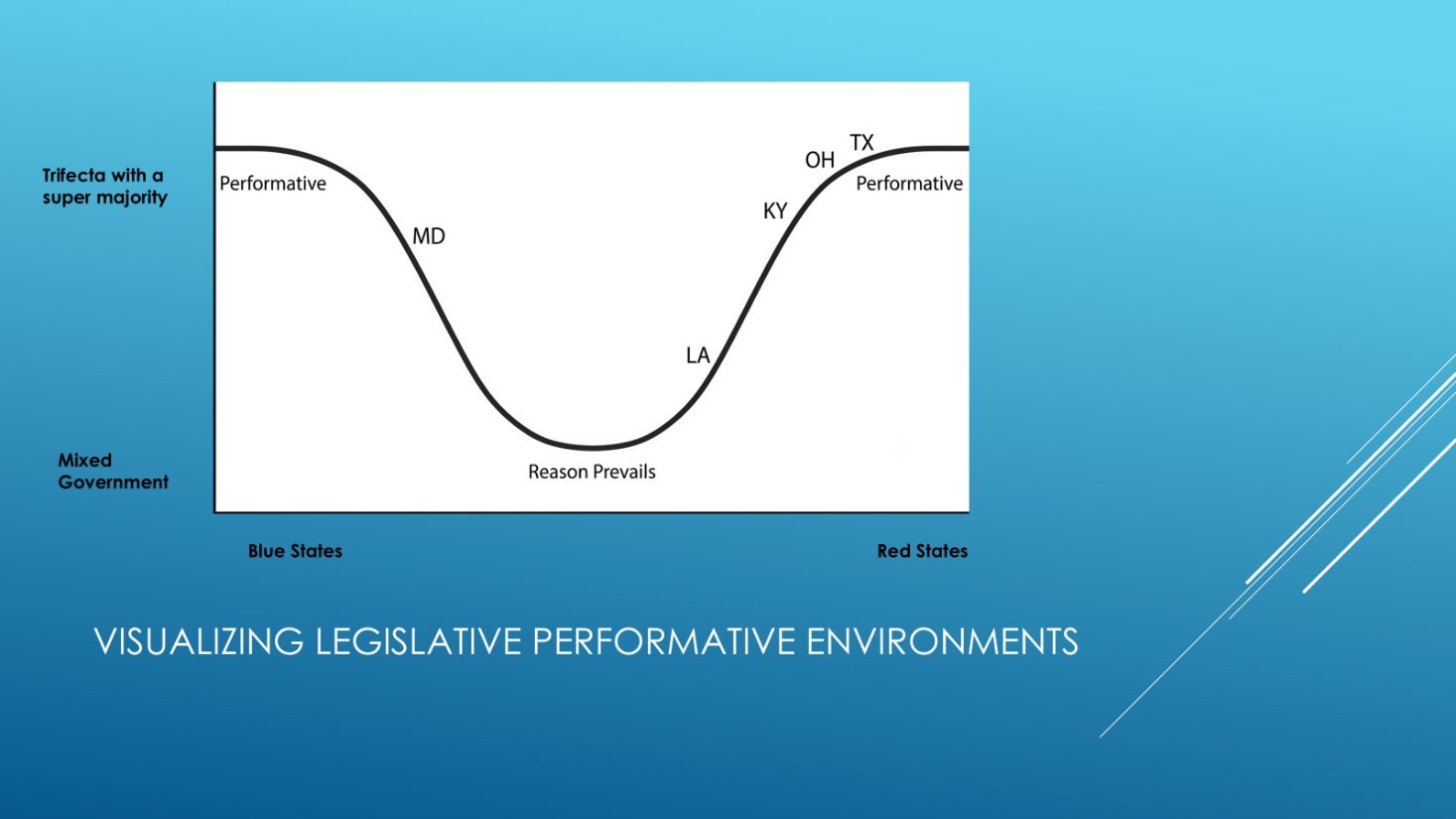
Our review of legislative encounters related to the FORUM Act revealed a range of persuasive environments at work. In the first type of environment, we found that reason, or logos, prevailed. This type occurred where there was a relative balance of power and competing arguments had to be taken into consideration for any legislation to pass. In the second type of legislative environment, character issues, or ethos, whether real or imagined, and emotion, or pathos, prevailed (i.e., they were based more on performances of character and its consequences than reasonable debate). We observed this second type in legislative encounters where systems of checks and balanced were undermined by supermajorities and trifectas. The following diagram illustrates this principle (Figure 3).
Our analysis also revealed that, regardless of the type of legislative environment, university representatives used the same rhetorical strategies when formally defending their institutional policies; that is, they seemed unable or unwilling to move away from a neutral, reason-based defense of their institutions, backed by their presumed authority and expertise, irrespective of the type of argument (i.e., reasonable or performative) made by the proponents of the FORUM Act. This was particularly problematic in Kentucky, where two conservative students, serving as proxies for ALEC, provided emotion laden testimony about how their institutions limited their ability to connect with other students, while the president of the University of Kentucky, when asked for his input, simply said, “We have no problem [with this legislation].”16
As rhetoricians, we were frankly astounded by the lack of rhetorical savvy demonstrated by higher education leaders and their clear misreading of different legislative environments, assuming all were reasonable. We concluded our initial study, therefore, with recommendations for engaging in advocacy in support of higher education in public testimony across different legislative terrains.17 As we have observed in the two years since our first project concluded, there has not been a significant increase in the advocacy skills displayed by college and university presidents in legislative testimony.18 This realization, therefore, led to our current study on how university leaders prepare for and enact legislative communications, with an eye to useful workshops. This second round of research revealed a much broader range of communicative settings we had not yet considered, from public to private, occurring across an even wider range of higher education and legislative environments, requiring even more rhetorical acumen than we initially presumed within our initial, more limited, focus on public testimony.
UNDERSTANDING PRESIDENTS’ AND GOVERNMENT AFFAIRS STAFFS’ EXPERIENCES IN LEGISLATIVE INTERACTIONS
Given that our original work focused only on a few cases of university leaders interacting with state legislatures, and only when providing official testimony, we next embarked on an empirical study of how higher education leaders prepare for and describe their legislative encounters. We initially set out to interview presidents from a variety of institutional types about their lived experience working with legislators. Our goal was to interview sixty presidents whose schools were geographically situated in different political environments. To that end, we developed an open-ended interview script that would inform our workshop design by highlighting both what worked for higher education leaders and what gaps they experienced in their interactions with legislators.19 We additionally sought to interview ten government relations staff members, from campuses and national organizations that support higher education, to better understand how their work complemented the efforts of presidents.20 We began recruiting in earnest in September 2025 by sending emails to college and university presidents as well as that president’s chief of staff or administrative assistants. Out of hundreds of solicitations, we only received one acceptance,21 which obviously necessitated a change in approach.
Through personal and professional connections, we were eventually able to interview three former college and university presidents, three government affairs staffers, and a former member of a state legislative staff, all with considerable experience in legislative relations. The quantity of interviews was far less than we had wished, but we nevertheless found consistent principles across all interviews that teased out not only what worked for these individuals but how we might build a workshop grounded in rhetorical theory. We supplemented these interviews with several others of college and university presidents that appeared in The Chronicle of Higher Education and Inside Higher Education addressing issues related to interactions with legislators.22 Taken together, these sources provided guidance not only on how to best engage with legislators, but also what limits exist on that engagement.
LIMITS ON LEGISLATIVE ENGAGEMENT AND TESTIMONY
Before we introduce key principles for successful legislative engagement, which our interviewees consistently shared, four important constraints emerged from our interviews that limit the ability of presidents to advocate for their institutions, regardless of preparation and training: 1) structural issues may constrain the president’s ability to engage with legislatures; 2) the declining tenure of college presidents complicates the ability to build relationships with legislators; 3) each president has to negotiate “baggage” as they build relationships with their legislators; and 4) hyperpolarized political environments constrain the limits of advocacy. There are, in other words, some battles that cannot be won, or even engaged, regardless of how well a president has gathered relevant information, established relationships, or designed communications. Learning about these limits was one of the most significant and consistent findings from our interviews, next to learning what consistently worked best in legislative encounters.
The first limit, or constraint, that emerged is that all higher education presidents serve at the pleasure of their boards, which means that presidents must carry their board’s political wishes into any legislative interaction.23 Presidents of private institutions, though, may occasionally have relative autonomy in advocating for their institutions, much more so than their public institutional colleagues. Public universities are almost always part of a system, and many systems are built on a hierarchy of institutions. These systems are complex and varied,24 constraining both the types of legislative engagements possible and the types of requests that may be made by presidents to legislatures. One clear example of this emerged in our interviews when the former president of a regional comprehensive in a large state system described their inability to set either tuition or expenses, which were established at the system level in concert with the state legislature. This president understandably described being constrained in their ability to advocate in this situation.
The second constraint that emerged was the length of time at the helm of an institution being a crucial variable in navigating legislative relationships. The former presidents we interviewed served between eight and twenty years, well above the average length of tenure reported by the American Council on Education in 2022 of 5.9 years.25 It is a simple but profound truism that the less time in office the more difficult it is to earn trust and establish expertise. In a published interview, George Pruitt, a long serving president at Thomas Edison State University, observed, “This trend of revolving-door presidencies has destabilized higher education and contributed to the public loss of confidence in the academy.”26 One of our interviewees noted that their “biggest win” was becoming a source of expertise and information for legislators, which is only possible when relationships have time to mature.
The third constraint, the broader communicative environment that precedes any legislative engagement, is both the most difficult to navigate and among the most important for determining rhetorical strategies for engagement. Presidents walk into legislative encounters that are largely predetermined by their predecessors. One of our interviewees described the acrimonious relationship their immediate predecessor had with the state legislature as a barrier they had to overcome. Our interviewees also noted that prior statements made by either their predecessors or themselves had the potential to be used against their institutions.
The fourth constraint impacts higher education at a macro-level. Presidents must act within a cultural and media environment that transcends their local relationships. There have been moments in history where that macro-level has worked in their favor, when higher education was broadly viewed as a public good, but the current climate has seen an erosion of public trust in the value of college degrees, with only 42% of Americans expressing confidence in higher education in 2024.27 This lack of trust is highlighted by media coverage of sensationalized issues on campuses, including the rising cost of attendance,28 campus protests,29 and controversies over commencement speakers.30 These narratives are often centered on elite institutions, obfuscating the diversity of higher educational institutions and increasing advocacy challenges for presidents from non-elite institutions.31
Taken together, these four constraints impact the rhetorical strategies our interview participants recommend as most helpful in legislative engagement. A newly appointed president at a regional comprehensive in a state system that is centralized, for example, may have fewer strategies at their disposal than a private college president who has served for a decade.32 Despite these broad constraints potentially limiting the communicative effectiveness of higher education leaders, straightforward recommendations for developing strong legislative relations also emerged from our interviews, providing important lessons on how to promote the interests of higher education. We turn now to these recommendations.
RECOMMENDATIONS FOR ENGAGING WITH LEGISLATORS
The first principal insight that emerged from our interviews was that legislative engagement is obviously much broader than formal testimony. As noted, our current project was motivated by our earlier observation of formal testimony before legislative bodies; it was there we found that rhetorical strategies employed by university representatives were uniformly based on reason and perceived as “lawyerly.” Our interviews shed light on the variety of situations where college and university presidents interact with legislators outside of formal testimony, including, but not limited to, on-campus events, local community events, and meetings and calls with their representatives. Such forms of engagement were universally perceived as far more impactful over the long term in creating a strong reputation for themselves and their institutions.
Each scene of engagement, from private to public, our interviewees noted, requires different strategies, both practical and rhetorical. Campus visits, for instance, are generally controlled by the president and provide opportunities to show off the elements of campus most appealing to the interests of a legislator. One interviewee related the story of a legislator who was visiting their campus who held the stereotype that the school was for children of the elite. The president therefore organized a tour of campus conducted by a student from that legislator’s hometown who was a first-generation college student benefiting greatly from state aid.
All the presidents interviewed reiterated the crucial importance of building personal, not just formal, relationships with local, state and, as appropriate, federal legislators. One interviewee encapsulated this theme clearly: “It is the moral duty of the president to forge relationships that are important for their institution.” Relationship building must begin long before there is an “ask” of a legislator. To that end, one president we interviewed recommended cultivating cordial low stakes meetings. Other interviewees stressed the importance of inviting legislators to campus regularly, and, when appropriate, recognizing those legislators and honoring them, noting any help they have given to their campus in the past. Interestingly, interviewees articulated that building these relationships was just “common sense.” While many presidents have an intuitive understanding of relationship building, it is still critical to be conscious of how to enter into and sustain these relationships.
The second recommendation that emerged from our interviews was that higher education leaders need to consider how both their own character and the character of their institution are perceived by members of their legislature. Before a president can establish relationships with any constituency, as rhetoricians are aware, they must establish ethos; that is, they must be viewed as dependable, honest and trustworthy. Another aspect of ethos reinforced by all interviewees was the crucial importance of non-partisanship. University leaders must not be seen as siding with one political party, even in their personal life. One interviewee, for example, changed their political affiliation to independent when they took their first presidential job and is very careful to make only token personal political contributions to the incumbents of both parties in their area.
Building and sustaining friendly, trusting relationships is fundamental to effective legislative engagement. One interviewee provided an excellent metaphor for this principle: “relationships are a garden needing constant tending.” Interviewees universally recommend seeking out legislators and forging relationships at an individual level. One interviewee even suggested getting to know the names of legislators’ pets, and certainly where they went to school. These types of relationships are intentional and work for the mutual benefit of both higher education leaders and legislators. Another interviewee noted that legislators should be treated as old friends not to be placed in awkward positions.
Higher education leaders must also be seen as advocates for the mission of their institution. Though they need to work collegially with legislators, they must not back down when their institution’s mission is challenged. One interviewee strongly asserted that leaders have a solemn duty to correct mischaracterizations about their institution; however, back to constraints, the strength of a leader’s advocacy needs to be balanced by caution in what issues they engage with at the legislature. Our interviewees universally stressed the importance of choosing to intervene, only when institutionally appropriate, in issues most crucial to their mission. One emphasized that any time they had the ear of a legislator they focused only on the biggest issues for the institution and were careful not to ramble.
The third recommendation for more effective legislative engagement emerging from our interviews was that presidents should leverage their institutional resources for both information and for communication strategies. Information resources provide both external and internal insight; they may be used to understand legislative environments as well as to develop advocacy on behalf of one’s institution. National organizations such as the American Council on Education, the National Association of Independent Colleges and Universities, the Association of Public Land Grant Universities, the American Association of Community Colleges, private college consortia, as well as state higher education boards, provide informational support to a variety of institutions.33 Although such organizations generally do not research issues that impact specific institutions, they are often at the forefront of understanding legislation impacting higher education and speaking for higher education writ large. All our interviewees recommended connecting with external resources to understand the national and state legislative environment even when their institution had internal staff working in government relations.
Internal communication resources, our interviewees noted, vary widely across higher education institutions, but one should maximally use what resources one has. While almost all higher education institutions have at least one staff member responsible for communications, not all schools have a depth of expertise in gathering information or developing stories to share with legislatures. There are, however, experts among staff and faculty that can serve as resources on specific issues of interest to either the institution or a legislator. One interviewee, who worked at a small under-resourced private college, related a story about meeting with their director of financial aid to understand how limiting a specific type of federally funded scholarship would impact the students at their institution. On a separate occasion, this president met with their health science faculty to promote a new program that would increase medical practitioners in the state. They were able to leverage the knowledge of their faculty and staff in both cases to garner information and create communicative strategies that advanced their institution’s mission.
Taken together, our interviews revealed both broad constraints and specific principles of universal value when navigating legislative engagement. The principles of building relationships, developing character and trust, and leveraging informational and communication resources, constrained by structural situation, tenure in office, prior relationships, and broader cultural/media settings, guided us to a theoretical architecture that undergirds the workshop we have developed for higher education leaders.34 That architecture focuses first on the analysis of rhetorical situations, second on using such analyses to better build trust and identification with legislators, and third, understanding legislative encounters as inherently theatrical; that is, understanding how different rhetorical situations require different types of performance. With these principles, and the attendant constraints, in mind, we turn now to a general overview of this theoretical architecture.
RHETORICAL THEORIES FOR NAVIGATING LEGISLATIVE ADVOCACY
Our initial research illustrated a pressing need for rhetorical training to assist higher education leaders in navigating different, and often fraught, formal legislative environments. Our subsequent interviews with college presidents and government affairs staff broadened our understanding of the types of legislative engagement that college presidents must develop beyond formal testimony. To be effective across types of legislative engagement, we maintain, they should first understand the nature of rhetorical situations, including a map of their informational, relational, and communication resources, their given structural constraints, and the issue at hand. Second, they must understand the basic principles of trust building, or how to develop and sustain informational and relational resources. Third, they must understand the nature of legislative encounters as dramas, or what we call “political theater,” because different types of argumentative performance are required by different rhetorical situations.
RHETORICAL SITUATIONS
We begin with the concept of rhetorical situation, for this concept provides an indispensable tool for mapping higher education and legislative environments, or scenes of action. Without such knowledge, we maintain, higher education leaders lack the contextual information needed to engage in appropriate rhetorical interventions related to the building of trust in different performative settings.
Rhetorical situations are, according to Lloyd Bitzer, composed of three key elements: (1) an exigence, or a pressing problem that can be remedied through discourse; (2) an audience that must be artfully addressed; and (3) various constraints unique to the situation (e.g., informational, relational, and communicative resources involving both speakers and their audiences). According to Bitzer, an “exigence is an imperfection marked by urgency,” where speech can resolve that imperfection.35 Death, winter, and natural disasters, therefore, are not rhetorical situations because speech can do nothing to remedy the reality, whereas legislative exigences are always rhetorical situations, because rhetors have the potential to influence outcomes. We also note that, according to Bitzer, “there will be at least one controlling exigence which functions as the organizing principle” of the rhetorical situation. An example of a controlling exigence on higher education was the crisis of the COVID 19 pandemic on campus. In this case, there were many competing exigences that existed, but the immediate concern of COVID outweighed all others.36
Bitzer’s second element of rhetorical situations is that “rhetoric always requires an audience” and that the audience consists “only of those persons who are capable of being influenced by discourse and of being mediators of change.”37 Bitzer, however, provides scant direction on how to theorize audience, so we turn to Perelman and Olbrechts-Tyteca’s conceptions of audience as a useful complement.38 From their work, we extract two parallel ideas: the particular and universal audience.
Particular audiences39 are theorized by an arguer, after analyzing the rhetorical situation, to allow them to best prepare their advocacy strategy. This allows arguers to examine, for example, any preexisting conditions, biases and predilections towards an issue being presented. In legislative advocacy concerning higher education, these may include such objects as party affiliation, a legislator’s experience with higher education systems, and conceptions fostered by the mass media. In addition, a particular audience is often heterogenous, requiring advocates to create arguments with different types of appeals for different audience members.40 In simple terms, what counts as evidence for one person might not be accepted by another in the audience, thus the need for extra special care in message construction. Although this principle may seem self-evident, attempting to persuade a highly diverse audience artfully may subject advocates to ethical slippage: an arguer could possibly present entirely different reasons to different audiences or audience members and thus appear manipulative.
To ethically ground particular audiences, Perelman and Olbrechts-Tyteca entreat arguers to also develop a universal audience that serves to anchor what counts as reasonable argument. The universal audience is an abstraction, made up of an imaginary “reasonable” audience, and its function is to transcend particular audiences. “Hence, the primordial importance of the universal audience, as providing a norm for objective argumentation.”41 As advocates create arguments to use to persuade particular, often highly diverse, audiences, they can employ the universal argument to ensure, despite tactical moves, the strategic consistency of appeals. We maintain that institutional mission functions similarly to the universal audience for advocacy in higher education.42 Higher education leaders usually need to alter rhetorical tactics to address the beliefs of different particular audiences, but to avoid appearing inconsistent these tactics should be grounded in institutional mission.43
Regardless of the persuasive tactics deployed for particular audiences, even when tempered by mission, Perelman and Olbrechts-Tyteca remind us that, ultimately, “since argumentation aims at securing the adherence of those to whom it is addressed, it is, in its entirety, relative to the audience to be influenced.”44 Higher education leaders, plainly, must deploy different methods of argument for different audiences in different rhetorical situations to best advocate for their institution. This is anything but easy, but mapping the rhetorical situation must always come first.
Finally, in addition to exigences and audiences, rhetorical situations always have constraints, which include but are not limited to “beliefs, attitudes, documents, facts, traditions, images, interests, motives and the like,” and there are two basic types: those managed by the rhetor and those encountered by the rhetor.45 Included among these constraints, of course, are the limits of informational, relational, and communication resources, as well as the constraints identified in our interviews. Constraints may, in addition, also be situational, as unexpected exigences emerge. For example, after the assassination of Charlie Kirk on the campus of Utah Valley University in 2025, higher education leaders felt compelled to respond.46
By mapping rhetorical situations as an initial strategy, and in so doing identifying controlling exigences, audience issues, and constraints unique to legislative encounters, advocates are well-positioned to work on tactically artful communicative interventions. Put plainly, educational leaders cannot begin developing artful communicative tactics until they understand the specifics of the rhetorical situation.
BUILDING TRUST AND IDENTIFICATION
Once one has a clear map of the given rhetorical situation, they are ready to build trust and identification purposefully, which is the very essence of persuasion. Trust and identification, in other words, are the ultimate goals to be reached through artful analyses of rhetorical situations. In turn, trust and identification are centered in character: what is a person presumed to know (logos), what are their intentions (ethos), and how do they make us feel (pathos)? If we believe what you say, believe your intentions are good, and you make us connect emotionally, then we are almost certain to agree with your policy recommendations.
Across the history of persuasive theory, therefore, the establishment and maintenance of character has been a central concern. For Aristotle, whose foundational theory of character has resonated across millennia, “Rhetoric is an art . . . defined as the faculty of discovering in the particular case what are the available means of persuasion,” and character is paramount among those means.47 There are, he maintains, three primary means of persuasion: ethos, or character, pathos, or emotion, and logos, or evidence-based reason, though each type play stronger or weaker roles in different settings. “The first kind resides in the character [ethos] of the speaker; the second consist in producing a certain [the right] attitude in the hearer; the third appertain to the argument proper, in so far as it actually or seemingly demonstrates.”48 As our research on legislative rhetorical situations has shown, when systems of checks and balances are in place and no party holds a supermajority, reason (logos) tends to prevail, but as we move into supermajorities, especially when exacerbated by trifectas, issues of character (ethos), whether real or imagined, and the attitude of hearers in relation to the issue at hand (pathos) take precedence. As Aristotle expressly states: “Evincing the right character is more important in deliberative [legislative] speeches,”49 thus the importance of moving from “argument proper” to performances of character and impression management in legislative situations with unbalanced power.
To better understand character as a persuasive resource, we will briefly review how Aristotle developed the key aspects of character in persuasive settings, as they universally prove true: projecting intelligence, virtue, and goodwill, and creating social cohesion, which depends upon the artful use of shared moral values, wherever they can be found, to create trust.
Projecting intelligence is a complex matter, particularly for those used to having relatively unquestioned authority on their campuses. As Cicero noted in his extensive treatise On the Character of the Orator, it is important that those with authority and expertise show intelligent humility in relatively unfamiliar circumstances, and his passage is worth quoting at length:
For the better the orator, the more profoundly is he frightened of the difficulty of speaking, and the doubtful fate of a speech, and of the anticipations of the audience. On the other hand, the [person] who can do nothing in composition and delivery that is worthy of the occasion, worthy of the name of orator, or of the ear of the listener, still seems to me to be without shame, be he never so agitated in his speaking; for it not by feeling shame at what is unbecoming, but in not doing it, that we must escape the approach of shamelessness. While as for [the person] who is unashamed – as I see is the case with most speakers, - I hold [them] deserving not merely of reprimand but of punishment as well.50
Showing intelligence in complex rhetorical situations, especially in those where character is more important than fact-based reason, and therefore when legislative environments are more ethos and pathos driven, requires intelligent humility.
This is a useful point at which to reflect on the key distinction between authority and expertise. On campus, the president of an institution has undeniable authority; however, when the president is invited to testify in front of legislative bodies, that authority is no longer absolute, and they must instead rely on being granted expertise. Our work on the FORUM act suggests that university leaders relied on authority when testifying about their institutions rather than establishing expertise via intelligent humility. We observed that in states where there were supermajorities and trifectas, the testimony of these leaders was given far less weight than the testimony of students.51
Authority is quite different from expertise, although the two concepts are often confounded. Authority, usually positional, confers the ability to control decisions. Expertise, on the other hand, is “the belief that some people have greater knowledge or skill than others in some areas”52 and is primarily called upon to support decision-making. In legislative settings, expertise is viewed as a resource, though the advice of the expert may or may not be followed. Unlike authority, which is conferred, expertise must be rhetorically constructed insofar as the expert is only granted their knowledge is greater by the assent of an audience.53 That is, while knowledge and skill are internal traits, the persuasiveness of expertise is dependent on an audience acknowledging that trait in each given context. Joanna Hartelius reinforces the rhetorical nature of the establishment of expertise: “To be an expert is to position your expertise not only as the antidote to society’s ills but also as important and relative to everyday reality. In other words, it is critical for experts to establish what they do and that what they know is relevant and significant to everyday life.”54
When presidents are called into legislative hearings, they are invited in their capacity as authorities, if not experts as well, on campus. In a study of state level policy makers, Moreland-Russell et. al conclude that the characteristics of the presenter enhanced the influence of testimony, and that the “credentialed expert” was seen as the most influential.55 Anyone providing invited testimony carries two types of credibility (or ethos): 1) the credibility that comes (or not) from how an audience judges the speaker before they provide testimony; and 2) how an audience judges the speaker during the testimony given. The first type of ethos includes factors such as title and prior reputation, the second type includes rhetorical elements such as language used, how the speaker dresses, and the speaker’s vocal characteristics. One of our participants, who worked for a state legislature, provided an example of how university presidents could miss the nuance of these different aspects of ethos. They explained that the president of the flagship university in their state would appear in front of their citizen legislature in a designer suit, surrounded by an entourage of attorneys, which alienated most members of the legislature. This example illustrates that presidents need to balance their credentials with the rhetorical elements of ethos to match the occasion.56
The key point here is that anyone speaking in defense of an institution of higher learning, no matter their assumed authority and expertise, must not appear as haughty or overconfident, particularly given the complex realities of artful persuasion, the complexities of particular audiences, and the unique occasions involved in legislative relations. This does not mean that one must hide their intelligence. Quite the opposite. Instead, the way in which higher education leaders best display their intelligence is through their understanding, via their performances, of the complexities of conveying authority and expertise in situations in which it is not automatically granted.
Aristotle’s next key tenets in building and maintaining character relates to the importance of conveying true virtue and goodwill. A virtuous individual, no matter what the rhetorical situation, ultimately reveres justice, courage, temperance, magnanimity (or the tendency to produce great benefits), magnificence (or the ability to present oneself with appropriate dignity), liberality (willingness to give rather than take), gentleness, prudence and wisdom (both of which require the artful management of the forgoing aspects of virtue). When blended with proper humility, and an equally proper understanding of the great difficulties accompanying artful persuasion, the final trait of those with honorable character is the establishment of goodwill, which simply defined means that the disposition of the speaker is to wish the best for the audience.57
In addition to humble intelligence, displaying virtue, and maintaining goodwill, artful rhetors must know how to build social cohesion by identifying shared moral values even among the most diverse audiences. This, again, is no easy business, particularly when making presentations to highly partisan audiences, or highly diverse audiences who among themselves tend to lack common values. This brings us back to Cicero’s admonition against haughtiness, or looking like a know it all, because finding common ground among highly diverse, let alone cynical, manipulative audiences driven by partisan ideology, is difficult work. Nevertheless, it is certain death to make overt political statements praising one party or attacking another, or to have made past statements that can be drawn upon, in or out of context, to make one appear as being deceptive or insincere when seeking to build common ground.
Kenneth Burke is a useful theorist to turn to when thinking about locating shared moral values and working to construct social cohesion through his complementary notions of identification and consubstantiation.58 Put simply, identification between a speaker and their audience members occurs when “their interests are joined,” and the speaker is “identified” with their audience.59 When this sort of identification occurs, people tend to have “common sensations, concepts, images, ideas, and attitudes that make them consubstantial.”60 Locating sites of moral common ground depends upon the unique exigences, audiences, and constraints composing the rhetorical situation. If one is a leader of a two-year technical college, even the most hostile critics of higher education might identify with the importance of job creation, particularly in certain sectors of concern to the audience. Or, if one is the leader of a prestigious research institution, a focus on patents, technological innovations, or the attraction of industry in areas valued by the legislators might be a useful form of identification.
Finally, even though the issues of character and the building of trust are so important that we could spend considerably more time on the topic, one cannot forget that character is not just developed “in the moment,” or during a presentation. One must still deal with pre-constructed characterizations that emerge in an audience which may be due to either manufactured cynicisms or honest misunderstandings. Character is susceptible not only to these previously existing conditions, but also to prior statements, cherry picked items related to the university brought up to foster division (e.g., “hasn’t your university had a history of prioritizing the advancement of minorities instead of using purely merit-based criteria over the last several decades?”), and other facts, issues, or statements taken out of context to score political points with ideological fellow travelers. These “manufactured” attitudes pose a tremendous threat to the conveyance of genuine character and processes of identification and consubstantiation.61
In sum, those charged with representing higher education in different legislative encounters, in light of their understanding of their own and their legislature’s relative wealth or paucity of informational, relational, and communication resources, their understanding of the unique rhetorical situation they are dealing with, which requires a close reading of their particular audiences, must also be sure to constantly focus on issues related to real and perceived character and the establishment of moral common ground, wherever possible. Even then, with all these wise precautions in place, one must still be aware of the broader aspects of legislative settings, more reasonable or more theatrical, and when evidence-based reasoning must turn toward a more specific focus on character and impression management, which leads us to our final theoretical component: the notion of political theater, or understanding legislative encounters as types of performance.
POLITICAL THEATER
It is clear to us that legislative engagement should be considered akin to political theater. This notion of viewing legislative interactions as theatrical is an undertheorized phenomenon in need of sustained, serious, attention. Irving Goffman has clearly shown how the presentation of self in everyday life is an inherently dramatic act, whether recognized or not.62 His investigations into this “drama of the self” reveal various ways we perform our socially constructed selves in front of others. both formally and informally. Kenneth Burke has also theorized how our social worlds are dramas, consisting of agents, acts, scenes, purposes, agencies and motives, all of which present opportunities and are limited by constraints.63 Erwin Piscator and August Boal have otherwise explored how theater proper can raise social consciousness on pressing exigences, rather than having theater display jingoistic ideals or escapist fantasies that all too often serve to obscure pressing exigences.64 This, though, seems to constitute the current state of theories anywhere close to the notion of political theater, or legislative interactions as inherently performative.65
Our notion of political theater is far more specific than the broad recognition of the performance of self in everyday life, or how social interactions are fundamentally dramatic, or how theater proper can be used to raise social awareness. It is instead a way of approaching legislative relations as fundamentally theatrical, and centrally concerned with character and emotion, which increases as we move away from effective systems of checks and balances. Whether a president is inviting a local congressperson to campus for lunch, or to attend a football game or ribbon cutting, or for a tour campus with students, or testifying before a powerful government body, all are dramatic patterns of opportunity and constraint that call for, and allow for, artful advocacy strategies and tactics.
Political theater, based on the evidence we have witnessed in our research, can be usefully divided into neutral, comic, and tragic forms, and we shall exemplify each, once they are adequately defined. Legislative encounters are minimally theatrical, in the neutral form, when fact and value arguments matter, when people must listen to one another and address legitimate concerns to reach consubstantiality because of effective balances of power. In comic legislative scenes there ultimately is no ill will; instead, misunderstandings, sometimes feigned, block what would otherwise be good will, identification, and consubstantiality. Such comic forms occur when checks and balances veer away from the ideal, and when one party has greater leverage but does not dominate. In tragic legislative scenes, conversely, there really is ill will in the form of factional, divisive manipulation. In such scenes, misunderstandings are manufactured to maintain self-interested divisions, undermining the otherwise more straightforward need to resolve misunderstanding under the umbrella of erstwhile goodwill.
As our earlier research revealed, legislative settings range from reason-based to increasingly character-based performances as we move from balanced to unbalanced forms of governments.66 However, our new findings complicate this earlier research (see Figure 3): there is not simply a dichotomy between legislative environments where reason or performance prevails, but more of a range of environments that move from reason, to comedy in the service of reason, to tragedy in the service of unreason.
This range of legislative environments in turn leads to a necessary emphasis on character across types. Character appropriate to balanced government is based on expertise, authority, virtue, goodwill, and social cohesion, as all parties work with evidence, despite honest differences concerning values, to build identification and consubstantiation and to clarify actual exigences. Character appropriate to the comic frame, where the balance of power tilts, is based more on ethos and purpose, not as much on evidence, authority, and expertise, though the latter remain relevant. Comic character is best when there are significant sources of non-manufactured division; that is, when there is not a strong partisan prejudice based on ideology and intentional misinformation, as happens under tragic conditions. Character appropriate to the tragic frame must be based almost entirely on ethos and emotion, a strategy most appropriate in highly unbalanced forms of government. In such settings, the character required of higher education leaders must be more calculated as purely performative, as in a show, since they are being subjected to pure theatrics that in no way involves reasonable argumentation. Under tragic conditions one cannot expect to win the day through reason; one must instead produce a counter-spectacle, an alternative characterization, often communicated through proxies67 for broader public consumption: a production based on the truth of one’s mission and ideally revealing manufactured divisions.
These key distinctions between neutral, comic, and tragic forms of political theater are crucial for effective performances on the part of higher education leaders. They are undoubtedly the most important factor to determine when analyzing rhetorical situations involving higher education leaders and their given legislatures. Awareness of the limits of authority and expertise must also be taken into consideration as legislative environments shift from type to type, given that the establishment and deployment of expertise are always central to character construction, even if that character construction is in the face of significant, intentionally divisive, tragedies.
The range of the tragic legislative frames is nicely illustrated by three examples, showing that these theatrical settings are nothing new, and they can be created by any dominant political party or any dominant coalition of parties: (1) the attack by the House on Un-American Activities on the Federal Theater Project; (2) the Texas legislature’s approach to passing the FORUM Act; and (3) Attorney General Pam Bondi’s interaction with the House Judiciary Committee in relation to the handling of the Jeffrey Epstein files. The first two illustrate what we can characterize as naïve encounters with tragic political theater, and the third illustrates the employment of counter-performances for public consumption in light of intractable, manufactured, division.
James Shapiro, in his discussion of the conflict between the Federal Theater Project, part of the New Deal policies of Franklin Roosevelt to rejuvenate theater and employ otherwise unemployed theater talent, and the subsequent creation of the so-called House on Un-American Activities, illustrates how political parties can join to create a tragic legislative setting. In this historical example from the 1930s, a majority of southern Democrats against racial equality, in tandem with northern Republicans against labor rights, condemned the Federal Theater Project as being “communist” due to its support for both things.68 Martin Dies, a direct precursor to the tragic political theatrics of Joseph McCarthy as Chairman of the Senate Permanent Subcommittee on Investigations during the Truman and Eisenhower administrations, helped to create a “playbook” in the late 1930s that has been in place, and effectively so, ever since: politically motivated character assassination based on hearsay evidence accepted as fact, picked up by the mass media for its sensationalism, where honest differences of opinion regarding the role of government in society are reframed as “un-American” by unchecked factional ideologues.69
A more current example of tragic political theater occurred when the Texas legislature “debated” the FORUM Act. In an apparent gesture of goodwill designed to erase misunderstanding, legislators invited higher education leaders to a hearing conducted at Texas State in San Marcos where all parties publicly seemed to agree that free speech policies at state institutions of higher education were sound. The discussion appeared to be reason-based, focusing on evidence, displaying no signs of either comedy or tragedy. However, in the subsequent Senate hearing where the FORUM Act was ultimately voted upon, no educational leaders testified. Instead, a highly orchestrated performance took place, which was later replicated in other states, where a series of students were paraded in front of legislators to express their outrage and humiliation for purportedly having their conservative voices stifled by “woke” college and university free speech policies. This tragic frame was intentionally designed to vilify higher education writ large, and perfectly in line with the aforementioned playbook. Unsurprisingly, given our theoretical understanding, this intentionally malicious tragic rhetorical situation, as opposed to the non-malicious divisions in comic situations, occurred when the Republican party of Texas had both a supermajority and a trifecta, thus structurally precluding the need for reasonable debate based on facts. The ultimate outcome: the FORUM Act easily passed without meaningful opposition.70
An even more recent example, and one which also illustrates effective counter-performance, occurred during former Attorney General Pam Bondi’s testimony before the House Judiciary Committee on February 11, 2026, when the Committee was investigating the handling of the Epstein files, in which many names of powerful men were redacted while victims’ names and addresses were publicly exposed.71 Congresswoman Pramila Jayapal, a Democrat from the State of Washington, used proxies, in this case Epstein victims whose names, against explicit orders, had been revealed by the Justice Department yet who were unable to have their testimony taken by the same, to stand during parts of the question and answer period. In a no-win situation, Jayapal showed, “for the record,” that none of the women present had been interviewed, compelling Bondi to refuse to acknowledge their presence. For her part, Democratic Congresswoman Jasmin Crockett from Texas then refused to ask Bondi any questions whatsoever but instead listed a series of serious accusations against the politicization of the Justice Department, since “this witness [Bondi] . . . had no intention of answering questions.”
Both congresswomen in this third case realized the tragic nature of the legislative environment, and both deviated from the normal give and take of questions and answers relevant to neutral and comic settings to provide counter-performances. Bondi, consistently performing moral outrage, explicitly stated she would not “get in the gutter with this woman [Jayapal] . . . she’s doing theatrics.” Kansas Republican Congressman Derek Schmidt then reiterated Bondi’s deflection, calling the Democrats use of their time as “quite the spectacle,” adding that he was “sad” about “the performance.”72
By the term tragic political theater, therefore, we mean to characterize legislative situations where the balance of power is upset by numerical majorities that make serious debate moot, but they do not preclude the ability to provide effective counter-spectacles “for the record.” There are effective counterstrategies even in the most tragic settings. Public legislative encounters in such settings, as we have sought to illustrate, resemble shows more than scenes of deliberation, and serious opposition simply does not need to be acknowledged. Logical arguments based on evidence are, in such situations, replaced by arguments about presumed character and emotion, both genuine and feigned. These are the precise situations where university leaders have appeared completely at a loss, given the presumed authority they carry with them into hearings, along with the belief that evidence-based reasoning will see them through.
There are, though, comic legislative settings where character performances are ultimately designed to ferret out dissent, work toward compromise, seek identification and consubstantiation, and otherwise return to general goodwill and fact-based decision making. A clear example of comic political theater also occurred in our FORUM Act study, this time in Louisiana, which then had a mixed legislature leaning heavily to the right. Senator John Kennedy, playing the role of “a good old boy,” and speaking with an exaggerated southern drawl, repeatedly told a story about how he grew up a country bumpkin only listening to popular country music but then went to college and learned about Mozart, which is why he wanted to see conservative voices better protected at the state’s higher education institutions for the sake of that diversity of opinion he now so cherishes. While himself deeply informed about law and legal processes,73 Kennedy would declare (in character) that experts were getting “all lawyerly on him,” and he would otherwise perform as if he just could not understand why people would oppose the FORUM Act legislation, thus the need for him to “smoke out the critters.” Eventually, with aides taking notes as objections were raised, given the semi-balanced nature of the legislative environment, the comic public scene passed from the hands of Senator Kennedy to another Senator, Dan Claitor, who, in a less public neutral scene, ensured a reasonable compromise could be reached once the key points of disagreement were made known via the prior comic performance.
The three general rhetorical theories we introduced for navigating legislative advocacy: 1) evaluating the rhetorical situation; 2) building trust and identification; and 3) understanding political theater form the basis of a workshop74 we hope will provide higher education leaders strategies and tactics to enable them both to develop messages to advocate for their institution and to be cognizant of their rhetorical persona and the constraints that may limit their ability to fully persuade legislators. Understanding the rhetorical nature of legislative engagement can aid leaders as they navigate different legislative scenes and will inform, for example, the artful navigation of expertise, including presumed versus negotiated authority, the appropriate use of proxies, and when to move from logic and reasoning to a focus on storytelling, featuring character and emotion instead of reason, authority and expertise. We envision our workshops as interactive sessions that will toggle between theory building and self-assessment. There is, unfortunately, no way to provide universal advice beyond strategic analysis. The crafting of individual, institution-specific, advocacy, given ever evolving exigences, audiences, and constraints must be handled locally. The workshop, however, should provide participants with a basic analytic framework for critically approaching any legislative environment they might encounter.
CONLUDING THOUGHTS
Although we view the intersection of higher education and legislative action as a never-ending confluence, 2026 has been a particularly difficult year for leaders of colleges and universities. Many have already begun to respond to declining public confidence in their abilities to fulfill their promise. Just over half of presidents surveyed by Inside Higher Ed reported that they had increased public relations and marketing efforts to emphasize their value to their communities.75 Yet, in the same survey, 63% of presidents agreed with the statement that “politician’s efforts to influence institutional strategy and policy are an increasing risk to my institution.”76 Despite optimism about their ability to influence the public’s perceptions about higher education though public relations, university leaders are doubtful that they may be successful advocates in legislative engagements.
We certainly cannot promise that helping college presidents increase their rhetorical skills will guarantee positive influence on legislative decisions. We do know, however, that the artful use of rhetoric will at least provide a framework for understanding when and how to best engage with legislators. Higher education is essential to democracy,77 and those defending its importance need a toolbox of rhetorical strategies to ensure it survives in forms proper to the needs of a reasonable citizenry.
Appendix A: College President Interview Questions
Question #1: How do you engage with legislators?
Possible follow up: in what capacity, for what reasons, and which are most crucial?
Question #2: How do you become aware of issues impacting your institution related to the legislature, and what network of support do you draw upon when preparing?
Possible follow up: whose voice matters most when getting advice?
Question #3: Can you give us an example of when an interaction went exceptionally well and explain why?
Question #4: Can you give us an example of when an interaction went poorly. Looking back, what do you think happened?
Question #5: Can you characterize the present relationship between your institution and the legislature?
Possible follow up: why does the relationship have that character?
Question #6: What would you recommend for improving interactions with legislators?
Appendix B: Questions for Government Relations Staff
Question #1: How would you characterize your top four responsibilities or tasks?
Question #2: What process do you follow to map/comprehend the emerging legislative terrain?
Possible follow up: how much time is taken responding to passed legislation and the necessary institutional response, and how much is taken in responding to legislation under consideration?
Possible follow up: which legislative environments are most crucial, and/or which legislative interactions do you spend the most time and effort preparing for?
Question #3: How does your team move from legislative analysis to an action plan, and what does the action plan generally consist of (e.g., order of steps taken, order of and types of interactions with legislators and legislative committees, advice to the President or?)
Question #4: Can you give us an example of when an interaction went exceptionally well and explain why?
Question #5: Can you give us an example of when an interaction went poorly and explain why?
Question #6: Can you characterize the present communicative relationship between your institution and the legislature?
Possible follow up: why does the relationship have that character?
Question #7: What should be done to make things better?
Appendix C: Workshop Outline and Flow Chart
- Concise preview providing our conceptual framework for effective legislative relations, and the self-assessment and group interaction goals and processes.
Here we first introduce the fact that different legislative environments require different persuasive strategies, introducing the reason-based/performance-based dichotomy. We explain the tools we will provide, including informational, relational, and communicative resource analysis, analysis of different rhetorical situations, analysis of character, including authority and expertise, and analysis of communication tactics most appropriate under different circumstances. In the process, we will introduce the range of potential encounters, promising the opportunity in the workshop to work through several. - Self-assessment phase one: demographic information.
In this part of the workshop, participants are asked to map their structural position and constraints related to their length of tenure, the relationship of their institution, including previous leadership, with the legislature, and the legislative environment of their institution. What, for example, is the leader’s institutional type and mission? How long has the leader been in their position? What are their common types of legislative encounters they engage in, and what are the limits of those encounters based on the constraints of their institution? - Introduction to rhetorical concepts: rhetorical situation; informational, relational, and communicative resources.
Here we introduce both an overview of the rhetorical situation and an explanation of the types of resources that may be available to support legislative engagement. - Self-assessment phase two: exigences, audiences, and constraints; mobilizing given resources.
During this phase of the workshop, participants will be asked to provide examples of relevant rhetorical situations impacting their campuses to think through the exigence, audience, and specific constraints related to the exigence, including possible informational, relational, and communicative resources at their disposal. - Introduction to rhetorical concepts: political theater, ethos/character (e.g., identification, authority).
Here we introduce the concept of political theater, with an emphasis on understanding whether the legislative environment with which a president must engage is neutral, comic or tragic. We also introduce the concept of character, and a discussion of the distinction between authority and expertise. - Self-assessment phase three: characterizing relational resources, identifying the legislative setting, mission.
During this part of the workshop, participants will identify their legislative environment and how their expertise might be perceived. - Group Work one: working in small teams with members from similar institutions to walk through what their process has been, and would be, considering their self-assessments in three different scenes for legislative encounters. Reporting to all attendees.
- Group Work two: working in small teams with members from dissimilar institutions to walk through what their process has been, and would be, considering workshop learning.
- Workshop assessment.
Works Cited
American Council on Education, “The American College President: 2023 Edition.” https://www.acenet.edu/Research-Insights/Pages/American-College-President-Study-2023.aspx.
American Council on Education. “Negotiators Pass Draft Rules to Overhaul College Accreditation” 22 May 2026, https://www.acenet.edu/News-Room/Pages/Draft-Rules-Passed-to-Overhaul-Accreditation-.aspx.
American Legislative Exchange Council “FORUM Act,” https://alec.org/model-policy/forming-open-and-robust-university-minds-forum-act/.
Amossy, Ruth, “Ethos at the Crossroads of Disciplines: Rhetoric, Pragmatics, Sociology.” Poetics Today vol. 22 no. 1, 2001, pp. 1-23.
Aristotle, The Rhetoric of Aristotle, Ed. Lane Cooper, Prentice-Hall, 1932.
Balter-Reitz, Susan and Michael Bruner, “The Performance of Argument in University Free Speech Legislation: Lessons for University Leadership in Public Communication.” https://freespeechcenter.universityofcalifornia.edu/fellows-23-24/the-performance-of-argument-in-university-free-speech-legislation-lessons-for-university-leadership-in-public-communication/.
Belkin, Douglas, “The Riskiest Gig in Public Speaking in a College Graduation.” The Wall Street Journal, 9 May 2026. https://www.wsj.com/us-news/education/college-graduation-speakers-commencement-controversies-c6ad4d7e.
Bhatia, Aatish, Amy Fan, Johan Smith and Irena Hwang, “The U.S. If Funding Fewer Grants in Every Area of Science and Medicine.” The New York Times 2 December 2025. https://www.nytimes.com/interactive/2025/12/02/upshot/trump-science-funding-cuts.html
Bitzer, Lloyd F. “The Rhetorical Situation.” Philosophy & Rhetoric vol 1, no. 1, 1968, pp. 1–14.
Blinder, Alan. “Yale Report Finds Colleges Deserve Blame for Higher Education’s Problems.” The New York Times, 15 April 2026. https://www.nytimes.com/2026/04/15/us/yale-report-colleges-unversities-trust.html.
Boal, Augusto, Legislative Theatre: Using Performance to Make Politics. Translated by Adrian Jackson Routledge, 1988.
Bollinger, Lee C. University: A Reckoning. W. W. Norton & Company, 2026.
Bradley, Elizabeth. “The Real Reason Why People are Losing Trust in Universities.” USA Today, 12 May 2026, https://www.usatoday.com/story/opinion/2026/05/12/yale-report-trust-higher-education-college-degree/89927945007.
Bridgeland, J. M., Muñoz, C. and Allen, D. (2024) “Can Higher Education Help Renew American Democracy?”, Change: The Magazine of Higher Learning, 56(2), pp. 11–20. doi: 10.1080/00091383.2024.2322913.
Brown, Danielle K. “Media Overage of Campus Protests Tends to Focus on the Spectacle, Rather than the Substance.” The Conversation, 4 May 2024. https://theconversation.com/media-coverage-of-campus-protests-tends-to-focus-on-the-spectacle-rather-than-the-substance-229172.
Bruner, M. Lane “Carnivalesque Protest and the Humorless State,” Text & Performance Quarterly, Vol. 25, No. 2 (2005), pp. 136-155.
Burke, Kenneth. A Grammar of Motives. University of California Press, 1969.
Burke, Kenneth. A Rhetoric of Motives. University of California Press, 1969.
Cicero, Marcus Tullius. De Oratore. Translated by E.W. Sutton, Harvard University Press, 1942.
“Hearing Recap: College Presidents Edition.” Committee on Education & the Workforce, 5 Dec. 2023, edworkforce.house.gov/news/documentsingle.aspx?DocumentID=409831.
Diep, Francie, “The Lobbying Arms Race” The Chronicle of Higher Education, 4 March 2026. https://www.chronicle.com/article/the-lobbying-arms-race?sra=true.
Federal Student Aid, “Title IV Program Volume Reports.” Https://studentaid.gov/data-center/student/title-iv.
Flaherty, Colleen, “Presidents Puzzled on Rebuilding Public Trust in Higher Ed” Inside Higher Ed 9 April 2026. Https://www.insidehighered.com/news/governance/executive-leadership/2026/04/09/presidents-puzzled-rebuilding-public-trust-higher.
Flaherty, Colleen and Sara Custer, 2026 Survey of College and University Presidents. Https://www.insidehighered.com/reports/2026/03/09/2026-survey-college-and-university-presidents.
Gallup, “U.S. Public Trust in Higher Ed Rises From Recent Low,” 16 July 2025. Https://news.gallup.com/poll/692519/public-trust-higher-rises-recent-low.aspx.
Goffman, Erving. The Presentation of Self in Everyday Life. Doubleday, 1959.
Goldstein, Evan. “‘Two People are in Jail Because of Threats Against Me:’ Jonathan Holloway and Ana Mari Cauce on the Physical and Psychological Toll of Leading a University in 2025.” The Chronicle of Higher Education 16 October 2025. Https://www.chronicle.com/article/two-people-are-in-jail-because-of-threats-against-me?sra=true.
Hartelius, E. Johanna, The Rhetoric of Expertise. Lexington Books, 2010.
Herman, Edward S., and Noam Chomsky. Manufacturing Consent: The Political Economy of the Mass Media. Pantheon Books, 1988.
Houlette, Hilary. "Amid the Fray: A Thematic Discourse Analysis of Presidential Statements Issued in Response to the 2023 War in Israel and Palestine." Innovative Higher Education, vol. 49, no. 5, 2024, pp. 927-952. Https://doi.org/10.1007/s10755-024-09719-3.
Institutional Eligibility Under the Higher Education Act of 1965, As Amended, 34 U.S.C. § 600 (2026) Https://www.ecfr.gov/current/title-34/section-600.1
Kahn, Maria I. and James R. Johnsen, “Dimensions of Variance in the Proposed Typology of American Public Higher Education Systems” Research & Occasional Paper Series: CSHE 3.2026. May 2026. Https://escholarship.org/uc/item/7f50h02w 29.
Kamola, Isaac, “Manufacturing Backlash: Right-Wing Thing Tanks and Legislative Attacks on Higher Education, 2021-2023”, American Association of University Professors May 2024. Https://www.aaup.org/file/Manufacturing_Backlash_final.pdf
Knott, Katherine, “Deciphering Trump’s Comact Invitation to All of Higher Ed.” Inside Higher Ed, 15 October 2025. https://www.insidehighered.com/news/government/2025/10/15/trump-opens-compact-all-higher-ed-now-what.
Lichtenberg, Nick. “Teacher, Blame Thyself: Yale Report Savages Ivy League Schools for Destroying Trust in Higher Education.” Fortune, 15 April 2026. https://fortune.com/2026/04/15/yale-committee-report-problems-higher-education-ivy-league-schools/
Lippmann, Walter. Public Opinion. Harcourt, Brace and Company, 1922.
McLean, Danielle. “Are Misperceptions about Higher Education’s Cost Causing Adults to Skip College?” Higher Ed Dive, 14 July 2025. https://www.highereddive.com/news/college-affordability-misperceptions-strada-survey/752553.
McNaughtan, J. et al. (2024) ‘“Architects of Change or Its Victim’: University Presidents’ Perspectives on the Role of Competing Values During the COVID-19 Crisis”, The Journal of Higher Education, vol 95 no. 2, pp. 200–226. Https:// doi: 10.1080/00221546.2023.2171206.
Mehlenbacher, Ashley Rose, On Expertise: Cultivating Character, Goodwill and Practical Wisdom, Penn State University Press, 2022.
Moody, Josh, “How College Leaders Responded to Activist’s Slaying” Inside Higher Ed 17 September 2025. Https://www.insidehighered.com/news/faculty/academic-freedom/2025/09/17/kirks-slaying-prompts-college-leaders-speak-out.
Moody, Josh, “College Presidents’ Survey Finds Alarm Over Trump.” Inside Higher Ed. 6 February 2026. Https://www.insidehighered.com/news/governance/executive-leadership/2025/02/06/college-presidents-survey-finds-alarm-over-trump.
Moreland-Russell, Sarah et al. “"Hearing from all sides:’ How Legislative Testimony Influences State Level Policy Makers in the United States.” International Journal of Health Policy and Management, vol. 4, n 2, pp. 91-98, 2015. Https://doi:10.15171/ijhpm.2015.13.
Neuman, Scott, “Top scientists warn that Trump policies are causing a 'climate of fear' in research.” National Public Radio, 1 April 2025. Https://www.npr.org/2025/04/01/nx-s1-5347411/scientists-trump-research-national-academies-open-letter.
Perelman, Chaïm. The Realm of Rhetoric. Translated by William Kluback, University of Notre Dame Press, 1982.
Perelman, Chaïm, and Lucie Olbrechts-Tyteca. The New Rhetoric: A Treatise on Argumentation. Translated by John Wilkinson and Purcell Weaver, University of Notre Dame Press, 1969.
Pen America, “Expanding the Web of Control: America’s Censored Campuses 2025.” 15 January 2026. Https://pen.org/report/americas-censored-campuses-25-web-of-control/#heading-3.
Peters, Jeremy W and Andrea Fuller, “How Universities Became So Dependent on the Federal Government.” New York Times 18 April 2025. Https://www.nytimes.com/2025/04/18/us/trump-universities.html.
Piscator, Erwin and Hugh Rorison, The Political Theatre. Eyre Methuen, 1980.
Poskanzer, Steven G. The University's Voice: Principled Silence and Purposeful Speech. Johns Hopkins University Press, 2025.
Pressley, Nelson. “Notes on Political Theater: The Perils of Spectacle” The Washington Post 18 November, 2016 https://www.washingtonpost.com/entertainment/theater_dance/notes-on-political-theater-the-perils-of-spectacle/2016/11/18/1c48c088-aa92-11e6-977a-1030f822fc35_story.html.
Pruitt, George A. “When Leadership Fails: The Board’s Role,” Higher Ed Jobs. 16 June 2023. https://www.higheredjobs.com/blog/postDisplay.cfm?post=3516&blog=39.
Roth, Michael S. “Yale Has Come Up With a Surefire Way to Make a Terrible Situation Worse” The New York Times 22 April 2026. https://www.nytimes.com/2026/04/22/opinion/yale-has-come-up-with-a-surefire-way-to-make-a-terrible-situation-worse.html.
Saul, Stephanie and Anemona Hartocollis, “College Presidents Under Fire After Dodging Questions About Antisemitism,” The New York Times. 6 December 2023. Https://www.nytimes.com/2023/12/06/us/harvard-mit-penn-presidents-antisemitism.html.
Schickler, Eric, and Elina Maria Rodriguez. “The College Campus and the Culture War: The Development of Party Polarization on Higher Education, 1980–2025.” Studies in American Political Development April 2026: pp. 1–21. Https://doi.org/10.1017/S0898588X26100327.
Schwartz, Natalie, “Kentucky Senate Passes Bill Making It Easier to Cut Faculty” Higher Ed Dive, 27 March 2026. Https://www.highereddive.com/news/kentucky-senate-passes-bill-making-it-easier-to-cut-faculty/816039/.
Shapiro, James. The Playbook: A Story of Theater, Democracy, and the Making of a Culture. Penguin Press, 2024.
State Higher Education Finance, “Performance-Based Funding for Higher Education.” Https://shef.sheeo.org/performance-based-funding-for-higher-education/?report_page=pbf-percentage-of-public-operating.
Stolberg, Sheryl Gay, “The Dangers of Political Theater” The New York Times” 27 March 2005 https://www.nytimes.com/2005/03/27/weekinreview/the-dangers-of-political-theater.html
Wepner, Shelly B., William A. Henk and Nora C.R. Boege, “A Conceptual Framework for Understanding Presidential Longevity,” Journal of Research on the College President, vol. 23 2023, pp. 3-20.
Yale Committee on Trust in Higher Education. Report of the Yale Committee on Trust in Higher Education. Yale University 10 Apr. 2026, https://president.yale.edu/sites/default/files/2026-04/Report-of-the-Committee-on-Trust-in-Higher-Education.pdf.
- Lee Bollinger, for example, suggests that higher education be considered the 5th pillar of society that should be free of all political interference. ↩︎
- There has been significant press over the last few years about the current attacks on higher education. See Moody; Neuman; Kamola; Schickler and Rodriquez. ↩︎
- This figure includes Pell grants, federal student loans, and work study. See Federal Student Aid. ↩︎
- Peters and Fuller. ↩︎
- See “Institutional Eligibility.” ↩︎
- As of this writing, the Department of Education was in the process of finalizing negotiated rulemaking on accreditation. Among the more political requirements that will be overseen by institutional accreditors are assessments of the “intellectual diversity” of the institution and verification that institutions have First Amendment policies. See American Council on Education, “Negotiators Pass Draft Rules.” ↩︎
- There is a growing movement in the states for performance-based funding requirements, which tie at least a portion of state appropriations to the institutions meeting of metrics determined by government actors. See State Higher Education Finance. ↩︎
- For example, see PEN America Expanding the Web of Control. ↩︎
- Diep, “The Lobbying Arms Race.” ↩︎
- For the remainder of this paper, we will refer to the CEO of the institution as “president.” In some public systems, presidents are subordinate to chancellors, while in other systems chancellors are subordinate to presidents. ↩︎
- A trifecta is defined here as having, in any given state, the Governor, Attorney General and Secretary of State positions controlled by a single party. ↩︎
- Our previous project may be found here: https://freespeechcenter.universityofcalifornia.edu/fellows-23-24/the-performance-of-argument-in-university-free-speech-legislation-lessons-for-university-leadership-in-public-communication/. ↩︎
- Such legislative models are especially effective in non-professional citizen legislatures, since part-time legislators with little staff support must rely on outside forces to provide key information on complex legislative matters. ↩︎
- For the text of the FORUM Act see https://alec.org/model-policy/forming-open-and-robust-university-minds-forum-act/. ↩︎
- Such model legislation is part of a large and growing trend. A relatively recent AAUP white paper traces over 150 bills introduced between 2021 and 2023 in state legislatures to more actively control higher education, and that number has expanded significantly under the second Trump administration. See Isaac Kamola, “Manufacturing Backlash.” ↩︎
- We are unsurprised, based on what we reviewed, that Kentucky now has some of the strictest oversight of its state universities in the United States. See Schwartz. ↩︎
- Balter-Reitz and Bruner. ↩︎
- Perhaps the clearest example of this was the hearing by the House Committee on Education and Workforce in December 2023. During this hearing, the presidents of Harvard, University of Pennsylvania, and MIT appeared insensitive and out of touch. The New York Times described the presidents’ responses as “evasive and lawyerly.” See Saul and Hartocollis. ↩︎
- Appendix A. ↩︎
- Appendix B. ↩︎
- Our research window coincided with flurry of executive actions by the second Trump administration aimed at higher education, including the Compact for Academic Excellence in Higher Education (Knott) and funding for research (Bhatia et.al). It is likely that college leaders were hesitant to answer questions about their interactions with legislators due to the rapidly changing nature of federal oversight. ↩︎
- These published interviews appeared intermittently during the period of our research, and we chose to include any interviews that specifically addressed legislative engagement. ↩︎
- This constraint is well articulated by Jonathan Holloway in his interview with The Chronicle of Higher Education. See Goldstein. ↩︎
- See Khan and Johnsen, pp. 2-3. ↩︎
- In 1960 the average length of tenure for university presidents was about fourteen years, but by 2025 it was reduced to less than six years. The American Council on Education found that the average tenure of a university president in 2023 was only 5.9 years, down from 8.5 in 2020. ↩︎
- See Pruitt “When Leadership Fails.” For a more through discussion of the factors that affect college presidents’ longevity, see Wepner et.al. ↩︎
- A 2025 Gallup poll, while showing a slight increase in confidence in higher education, still shows an overall level of confidence at 42%. ↩︎
- See McLean for an explanation of how higher education costs became sensationalized by the media and its effects on college attendance. ↩︎
- Danielle Brown shows that media coverage of protests on college campuses spiked in 2024. ↩︎
- See Belkin. ↩︎
- Perhaps the most obvious example of the focus on elite institutions is the media attention given to the “Report of the Yale Committee on Trust in Higher Education,” which focuses specifically on issues on Yale’s campus, and which was covered extensively by major media outlets including the New York Times and Fortune (Blinder and Lichtenberg). There were, however, counter narratives that questioned the claims made by the Yale Committee, in particular its blanket treatment of problems at Yale as endemic to the entire sector of higher education. See, for example, Roth and Bradley. ↩︎
- Unfortunately, due to the current political climate, we were unable to interview presidents who were newer to their position. The Chronicle of Higher Education also noticed how reticent higher education leaders were to talk about political engagement. “Presidential candor is rare currency in the best of times, and even rarer when the stakes are so high.” See Goldstein. ↩︎
- Some of these resources are specific for different institutional types. Additionally, these organizations are member based, so there may be different levels of access to resources dependent on a school’s membership status. ↩︎
- Appendix C. ↩︎
- Bitzer, p. 6. ↩︎
- For example, see McNaughtan et.al. ↩︎
- Bitzer, pp.7-8. ↩︎
- Perelman and Olbrechts-Tyteca, pp. 17-35. ↩︎
- Perelman and Olbrechts-Tyteca differentiate the particular audience from the real audience, or those who are physically present at a persuasive event. A particular audience is more specifically a construct of the speaker that is based on the real audience but not identical to that audience. ↩︎
- “It often happens that an orator must persuade a composite audience, embracing people differing in character, loyalties and functions.” Perelman and Olbrechts-Tyteca, p. 21. ↩︎
- Perelman and Olbrechts-Tyteca, p. 31. ↩︎
- Steven Poskanzer’s views on fidelity and focus are particularly helpful in thinking about mission as a frame for ethical argument. Poskanzer pp. 84-93. ↩︎
- Here we do not mean to conflate audience (based on people) with mission (based on message). Instead, we suggest that presidents should ensure their different rhetorical appeals predicated on their mission. They should imagine an audience who would reject an argument that diverges from the primacy of the institution’s mission. ↩︎
- Perelman and Olbrechts-Tyteca, p. 19. ↩︎
- Bitzer p. 8. ↩︎
- Moody, “How College Leaders Responded to Activist’s Slaying.” ↩︎
- Aristotle p. 7. ↩︎
- Aristotle p. 8. ↩︎
- Aristotle p. 91. ↩︎
- Cicero p. 85. ↩︎
- During our research of debate over the FORUM Act, we observed that student voice was consistently featured as justification for passage of the legislation. Perhaps the clearest example of this occurred in Texas, where university presidents were only permitted to provide testimony in a hearing that occurred outside of the legislative chambers. When it came time to vote on the act, only conservative student voices were heard in legislative chambers. ↩︎
- Mehlenbacher, p. 7. ↩︎
- Hartelius, p. 9. ↩︎
- Hartelius, p. 166. ↩︎
- Moreland-Russell et al., p 94. ↩︎
- We view the preexisting ethos of a speaker and the rhetorical construction of ethos as mutually reinforcing; a college president cannot overcorrect their image to appeal to an audience. For example, the president who appeared in a designer suit in front of a citizen legislature could not appear in Carhartt overalls without looking just as foolish. For a more detailed explanation of this concept, see Amossy, pp. 7-9. ↩︎
- Aristotle provides a long list of characteristics for what constitutes goodwill. The speaker must be friendly, sharing in others pleasure and sympathizing with others pains; work to identify, to the greatest extent possible, where shared conceptions of good and evil reside; seek to do good for those in their orbit of influence; be inclined to beneficence, either with funds or by providing other means of safety, with particular care for “farmers” or those “who work with their own hands;” be just and temperate, mind their own business, and generally be humble and likeable; be clean in person, grateful, avoid speaking evil of others, take the perspectives and values of others seriously; be faithful to friends, and assiduously avoid anger. Conversely, of course, those who fail to establish goodwill display opposing traits. For example, they do not sympathize with the pain of others, they do not take into account the different values and priorities of their auditors, they appear haughty, overly authoritative, display anger, and so on. ↩︎
- Burke, A Rhetoric of Motives, pp. 19-23. ↩︎
- Burke, A Rhetoric of Motives, p. 19. ↩︎
- Burke, A Rhetoric of Motives, p. 21. It is important to note as well that identification can be both superficial (e.g., when a legislator visiting campus wears a jacket with the university logo, or one of their children attended the campus), and deep-seated, where both parties find agreements on the value and purposes of the given institution. ↩︎
- See, for example, the classic texts on the elite manipulation of public perception: Walter Lippmann, Public Opinion; and Edward S. Herman and Noam Chomsky, Manufacturing Consent: The Political Economy of the Mass Media. Schickler and Rodriguez specifically illustrate the pressing nature of this phenomenon in the age of new media, revealing through their detailed empirical analyses how present hostility against higher education in the Republican Party was “instigated by nationally oriented ideological activists rather than mass-level demands” (p. 1). This insight is confirmed in the AAUP’s (2024) report on “Manufacturing Backlash.” ↩︎
- Erving Goffman, The Presentation of Self in Everyday Life. ↩︎
- Kenneth Burke, A Grammar of Motives. Burke’s theory, called “dramatism,” is well-developed, showing how in different types of dramas there are elements of the “pentad” (i.e., agent, act, scene, agency, purpose) that dominate, leading to different dramatic “ratios.” When a tornado strikes, for example, the scene dominates the acts of the actors, while the creation of a tornado warning system is when actors, through their acts and agency, seek to mitigate or transform an otherwise scene-dominated situation. Burke’s dramatistic approach resonates with Bitzer’s notion that situations are only rhetorical when the actions of actors can ameliorate an exigence. These ratios in turn lead to a series of situational logics, making Burke’s theory even more useful. ↩︎
- Augusto Boal, Legislative Theatre: Using Performance to Make Politics; Erwin Piscator and Hugh Rorison, The Political Theatre. ↩︎
- We have observed news coverage using the term “political theater.” See Pressley and Stolberg for examples of how the term is used. There are notions of spectacle and performance in these articles, but no theory emerges on how to navigate these environments. ↩︎
- We do not wish to oversimplify here. Sometimes even balanced power can coordinate to obscure key exigences. Thus, there should be an additional distinction between silencing oppositional voices within legislative settings and silencing the public’s legitimate concerns due to multi-party collusion. ↩︎
- The use of proxies can be a powerful tragic tactic that must be handled delicately. Legislators have learned how to use proxies to further their theatrics in the absence of forthright debate, and we believe higher education leaders must learn to do the same. ↩︎
- See Shapiro ↩︎
- Shapiro, p. 226-227. It is also interesting to note that the primary rationale for the establishment of the House on Un-American Activities was the purported internal threat of National Socialism, though the committee immediately went after the Federal Theater Project for supporting communism given its widespread success at educating citizens about political realities in the country that threatened pro-capitalist and pro-segregationist forces. ↩︎
- For another take on the political realm as being fundamentally theatrical, see Bruner. ↩︎
- We draw upon two extracts from the hearing to show how Democratic lawmakers intentionally created a counter-performance: (1) the interaction between Congresswoman Pramila Jayapal and Bondi, https://www.youtube.com/watch?v=071GwcgyIPI; and (2) the interaction between Congresswoman Jasmine Crockett and Bondi, https://www.youtube.com/watch?v=we3SuHqe9fI. ↩︎
- In psychological terms, this move on the part of Bondi and Schmidt is known as a projection device, deflecting attention from one’s own behavior by claiming that very behavior is being displayed by one’s opponent. In rhetorical terms, this is known as an appeal to hypocrisy, again deflecting attention away from the question at hand by accusing one’s opponent of doing precisely what the attacker is doing. ↩︎
- Senator Kennedy holds a political science degree from Vanderbilt and a law degree from the University of Virginia. ↩︎
- See Appendix C for an outline of our proposed workshop. ↩︎
- Flaherty and Custer, p. 6 ↩︎
- Flaherty and Custer, p. 45 ↩︎
- Bridgeland, Munoz & Allen provide a clear defense of the role of higher education in ensuring the fate of American democracy. ↩︎