
Defending Academic Freedom: Title VI Policies and Procedures in Higher Education
Introduction
On March 14, 2025, the Department of Education Office of Civil Rights (OCR) sent letters to 45 universities and colleges under investigation for race-based discrimination under Title VI. On March 10 2025, OCR had sent letters to sixty institutions of higher education (some of them overlapped with the 45 institutions) under investigation, warning them of dire consequences, if they do not fulfill their obligations to protect Jewish students under Title VI of the Civil Rights Act1. Three days prior to that, March 7, the Department of Education, alongside members of the Joint Task Force to Combat Antisemitism (including the Department of Justice, the Department of Health and Human Services, and the U.S. General Services Administration), announced the cancellation of $400 million in federal funding to Columbia University “due to the school’s continued inaction in the face of persistent harassment of Jewish students."2 These rapid and shocking developments in the ongoing intrusions of the federal government into universities and colleges came under the cover of antidiscrimination and more specifically of purportedly fighting antisemitism.
By August of 2025, the amount of funding being withheld or cut by the federal government was estimated to be around 6 billion dollars affecting nine major research institutions. Six institutions to date have come to agreements with the Trump government to gain access to their federal funding again. These institutions are University of Virginia (UVA), Brown University, Cornell University, University of Pennsylvania (Upenn), Northwestern University, and Columbia University.3 While these six institutions came to agreements to restore federal funding, there are many other institutions who reached resolutions to end Title VI investigations that were not tied to federal funding freezes.
However, this story of how the federal government has wielded Title VI starts much earlier than March of 2025. In fact, as the MESA/AAUP recent report “Discriminating Against Dissent: The Weaponization of Civil Rights Law to Repress Campus Speech on Palestine” notes it was the Biden administration that opened an unprecedented number of Title VI investigations, especially after October 7, 2023.4 But the weaponization has continued under Trump and the cases will likely far exceed those opened under Biden.
The attacks on free speech and academic freedom using Title VI have narrowed the borders of acceptable speech, acceptable course content, and indeed acceptable academic disciplines. The ripple effects on course content, classroom speech, and even public speech and scholarship are unmistakable. Yet, the scope is far bigger than just institutions of higher education. Such attacks weaken the foundations of democracy. The continuing narrowing of speech and acceptable forms of protest, the arrests of college and university students are another reminder that a democracy whose core pillars of free speech for its citizens and academic freedom and free inquiry in its institutions of higher education are attenuated, will eventually fall.
The Connection Between Academic Freedom and Title VI
January 2024, Laura Rosenbury, the president of Barnard College, called sociology professor Debbie Becher into her office to try and prevent a screening and discussion of the documentary Israelism, which chronicles young American Jews’ disaffection with Zionism.
Barnard officials allowed her to move ahead with the screening. Even after approval, though, a college official emailed Becher to note that audience reactions to the film at other schools had been alleged to contribute to a hostile environment in violation of Title VI, and asking that she “ensure that audience reactions and the ensuing panel discussion will remain respectful and inclusive at all times and devoid of any discrimination or hate speech. 5
It is not hyperbolic to say that no set of policies in higher education today are as consequential as those that fall under the umbrella of anti-discrimination policies. These policies bear on the rights of students - as protestors, club members, event organizers; they bear on the academic freedom rights of professors - including their extramural speech as citizens, their classroom teaching, and their research; they bear on the free speech rights of all campus constituents; and they bear on the historical missions of universities and colleges to serve as sanctuaries of free inquiry and to advance knowledge without fear or political pressure. What makes the use and abuse of these policies especially powerful and expansive in their consequences in the current political environment is the ease of appropriation of the language of Title VI to serve the anti-diversity, equity, and inclusion (DEI), or the anti-affirmative action agendas of politicians and state legislatures. The announcement by the Department of Education to investigate universities for racial discrimination for their partnership with The PhD Project, a non-profit organization that helps students from underrepresented groups get degrees in business, is one such example.6 Most of these universities have since severed their relationships with The PhD Project and other such entities to resolve the Title VI cases against them.
To understand the salience of Title VI policies we need to first understand the often misunderstood and (at times) maligned concept of academic freedom. What does academic freedom ensure? What does it protect? The AAUP 1940 Statement of Principles on Academic Freedom and Tenure- a joint formulation of the AAUP and the American Association of Colleges and Universities (AAC&U) and endorsed by more than 250 scholarly societies and higher-education organizations, is the leading authority on academic freedom. According to this statement, academic freedom provides for the following:
- “Teachers are entitled to full freedom in research and in the publication of the results….”
- “Teachers are entitled to freedom in the classroom in discussing their subjects....”
- “College and university teachers are citizens, members of learned profession, and officers of an educational institution. When they speak or write as citizens, they should be free from institutional censorship or discipline....”
Protecting an Independent Faculty Voice: Academic Freedom after Garcetti v. Ceballos (2009) provides further guidance, stating that:
Academic freedom is the freedom to teach, both in and outside the classroom, to conduct research and to publish the results of those investigations, and to address any matter of institutional policy or action whether or not as a member of an agency of institutional governance. Professors should also have the freedom to address the larger community with regard to any matter of social, political, economic, or other interest, without institutional discipline or restraint, save in response to fundamental violations of professional ethics or statements that suggest disciplinary incompetence.7
Academic freedom, then, protects 1) freedom to teach, 2) freedom to research 3) freedom to comment on institutional initiatives (often referred to as intramural speech) and 4) the freedom to speak as citizens, including social media posts, public essays and other public utterances (often referred to as extramural speech).
The federal government has interfered with each and every one of the above protections afforded by academic freedom through its invocation of anti-discrimination laws, specifically Title VI. As the recent AAUP report On Title VI, Discrimination, and Academic Freedom notes,
At their core, questions about discrimination in higher education are questions of how to explain and address histories of educational exclusion and differential access. The Civil Rights Act of 1964—a monumental piece of bipartisan legislation—was, for all its shortcomings, designed to counteract structures of discrimination, or the policies and practices grounded in explicit or unacknowledged bias that raise obstacles for disfavored groups to employment or educational opportunities. Yet today, as we write about the recent spate of Title VI investigations, we must directly address the severity and scale of the Trump administration’s attempts to redefine discrimination and, in the process, to erode democratic norms on and off campus.8
Despite their significance, anti-discrimination policies have been overlooked by faculty governance bodies. Such policies are thought to be particularly dense, mired in legalese, and outside of faculty expertise. But given their recent uses and abuses, there is greater interest in understanding the limits and implications of these policies and in ensuring that policies and procedures for assessing claims, conducting investigations, and determining sanctions sufficiently protect faculty rights, free speech, and academic freedom.
Methods
This report and the accompanying brochure and flyers rely on multiple sites of data collection regarding Title VI. These include, 1) publicly available reports, investigations, media stories, statements, and social media posts regarding recent Title VI cases against faculty members and institutions, 2) Title VI policies at institutions (housed typically under the umbrella term of “anti-discrimination policies” or “equal opportunity policies”), 3) information available on the OCR website (though the lack of updates by the federal government during President Trump’s second term makes this source somewhat unreliable).
Analyzing recent cases of Title VI yields information about patterns regarding the deployment of institutional anti-discrimination policies, as well as areas of concern. Supplementing this information with an analysis of policies from various institutions reveals the gaps between theoretical understanding of policies and the practical enforcement of such policies. The two together help develop a clear picture of the areas of faculty governance, policies, and procedures that must be bolstered moving forward.
The remainder of the report provides a glimpse into a sample of recent Title VI cases and a summary of Title VI policy elements from those institutions which reached deals with the federal government to release the hold on their federal funding and resolve the Title VI complaints against them.
Recent Cases of Title VI and Institutional Policies
Recent cases of Title VI provide a good starting point for us to consider whether they reveal any common patterns, trends in who or what is targeted, and gaps in policies on campuses. Here, I rely on publicly available reports and news stories. One of the difficulties in trying to piece together a comprehensive picture is that the OCR website has not been updated regularly since the Trump administration’s second term. I offer the following cases as examples of recent Title VI cases that can help us identify trends when combined with other recently released reports on the topic of Title VI.
Up until 2025, OCR was responsible for covering a wide range of discrimination complaints. However, according to a recent research report by Brookings Institution, in 2025 all of OCR’s Title VI complaints dealt with antisemitism (63% of cases) and reverse discrimination (50%)—cases of equity-based initiatives (or non-white respondents) accused of being discriminatory toward white students.9 According to the report, OCR did not pursue a single Title VI complaint of discrimination against Black students. According to a joint report published by MESA and AAUP, of all the antisemitism complaints opened and analyzed by the authors of the report, “student speech or activity is the primary subject of antisemitism complaints, approximately one-third (30) made at least one allegation concerning named faculty members or staff. Of these, 10 complaints related to classroom conduct, and 20 dealt with public statements, including on social media”(p. 11).10 Two-thirds of complaints about faculty then have centered around social media posting—activity that is either protected as “extramural utterances” in conceptions of academic freedom or by the First Amendment; and one-third of the complaints against faculty members have to do squarely with speech and conduct in the classroom—one of the most central protections afforded by academic freedom.
The following case studies of Title VI cases against faculty members offer some qualitative highlights of recent cases, as reported in media and publicly available documents.
Andrea Brower, Gonzaga University11
In 2023 Professor Brower was hired as a tenure-track assistant professor for Gonzaga University’s (GU) Department of Sociology and Criminology. She was the lead instructor for the Solidarity and Social Justice program, though she had been an adjunct/visitor at GU since 2017. Professor Brower reports first being welcomed into the community and her role but started running into resistance from university administrators when she started organizing around issues on campus such as adjunct rights, administrative salaries, university’s investment in fossil fuels. But when she started protesting the war in Gaza, and protesting Gonzaga’s investment in weapons manufacturing, her troubles escalated dramatically and a colleague whom she had never met, filed a complaint against her of antisemitism.
During the course of the investigation, Professor Brower was never informed of the charges, and she never received a written notice of allegation. Even at her interview—a month into the investigation—she was not informed of the allegations against her. She states that it was not until the investigation was closed in July that she was read the charges she had faced. While the complaints were found to be unsubstantiated (after nearly eight grueling months), she asserts that the university continued to use the Title VI process to silence her by producing a list of “concerns” about her behavior needing intervention. She ultimately did not feel that she could fulfill her calling under the continued surveillance and resigned from her position.
Anne d’Aquino, Depaul University12
In a rare occurrence, Professor d’Aquino’s case, an adjunct faculty member in Biology at DePaul University, made the national news when she was fired for the content of an assignment. In week six of the course, “Human Pathogens and Defense” Professor d’Aquino offered an optional assignment that asked students to “use scientific analysis and critical thinking to understand and communicate the impact of genocide on human biology” using Gaza as an example. The course objectives list, among others, “to build critical thinking skills and evaluate microbiology research findings and their relevance to real-world daily life” and “to connect microbiology to big picture impacts on individuals and communities.” The administration terminated Professor d’Aquino’s contract. An appeals board later ruled unanimously in her favor and concluded that the administration had violated Professor d’Aquino’s academic freedom by firing her. As an adjunct professor though, Professor d’Aquino had no means for being reinstated even after the favorable appeal.
Maura Finkelstein, Muhlenberg College13
The case of Professor Finkelstein is amply documented given that it was the subject of an AAUP investigation and of several high-profile media news coverage. Professor Finkelstein was a tenured associate professor and chair of the Department of Sociology and Anthropology at Muhlenberg. She was first suspended then dismissed in May 2024, for an Instagram post considered to be antisemitic—a repost on her IG Stories of a Palestinian poet. The OCR investigation into the college appeared to have been initiated based on a complaint by a student who never took a course with her, but was privy to a screenshot of her Instagram post, which was shared in a Hillel WhatsApp group of staff, students and alumni. She then became the subject of a social media campaign and change.org petition calling for her to be fired.
Professor Finkelstein was initially dismissed through the equal opportunity and non-discrimination policy– and none of the policies used for faculty dismissals were initially activated. Upon her appeal of that decision, the case was then sent to a faculty committee for review. The committee found in her favor and recommended reinstating her. The AAUP investigation also concluded that the administration had not demonstrated “cause” or addressed her “fitness” as a teacher before dismissal. Thus, her dismissal was unwarranted. The case of Professor Finkelstein revealed a concerning practice of surveilling, documenting, and then disseminating social media posts by faculty—perhaps for the purpose of generating outrage. While the faculty at Muhlenberg eventually mobilized against the actions of the administration, after initially being silent on the matter, as in many of the cases of Title VI investigations, Professor Finkelstein chose not to return to the college and settled with the administration in April 2025.
Katherine Franke, Columbia University14
Professor Katherine Franke, Professor of Law, at Columbia is probably the most well-known case on this topic. Her activities and activism on campus supporting student protestors and encampments, and an interview with Democracy Now! in January 2024 led to a Title VI complaint against her. In February 2024, two professors at Columbia filed a complaint against her claiming she had created a hostile environment for Israeli students because of her remarks in the interview. In April of 2024, she became the subject of the congressional hearing at which then-president Minouche Shafik was being questioned about antisemitism on Columbia’s campus. President Shafik's refusal to defend Professor Franke or correct the record, likely escalated things further. Professor Franke reported being harassed, secretly taped and publicized by students and faculty members in ways that put her safety at risk. In November 2024, she was found responsible for having violated three of the four Equal Opportunity and Affirmative Action Policies based on the content of her interview. The whole process eventually led to an agreement with the administration and to her retirement in January 2025, which she called “termination dressed up in more palatable terms.”15
In January 2025, after she retired, she filed a grievance against the office of institutional equity regarding how her case was handled. Professor Franke wrote in her grievance that, based on the investigative report prepared by the outside law firm, the investigators, “acting on OIE’s [Office of Institutional Equity] behalf conducted a biased and flawed investigation.” She added that the University followed a pattern of “targeting” faculty and students engaging in protected conduct, including pro-Palestinian activism, for investigation. Professor Franke also alleged that the practices of the OIE are in violation of due process rights of respondents by not providing them a written copy of the investigative report or evidence from investigations.16
Jairo Fúnez-Flores - Texas Tech University17
Professor Fúnez-Flores is assistant professor of curriculum studies and teacher education at Texas Tech University. In March 2024, he was placed on leave for his social media posts. The allegations that led to his suspension were first posted on the right-wing media website Texas Scorecard in February, 2024. Shortly after, the university suspended him using Title VI policies, but never actually opened a Title VI complaint against him. After 40 days he was reinstated due to massive public pressure. The president issued a letter on April 12, 2024.18 In it, he stated, “After completing the investigation, OEO [Office of Equal Opportunity] did not find evidence of a violation of Texas Tech policy for discriminatory harassment. As a result, Prof. Fúnez-Flores’ suspension with pay has concluded, and he is cleared to return to his job functions.” But the letter also went on to state,
It is important to reiterate that we deplore the social media posts by Prof. Fúnez-Flores’ and find them to be hateful, antisemitic, and antithetical to our Code of Ethics…As educators, we are responsible for much more than preparing our students for a professional career. Our words and actions should help students to become responsible citizens, prepared to engage with others who may have differing views in a civil and respectful manner. Prof. Fúnez-Flores’ social media comments fail to fulfill this broader responsibility.
It is worth noting that the comments above go beyond simply expressing disagreement with Professor Fúnez-Flores’ words—they call his posts antisemitic (which presumably would be a violation of university policies) even though he is officially cleared of wrongdoing.
Judith Norman, Trinity University, Texas
Judith Norman, Professor of Philosophy, is also a long-time member of Jewish Voices for Peace. She has been at her institution for nearly 30 years. From 2023-2025 she faced six Title VI complaints grouped into two investigations, as well as two “formal investigations” which she says didn’t rise to the level of Title VI.19 The complaints centered on a range of acts—from social media posts, to classroom speech, to invited speakers. While the university did not tell Norman who filed the complaints, at least one appeared to have come through an anonymous whistleblower tip line. One stemmed from a social media post in which Norman shared a nationwide call to “Drop Hillel.” Professor Norman was cleared after an external investigator was hired. While Professor Norman’s case was resolved in her favor and she believes the process worked as it should, she notes, “The degree of intimidation that is caused by just the fact that I’m being dragged through these processes is absolutely tangible.”20
The cases above reveal several important trends: 1) faculty members are being increasingly targeted for social media posts and support of student protests; 2) while institutions pay lip-service to academic freedom, the procedures adjudicating Title VI cases do not offer robust protections - claims of harm and safety can be easily weaponized to undermine academic freedom and free speech; 3) the process of having to defend oneself against a Title VI complaint acts as its own punishment. Thus, the process itself is punishing to those who undergo it—resulting in many resigning or retiring from their institutions—and intimidating for those who witness their colleagues becoming the subjects of investigations.
It is also worth noting that these case studies are just a glimpse into the many cases that have surfaced but there are many that never did or will surface. As the AAUP Muhlenberg investigation noted, “Dr. Finkelstein’s case was especially egregious since it initially involved the outright dismissal of a tenured faculty member without a faculty body’s involvement, but it would be naive of us to assume that it was unique or that it will be the last of its kind. The case drew national attention because Professor Finkelstein was tenured, but the weight of a repressive environment is much more likely to be felt by contingent faculty members, many of whom might be suspended, not reappointed, or dismissed without proper recourse and hardly any media coverage” (p. 24).21
In addition to the cases above, I also studied the anti-discrimination policies of the six universities that struck deals with the federal government in order to restore funding and resolve the Title VI investigations that the OCR had opened. As noted, these six universities are: Brown; Columbia, Cornell, Northwestern, University of Virginia, and University of Pennsylvania.
Institutional Policies
I analyzed the policies of the above institutions with an eye toward assessing whether they have sufficient protections for academic freedom and procedures that protect faculty rights and academic freedom once a complaint is initiated. In conjunction with the cases of individual faculty, the survey of policies reveals the following areas/questions in need of special attention:
- Does the policy include language on academic freedom and free speech?
- What is the standard of evidence used? Is it preponderance of evidence (weaker threshold for establishing responsibility or it is it a clear and convincing standard as recommended by the AAUP)?
- What is the process of complaint resolution? (i.e. who are the investigators, who receives the report, who decides on consequences)
- Related to complaint resolution (#3 above): Does the university have a robust and fair appeals process?
The policies and procedures of the six institutions are summarized in the table below:22
| Policy Element | Language asserting importance of academic freedom | Using Preponderance standard of evidence | Investigator appointed by administration/EO office | Decision maker - decision of wrongdoing made by administration/ EO office | Disciplinary Authority/ Sanctions imposed by administration | Appeals heard by administrative or EO officers |
|---|---|---|---|---|---|---|
| Number of Institutions | 5/6 | 6/6 | 6/6 | 5/6 | 6/6 | 5/6 have appeals (but not reviewed by a faculty appeals committee) |
| Exceptions | No language for academic freedom at UVA | Columbia (investigators provide decision letter) | No appeal at UVA |
As was clear most of the cases reviewed above, robust ideals of academic freedom and free speech must be protected by procedures at every step of the way. While 5/6 institutions above have specific language safeguarding academic freedom as an ideal, the procedures that follow—which would make this ideal real and meaningful—are generally top-down and non-transparent.
As the table shows, not a single institution uses the AAUP recommended “clear and convincing” standard of evidence. They rely instead on the weaker, “preponderance of evidence.” Nearly all of the processes are controlled by senior administrators or EO officers. The role for faculty committees, especially elected ones (as recommended by the AAUP) is limited or non-existent. But the cases above, especially Finkelstein and d’Aquino reveal the importance of faculty review and appeals committees.
Conclusion: Lessons Learned
If academic freedom is to be protected against the continued weaponization of Title VI, it has to be supported and upheld at all stages of a Title VI complaint and investigation. The cases above and the policies at various institutions reveal that Title VI policies currently do not sufficiently safeguard academic freedom.
The faculty case studies above, analysis of sample policies, and AAUP recommended institutional regulations, reveal the necessity of incorporating the following elements into faculty handbooks or contracts. These elements are aimed at ensuring robust protections of academic freedom and due process in all policy documents dealing with Title VI investigations. All faculty handbooks and contracts should include:
- Language on academic freedom and free speech/incorporation of AAUP 1940 Statement of Principles on Academic Freedom and Tenure
- The process of complaint resolution - who receives the complaint, who are the investigators, who receives the investigative report, who decides on consequences, who receives the appeal
- A provision for a written notice to the respondent and complainant, with details of the complaint and appropriate policies and procedures to be followed.
- A provision for a written copy of the investigative report delivered to all parties and the ability to offer corrections
- A faculty review/hearing committee responsible for receiving findings and recommending sanctions, if any
- A clear statement regarding the standard of evidence - AAUP recommends the use of a "clear and convincing" standard rather than a "preponderance of evidence" standard
- A statement regarding the burden of proof. The burden of proof to show cause for dismissal or other major sanction (such as suspension; administrative leave; removal from the classroom etc.) should be on the administration in a faculty hearing.
- A clear statement that any major sanction against a faculty member (regardless of rank or tenure status), such as dismissal or suspension from service, will not be effected through an equal opportunity policy alone or by the administration alone.
- AAUP Recommended Institutional Regulations on dismissal and sanction.
- A faculty appeals committee - appeals should not be heard by the same parties responsible for adjudicating or handing down decisions regarding sanctions.
The above elements are necessary procedural protections in the face of continuing misuse of Title VI. This report does not delve into areas outside of Title VI which faculty governing bodies also need to shore up. It is not far-fetched to imagine that in those states where the state legislature is not in favor of censoring DEI or curricula on gender, sexuality, or race and ethnic studies, that external bodies, such as right-wing media or think tanks will use Title VI to influence what is taught in the classroom. As such, it will be necessary for institutions to ensure that the approval of courses and subject matter rests squarely with the faculty and that there are mechanisms for faculty to approve or disapprove courses and content. Curriculum review committees and academic freedom committees will be essential in the coming years, as will social media and protest policies that enforce time, manner, and place restrictions. 23
On the administrative side of institutional governance, the ability of the leadership to actively defend academic freedom cannot be overstated. The Yale AAUP report on academic freedom documents the many ways that faculty report having changed their classroom content, research, teaching, or public engagement since January 2025. But the report emphasizes,
Although many of these changes are responses to the current federal administration, qualitative data from responses to open-ended questions make clear that the University bears a significant share of responsibility for faculty concerns. While some reporting has taken the view that Yale has successfully defended the institution and its finances from the present administration, our data show that all is not well at Yale. The classroom and critical research across most academic disciplines are being negatively affected, in ways that Yale has not yet begun to address—and that can be seen as in part a consequence of the strategy of public conciliation.
Uncertain that Yale will protect academic freedom when tested, faculty are managing risk alone and making concessions that narrow what Yale teaches, researches, and communicates to the world.24
The silence on the part of the Yale administration is not surprising. As an AAUP statement, “Against Anticipatory Obedience” noted,
There is good reason to fear that many college and university leaders—trustees, chancellors, presidents, provosts, deans, and more than a few faculty members—will seek to accommodate, if not capitulate to, these unwarranted incursions into higher education, especially when they come in the form of new laws. Some may even welcome another Trump administration as offering an opportunity to implement “reforms” they have long sought . . . One might sympathize with administrators who are pressured by politicians and, in some cases, monied donors. The power of the purse is strong . . . But resistance is necessary, and it can take many forms. Unfortunately, troubling recent events suggest that some administrations are not only acquiescing to attacks on fundamental principles but engaging in what scholars of authoritarianism call anticipatory obedience—that is, they are acting to comply in advance of any pressure to do so.25
In such a climate, where university administrations refuse or are unable to publicly defend academic freedom and free speech, it is even more necessary to ensure that the policies and procedures in faculty handbooks and contracts have robust protections and due process. Campuses may not be able to create a culture of defending academic freedom, but they can ensure that institutional structures offer adequate procedural safeguards.
This report, and the accompanying brochure and flyers are an attempt to demystify these policies and to provide concrete guidance regarding Title VI policies.
- Title VI of the Civil Rights Act of 1964 prohibits discrimination on the basis of race, color, and national origin in programs and activities receiving federal funding. ↩︎
- Alexandra Marquez, “Trump administration cancels $400 million in grants for Columbia University,” NBC News, March 7, 2025. https://www.nbcnews.com/politics/politics-news/trump-administration-cancels-400-million-grants-columbia-university-rcna195373 ↩︎
- Ben Unglesbee et, al., “Tracking the Trump administration’s deals with colleges.” Higher Ed Dive, October 22, 2025 https://www.highereddive.com/news/tracking-the-trump-administrations-deals-with-colleges/803434/ ↩︎
- See, “Discriminating Against Dissent: The Weaponization of Civil Rights Law to Repress Campus Speech on Palestine,” MESA/AAUP November, 2025. https://www.aaup.org/sites/default/files/2025-11/Discriminating-Against-Dissent_0.pdf ↩︎
- Alex Kane, “The Civil Rights Law Shutting Down Pro-Palestine Speech,” Jewish Currents, November 15, 2024, https://jewishcurrents.org/civil-rights-law-pro-palestine-speech-israel-trump ↩︎
- “Office for Civil Rights Initiates Title VI Investigations into Institutions of Higher Education,” March 14, 2025, https://www.ed.gov/about/news/press-release/office-civil-rights-initiates-title-vi-investigations-institutions-of-higher-education-0 ↩︎
- “Protecting an Independent Faculty Voice: Academic Freedom after Garcetti v. Ceballos” AAUP https://www.aaup.org/reports-publications/aaup-policies-reports/topical-reports/protecting-independent-faculty-voice ↩︎
- “On Title VI, Discrimination, and Academic Freedom” AAUP, September 2025 ↩︎
- Rachel Perera, “How the US Department of Education has turned civil rights enforcement into a discriminatory tool.” Brookings, February 20, 2026. https://www.brookings.edu/articles/how-the-us-department-of-education-has-turned-civil-rights-enforcement-into-a-discriminatory-tool/ ↩︎
- “Discriminating Against Dissent: The Weaponization of Civil Rights Law to Repress Campus Speech on Palestine,” MESA/AAUP, November, 2025. https://mesana.org/pdf/Discriminating_Against_Dissent_Report.pdf ↩︎
- See “Faculty on the Frontline: Andrea Brower,” https://www.youtube.com/watch?v=rydWwc3-osg; Alice Speri, “The chilling effect of Title VI investigations: the professors accused of antisemitism,” The Guardian, September 11, 2025, https://www.theguardian.com/us-news/2025/sep/11/campus-investigations-professors-gaza-antisemitism ↩︎
- Alexander Murphy and Nupur Bosmiya, “Academic Freedom vs. Political Neutrality: Adjunct Faculty Member Anne d’Aquino Speaks Out About Termination,” Fourteen East, June 10, 2024 https://fourteeneastmag.com/index.php/2024/06/10/academic-freedom-vs-political-neutrality-adjunct-faculty-member-anne-daquino-speaks-out-about-termination/ ↩︎
- “Academic Freedom and Tenure: Muhlenberg College,” AAUP, April 2025, https://www.aaup.org/sites/default/files/IRep-Muhlenberg-College-April-2025.pdf ↩︎
- “A toxic environment for those who dare to question: Prof. Katherine Franke w/ Peter Beinart” January 22, 2025 https://fmep.org/resource/a-toxic-environment-for-those-who-dare-to-question-prof-katherine-franke-w-peter-beinart/ ↩︎
- “Statement from Katherine Franke,” https://ccrjustice.org/sites/default/files/attach/2025/01/Statement%20from%20Katherine%20Franke.docx.pdf ↩︎
- Emily Pickering, “Former law professor Katherine Franke, BC ’81, files grievance against Office of Institutional Equity,” Columbia Spectator, January 23, 2025, https://www.columbiaspectator.com/news/2025/01/23/former-law-professor-katherine-franke-bc-81-files-grievance-against-office-of-institutional-equity/ ↩︎
- Jonathan Friedman, Elly Brinkley, “Suspension of Texas Tech Professor Raises Questions About Due Process and Academic Freedom,” PEN America, March 8, 2024, https://pen.org/suspension-of-texas-tech-professor-raises-questions-about-due-process-and-academic-freedom/; See, Faculty on the Front Lines: Jairo Fúnez, https://www.youtube.com/watch?v=5qeAwXAnVro; “Letter to Texas Tech University regarding the suspension of Professor Jairo Fúnez-Flores”, MESA, March 11, 2024, https://mesana.org/advocacy/committee-on-academic-freedom/2024/03/11/letter-to-texas-tech-university-regarding-the-suspension-of-profesor-jairo-funez-flores ↩︎
- “Letter from the President,” https://www.ttu.edu/president/communications/2024/2024-04-12-findings-from-investigation-of-ttu-faculty-member.php ↩︎
- See Faculty on the Frontlines: Judith Norman, https://www.youtube.com/watch?v=zZEMdOLmtLA ↩︎
- Alice Speri, “The chilling effect of Title VI investigations: the professors accused of antisemitism,” The Guardian, September 11, 2025, https://www.theguardian.com/us-news/2025/sep/11/campus-investigations-professors-gaza-antisemitism ↩︎
- “Academic Freedom and Tenure: Muhlenberg College,” AAUP, April 2025, https://www.aaup.org/sites/default/files/IRep-Muhlenberg-College-April-2025.pdf ↩︎
- See websites below for institutional policies for the six institutions: https://campus-life.brown.edu/equity-compliance-reporting/title-ix/discrimination-and-harassment-complaint-resolution-procedure https://oeop.upenn.edu/resources/complaint-resolution https://eocr.virginia.edu/sites/eocr/files/2024-08/PADHR%20Complaint%20Procedures%20-%20Rev.%208.26.24.pdf https://institutionalequity.columbia.edu/sites/institutionalequity.columbia.edu/files/content/Documents/Policies/ANTI-DISCRIMINATION_AND_DISCRIMINATORY_HARASSMENT_POLICIES_and_PROCEDURES_FOR_FACULTY_and_STAFF.pdf https://policy.cornell.edu/policy-library/prohibited-bias-discrimination-harassment-and-sexual-and-related-misconduct https://www.northwestern.edu/civil-rights-office/policies-procedures/policies/policy-on-discrimination-harassment-and-sexual-misconduct-2025-20263.pdf ↩︎
- The case of Professor Sang Hea Kil, tenured professor of Justice Studies at San Jose State University (SJSU), serves as an example of time, manner, place, restrictions being used to limit, control, or punish faculty participation in or support of student protest. See letter from MESA to SJSU administration:https://mesana.org/advocacy/committee-on-academic-freedom/2025/06/20/letter-to-san-jose-state-university-regarding-the-termination-of-professor-sang-hea-kil ↩︎
- “The State of Academic Freedom at Yale: A Report from the Yale Chapter of the AAUP” Spring, 2026. https://aaupyale.org/wp-content/uploads/2026/05/academic-freedom-report.pdf ↩︎
- “Against Anticipatory Obedience” AAUP, January 2025, https://www.aaup.org/reports-publications/aaup-policies-reports/policy-statements/against-anticipatory-obedience ↩︎
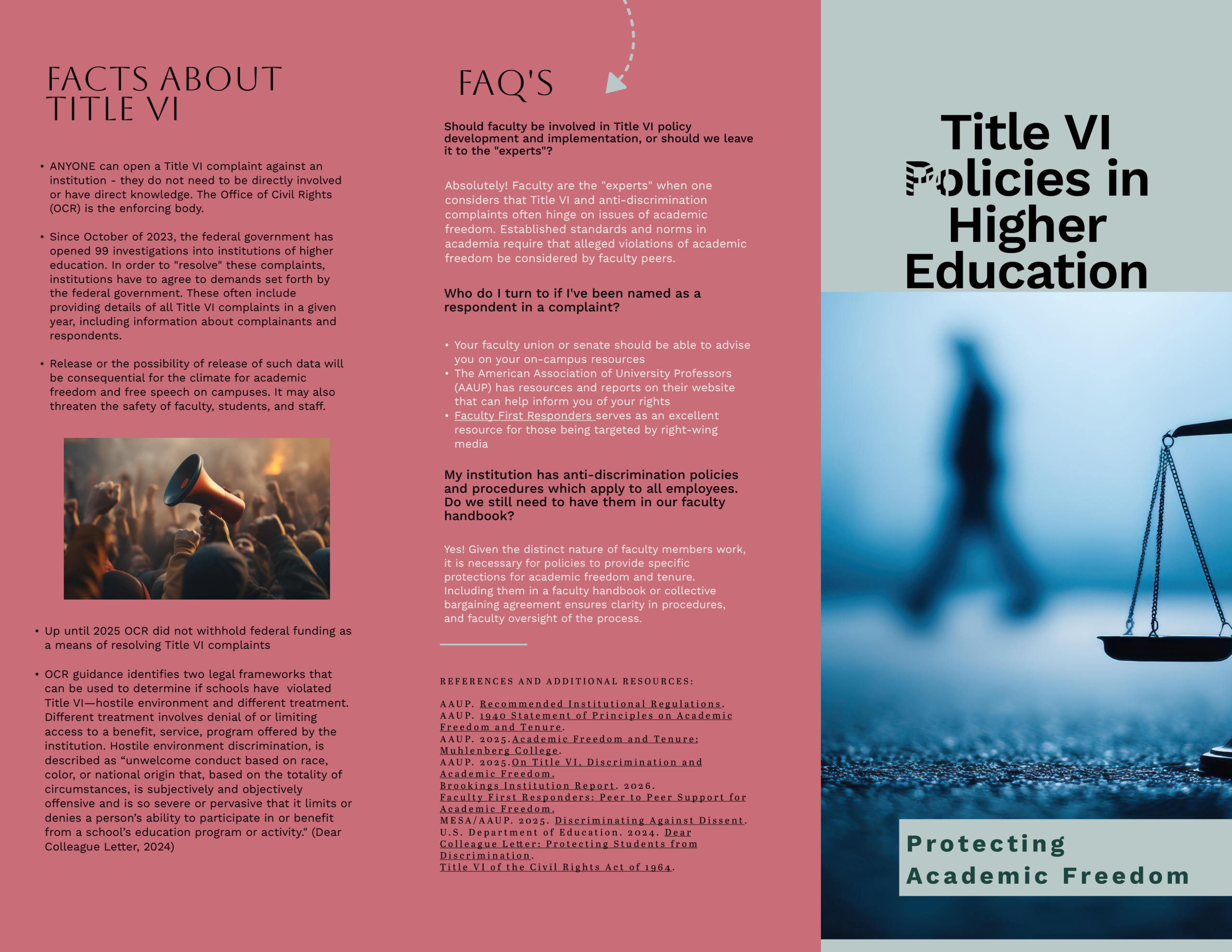
FACTS ABOUT TITLE VI
- ANYONE can open a Title VI complaint against an institution - they do not need to be directly involved or have direct knowledge. The Office of Civil Rights (OCR) is the enforcing body.
- Since October of 2023, the federal government has opened 99 investigations into institutions of higher education. In order to "resolve" these complaints, institutions have to agree to demands set forth by the federal government. These often include providing details of all Title VI complaints in a given year, including information about complainants and respondents.
- Release or the possibility of release of such data will be consequential for the climate for academic freedom and free speech on campuses. It may also threaten the safety of faculty, students, and staff.
- Up until 2025 OCR did not withhold federal funding as a means of resolving Title VI complaints
- OCR guidance identifies two legal frameworks that can be used to determine if schools have violated Title VI—hostile environment and different treatment. Different treatment involves denial of or limiting access to a benefit, service, program offered by the institution. Hostile environment discrimination, is described as “unwelcome conduct based on race, color, or national origin that, based on the totality of circumstances, is subjectively and objectively offensive and is so severe or pervasive that it limits or denies a person’s ability to participate in or benefit from a school’s education program or activity." (Dear Colleague Letter, 2024)
FAQ'S
Should faculty be involved in Title VI policy development and implementation, or should we leave it to the "experts"?
Absolutely! Faculty are the "experts" when one considers that Title VI and anti-discrimination complaints often hinge on issues of academic freedom. Established standards and norms in academia require that alleged violations of academic freedom be considered by faculty peers.
Who do I turn to if I've been named as a respondent in a complaint?
- Your faculty union or senate should be able to advise you on your on-campus resources
- The American Association of University Professors (AAUP) has resources and reports on their website that can help inform you of your rights
- Faculty First Responders serves as an excellent resource for those being targeted by right-wing media
My institution has anti-discrimination policies and procedures which apply to all employees. Do we still need to have them in our faculty handbook?
Yes! Given the distinct nature of faculty members work, it is necessary for policies to provide specific protections for academic freedom and tenure. Including them in a faculty handbook or collective bargaining agreement ensures clarity in procedures, and faculty oversight of the process.
REFERENCES AND ADDITIONAL RESOURCES:
AAUP. Recommended Institutional Regulations.
AAUP. 1940 Statement of Principles on Academic Freedom and Tenure.
AAUP. 2025. Academic Freedom and Tenure: Muhlenberg College.
AAUP. 2025. On Title VI, Discrimination and Academic Freedom.
Brookings Institution Report. 2026.
Faculty First Responders: Peer to Peer Support for Academic Freedom.
MESA/AAUP. 2025. Discriminating Against Dissent.
U.S. Department of Education. 2024. Dear Colleague Letter: Protecting Students from Discrimination.
Title VI of the Civil Rights Act of 1964.
Title VI Policies in Higher Education
Protecting Academic Freedom
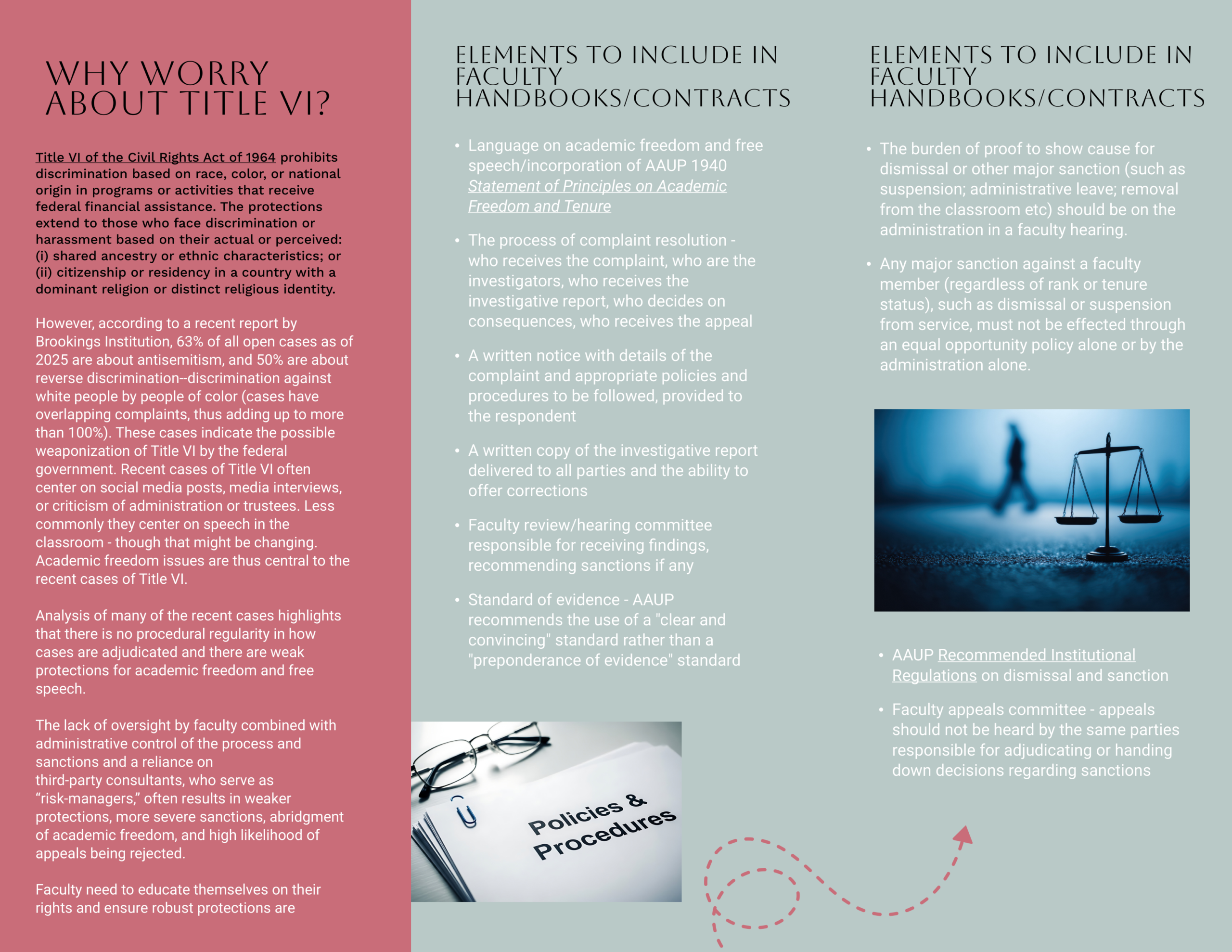
WHY WORRY ABOUT TITLE VI?
Title VI of the Civil Rights Act of 1964 prohibits discrimination based on race, color, or national origin in programs or activities that receive federal financial assistance. The protections extend to those who face discrimination or harassment based on their actual or perceived: (i) shared ancestry or ethnic characteristics; or (ii) citizenship or residency in a country with a dominant religion or distinct religious identity.
However, according to a recent report by Brookings Institution, 63% of all open cases as of 2025 are about antisemitism, and 50% are about reverse discrimination--discrimination against white people by people of color (cases have overlapping complaints, thus adding up to more than 100%). These cases indicate the possible weaponization of Title VI by the federal government. Recent cases of Title VI often center on social media posts, media interviews, or criticism of administration or trustees. Less commonly they center on speech in the classroom - though that might be changing. Academic freedom issues are thus central to the recent cases of Title VI.
Analysis of many of the recent cases highlights that there is no procedural regularity in how cases are adjudicated and there are weak protections for academic freedom and free speech.
The lack of oversight by faculty combined with administrative control of the process and sanctions and a reliance on third-party consultants, who serve as “risk-managers,” often results in weaker protections, more severe sanctions, abridgment of academic freedom, and high likelihood of appeals being rejected.
Faculty need to educate themselves on their rights and ensure robust protections are
ELEMENTS TO INCLUDE IN FACULTY HANDBOOKS/CONTRACTS
- Language on academic freedom and free speech/incorporation of AAUP 1940 Statement of Principles on Academic Freedom and Tenure
- The process of complaint resolution - who receives the complaint, who are the investigators, who receives the investigative report, who decides on consequences, who receives the appeal
- A written notice with details of the complaint and appropriate policies and procedures to be followed, provided to the respondent
- A written copy of the investigative report delivered to all parties and the ability to offer corrections
- Faculty review/hearing committee responsible for receiving findings, recommending sanctions if any
- Standard of evidence - AAUP recommends the use of a "clear and convincing" standard rather than a "preponderance of evidence" standard
ELEMENTS TO INCLUDE IN FACULTY HANDBOOKS/CONTRACTS
- The burden of proof to show cause for dismissal or other major sanction (such as suspension; administrative leave; removal from the classroom etc) should be on the administration in a faculty hearing.
- Any major sanction against a faculty member (regardless of rank or tenure status), such as dismissal or suspension from service, must not be effected through an equal opportunity policy alone or by the administration alone.
- AAUP Recommended Institutional Regulations on dismissal and sanction
- Faculty appeals committee - appeals should not be heard by the same parties responsible for adjudicating or handing down decisions regarding sanctions
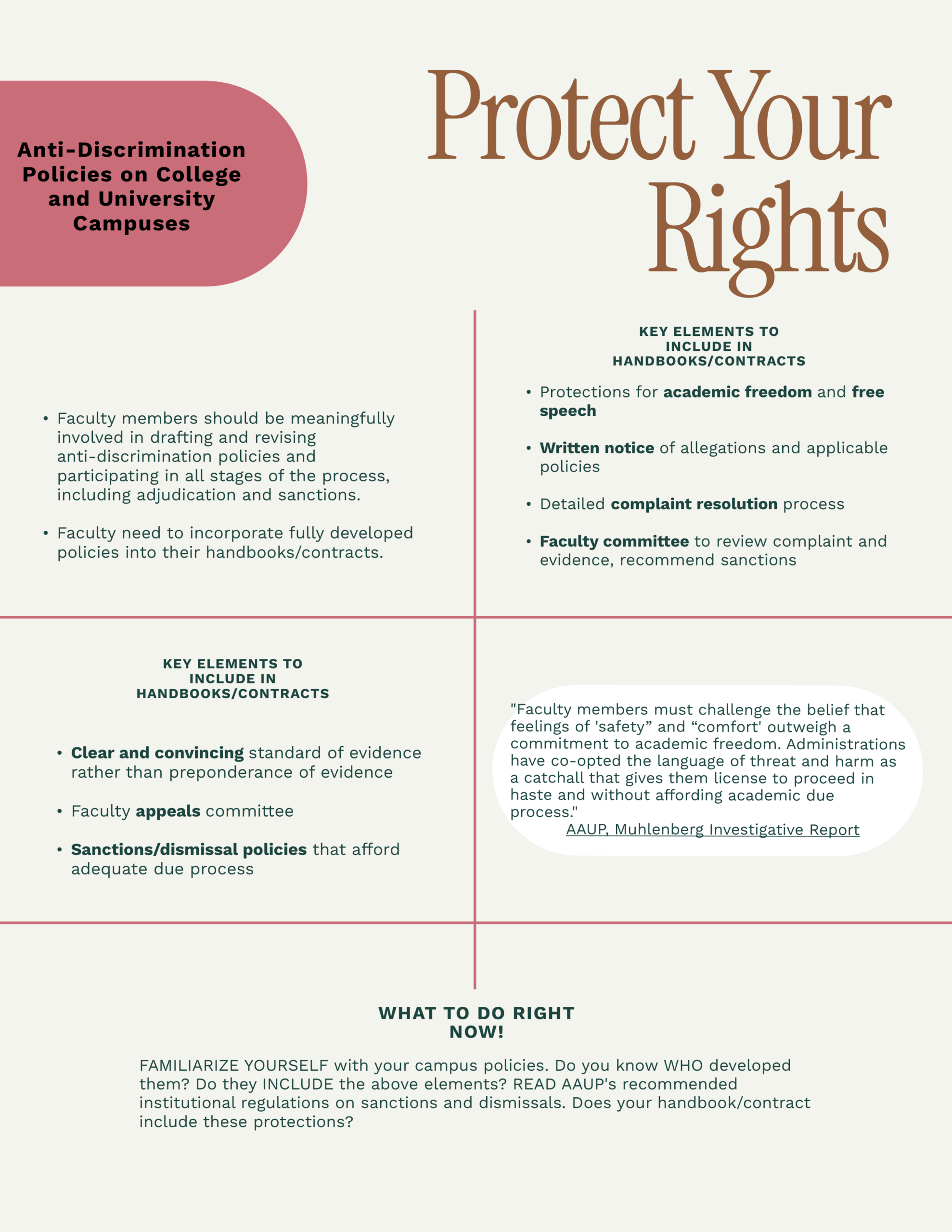
Anti-Discrimination Policies on College and University Campuses
Protect Your Rights
- Faculty members should be meaningfully involved in drafting and revising anti-discrimination policies and participating in all stages of the process, including adjudication and sanctions.
- Faculty need to incorporate fully developed policies into their handbooks/contracts.
KEY ELEMENTS TO INCLUDE IN HANDBOOKS/CONTRACTS
- Protections for academic freedom and free speech
- Written notice of allegations and applicable policies
- Detailed complaint resolution process
- Faculty committee to review complaint and evidence, recommend sanctions
KEY ELEMENTS TO INCLUDE IN HANDBOOKS/CONTRACTS
- Clear and convincing standard of evidence rather than preponderance of evidence
- Faculty appeals committee
- Sanctions/dismissal policies that afford adequate due process
"Faculty members must challenge the belief that feelings of 'safety” and “comfort' outweigh a commitment to academic freedom. Administrations have co-opted the language of threat and harm as a catchall that gives them license to proceed in haste and without affording academic due process."
AAUP, Muhlenberg Investigative Report
WHAT TO DO RIGHT NOW!
FAMILIARIZE YOURSELF with your campus policies. Do you know WHO developed them? Do they INCLUDE the above elements? READ AAUP's recommended institutional regulations on sanctions and dismissals. Does your handbook/contract include these protections?