
Mapping Viewpoint Diversity Discourse Around Higher Education: From Matters of Fact to Matters of Concern
Overview
Viewpoint diversity has emerged as a central plank of the legislative and policy agenda of President Trump's second term, reshaping higher education in ways that carry important implications for academic freedom and free speech. Proponents argue that higher education institutions in the United States, particularly their faculty compositions, are overwhelmingly liberal, creating a chilling environment for free expression of conservative perspectives and exercise of academic freedom for conservative faculty and students. As such, they argue that viewpoint diversity should be increased on college campuses. Critics counter that viewpoint diversity is being used in a partisan manner to undermine academic norms of knowledge production and academic freedom.
Whatever the empirical merits of these competing claims, viewpoint diversity has entered the policy arena, and higher education is being changed in the process. The present study seeks to shift the attention away from viewpoint diversity as a matter of fact, or what is being said, to viewpoint diversity as a matter of concern to consider who is speaking of it. Data are collected from across major sources of information, including academic research, media coverage, intermediary organizations, and legislation, in which the exact term viewpoint diversity appears through the end of 2025. These conversations are shown to be located across diverse institutional sites, which are described here and mapped according to their political leanings and their relative prominence in the higher education policy landscape.
Overall, the report does not claim to uncover what lies behind viewpoint diversity. Rather, attention is directed to a set of organizations, anxieties, objectives, strategies, and social actors that are assembled in ways that make viewpoint diversity matter in higher education.
Background and Purpose
Over the past two centuries, the modern university has been transformed into an institution governed largely by scientific norms and a professional ethos, displacing an earlier conception of knowledge grounded in religious and moral education.1 The development of academic freedom norms formed one step in this direction, as articulated in the American Association of University Professors' 1940 Statement of Principles on Academic Freedom and Tenure: “institutions of higher education are conducted for the common good and not to further the interest of either the individual teacher or the institution as a whole. The common good depends upon the free search for truth and its free exposition.” 2 In recent years, however, free speech rights and academic freedom on college campuses have come under increasing challenge,3 a trend sharpened by the polarization of public attitudes toward public institutions in the United States.4
Over the past decade, viewpoint diversity has emerged as a key term in criticism of higher education. Advocates argue that colleges and universities serve partisan ends by silencing conservative voices among students, faculty, and staff (primarily a free speech concern) and by constraining open inquiry, scientific process, and teaching (primarily an academic freedom concern).5 The founding of Heterodox Academy marked a particularly important moment in the advancement of and advocacy for viewpoint diversity in higher education, though the organization is no longer the only voice in what some have called the viewpoint diversity movement.6 Through legislation advanced in Republican-controlled state legislatures and funding support from the second Trump administration, that movement is already effecting change across many colleges and universities.
These efforts include bills, grant incentives, and other measures adopted by federal and state governments to promote viewpoint diversity on college campuses.7 Federal grants from the U.S. Department of Education have been directed specifically toward advancing civil dialogue for viewpoint diversity on campuses, with a designated allocation of $60 million.8 Institutions such as Harvard and Columbia have been threatened with reductions in federal research funding for a perceived lack of viewpoint diversity.9 In Iowa and several other states, universities have been required by statute to establish new centers, frequently conservative in orientation, and to revise curricular requirements in the name of viewpoint diversity.10 But what is viewpoint diversity?
What is Viewpoint Diversity?
Despite the volume of concern that has gathered under the term, little consensus exists on what viewpoint diversity means across the news articles, legislative actions, opinion pieces, academic research, and nonprofit and policy reports that address it. Writing in The New York Times, Jennifer Schuessler observes that critics who invoke the term might equally speak of ideological or political diversity, but that viewpoint diversity has proven the more effective rallying cry, in part, as sociologist Neil Gross suggests, because "it’s a very ambiguous term... and that gives it a little bit more power."11 What appear to be debates over the real meaning of viewpoint diversity are, in this sense, often ideological struggles conducted by definitional means.12
The absence of a settled definition has allowed a wide range of concerns to be advanced under the banner of viewpoint diversity. Heterodox Academy, which is non-partisan and which has been a pioneering voice in the movement, invokes the term against an alleged culture of groupthink in a liberal-leaning academy. In fact, most writings on viewpoint diversity offer it as an antidote to a problem but rarely offer a clear-cut definition. Critics, meanwhile, have seized on the legislative efforts to expose what they take to be the fallacies and ideological commitments of the movement, some going so far as to call it a "MAGA plot" to take over higher education.13 Siraganian writes:
Contriving a smashup between ‘viewpoint diversity’ and academic freedom has been part of the right’s political project for a very long time. And those efforts are paying off right now. Whatever its adherents claim they are doing, they are in fact engaged in a prolonged effort to undermine higher education by attacking academic freedom.
To which Tomassi (2026) responds by listing evidence on liberal bias in the academy and insisting on the factuality of the cause.14 This back-and-forth is emblematic of the larger discourse on viewpoint diversity where the facts of the matter of viewpoint diversity are discussed, often though some expression of concern.
Research Questions
Each side of the debate presents itself as the defender of academic freedom and free speech against the other. Change on the ground, however, is being enacted largely through legislation advanced in the name of viewpoint diversity. As viewpoint diversity has entered the political arena, important questions arise about how problems, actors, organizations, and policy agendas have assembled around the term.
Rather than arguing for or against viewpoint diversity, then, this study asks who the social actors constructing viewpoint diversity are and what their concerns might be. Drawing on Latour's work,15 the multiple and often divergent social worlds surrounding viewpoint diversity are traced here, in place of a judgment about who has the better argument. This analytical shift makes it possible to consider how viewpoint diversity has been instrumentalized in the political arena surrounding higher education. The aim is to open space for constructive dialogue that shifts away from furthering the us vs. them framing16 which continues to disrupt any potential for transformative change in higher education and the public it serves by including all forms of difference in processes of learning and inquiry.
Methodological Notes
To map the production of discourse on viewpoint diversity in higher education, a database was developed of online artifacts17 containing the exact phrase "viewpoint diversity." Related phrases associated with the movement, like intellectual diversity, ideological diversity, political diversity, were excluded, along with variations in wording like ‘diversity of viewpoints.’18 A singular focus on viewpoint diversity provides a bounded container for examining both the volume of discourse and the range of social actors within it. The exclusion of related terms also allows capturing social actors who have adopted the movement’s preferred vocabulary11 above to shape the discursive space. The aim is not an exhaustive census of every online artifact in which the term appears, but a picture of the infrastructure of knowledge production surrounding it.
Two considerations justify this focus. First, viewpoint diversity has been central to the stated values of Heterodox Academy, an organization at the forefront of the movement whose vocabulary has gained currency both outside the academy and within it. Second, the term carries its own intellectual history, having figured in earlier debates over diversity in higher education, particularly those concerning affirmative action.
Data collection sought to capture a wide range of perspectives and concerns, consistent with Latour's work.15 Analytical insights were also drawn from the Sociology of Knowledge Approach to Discourse (SKAD) and from Situational Analysis.19 These approaches direct attention to the infrastructure of knowledge production and to the social worlds, or discursive spaces, in which conversations about viewpoint diversity have developed. The analysis relies heavily on descriptive information in order to convey the overall shape of that infrastructure.20
Data
Data were collected from four sources of knowledge production, each with distinct communicative genres, discursive practices, and sources of legitimacy: academic peer-reviewed scholarship; news media, including higher education trade media; intermediary organizations; and legislative documents.21 The corpus extends through the end of 2025. Table 1 reports the number of artifacts in each category in the final database. An artifact is a single document: a peer-reviewed article, a news story, an individual webpage22 from an organization's site (a blog post, report, or podcast episode), or a bill.
For peer-reviewed scholarship, several academic databases and content aggregators were searched, including JSTOR, ERIC (ProQuest), SAGE, Web of Science, Academic Search Premier, PsycINFO, PsycARTICLES, and the Psychology and Behavioral Sciences Collection. These searches returned 396 results. After removal of duplicates (n = 76) and exclusion of articles unrelated to higher education (n = 169), 151 articles remained in the final database.
| Data Type | Count of Artifacts |
|---|---|
| News Media | 2,073 |
| Intermediary Organization | 1,344 |
| Academic Scholarship | 151 |
| Legislation | 125 |
| Total | 3,693 |
Note. A bill and a blog post differ considerably in the influence each carries. They are counted here as equivalent because the table reports the volume of discourse rather than its significance.
News media and legislative documents were retrieved through Nexis Uni, using the search string ("viewpoint diversity") AND (college* OR universit* OR "higher education"). News sources were subsequently categorized to distinguish national outlets, state outlets, and student newspapers. Articles concerning viewpoint diversity in media or in business rather than in higher education were excluded on review. Trade news was collected separately: two graduate assistants searched the Chronicle of Higher Education and Inside Higher Ed websites for the exact phrase using each site's search function.
For legislation, each instance of a bill being introduced, amended, or enacted was counted as a separate artifact. This choice reflects the report's focus on legislative activity, the volume of attention a measure receives, rather than on the number of measures enacted; a single contested bill generates more discourse than a quietly passed one, and it is that discourse the corpus is designed to capture.
Artifacts from intermediary organizations were gathered through several strategies.23 Where an organization's website offered a search function, it was used to identify pages mentioning viewpoint diversity; elsewhere, a crawler24 scanned the domain and collected pages containing the phrase. The pages saved were spot-checked for accuracy. When an article was republished from one source in another, it was counted as one unit in each intermediary organization. On the Heterodox Academy website, the phrase appears in the header or footer of every page. Collection was therefore restricted to pages the organization tags as addressing viewpoint diversity, which excludes pages where the phrase appears only in site-wide elements. This criterion differs from that applied to other organizations where viewpoint diversity was not appearing in site webpage headers or other elements.
The initial list of intermediary organizations was drawn from organizations commonly referenced across the media sources and in organizational fellowship networks. Cross-references among organizations were then used to extend the list iteratively. All affiliate member organizations of the State Policy Network were included, and associate members were included only when they appeared in cross-references25. As initial data collection and analysis revealed the larger volume of discourse from right-learning intermediary organizations, an intentional supplementary search of left-leaning organizations was conducted to ensure that their scarcity in the corpus reflected the discourse itself rather than the sampling strategy. In the absence of a comparable left leaning state policy network, InfluenceWatch database was used to obtain a list of 525 groups that were left-of-center in ideological alignment and advanced educational policy in their issue area, using the website’s search filters. Of the 525 groups, 412 had a reported website on the InfluenceWatch and were scanned for viewpoint diversity using Google Search.26 The resulting list of intermediary organizations is not exhaustive, and no claim is made that it captures every intermediary organization publishing on viewpoint diversity in higher education. See Appendix A for the full list of included intermediary organizations.
Political Leaning and Bias Variables
Additional variables were collected to capture the politics of the discourse in finer grain. First, publication dates were recorded to permit analysis of discourse production over time; for artifacts collected from the web, author names and dates were extracted either manually or through automated scripts. 27 Second, political leaning was recorded for two categories of source, as described below.
For intermediary organizations, ratings were taken from Media Bias/Fact Check. 28 The site reports both a bias rating and a factual-reporting rating; only the former was collected. Its categories are Extreme Right, Right, Right-Center, Least Biased, Left-Center, Left, and Extreme Left.
Where Media Bias/Fact Check had no rating for a source, two further sources were consulted: InfluenceWatch and SourceWatch. Both trace organizational funding and stated values, and neither issues a rating on a fixed scale; ratings drawn from them therefore reflect the author's judgment on the basis of the profiles provided. Given the number of conservative intermediary organizations in the database, InfluenceWatch was given priority. Because InfluenceWatch is itself conservative in orientation,29 this choice pushes the resulting ratings leftward: organizations are, if anything, coded as more liberal and less conservative than a neutral rater would judge them. That is, ratings err in the direction that makes conservative presence in the corpus look smaller than it may be.
For national news outlets retrieved through Nexis Uni, ratings were taken from Ad Fontes Media, which has been used for this purpose in other research on the political leaning of news sources. Its bias categories are Most Extreme Right, Hyper-Partisan Right, Strong Right, Skews Right, Middle or Balanced, Skews Left, Strong Left, Hyper-Partisan Left, and Most Extreme Left. Where an outlet was not already rated, either the Ad Fontes rating tool was applied to the collected articles, or a rating was assigned on the basis of background research. As with the intermediary organizations, borderline cases were resolved in the direction that understates conservative presence in the corpus.
Author information was collected for artifacts from intermediary organizations, including name and affiliation. To capture the basis of each actor's legitimacy, expertise and disciplinary area were recorded for actors holding professorships or doctorates. Where no author was named, the artifact was attributed to the Organization, on the reasoning that institutional standing rather than individual authority underwrote the view expressed. Remaining actors, those without doctorates who were not independent writers, journalists, or fellows of other organizations, were coded as Policy Actors, denoting influence exercised through position rather than credential. Importantly, since some artifacts had multiple authors, the total count of authors is larger than the total number of artifacts.
For legislation, student newspapers, and state news outlets, state-level geographic information was recorded to permit geographic mapping. Tableau was used to visualize the data.
Findings
The findings are presented in two parts. The first part introduces the concept of a social world, describes the four social worlds included in this study, and considers their significance for understanding the politics of viewpoint diversity. The second turns to a more fine-grained analysis of these politics as they play out in the discourse itself. Each part introduces the relevant analytical concepts and explains what is at stake in them for understanding the viewpoint diversity movement in higher education.
Social Worlds and the Infrastructure of Discourse
This study examines four social worlds (media, intermediary organizations, academic research, and legislation) that shape the discourse on viewpoint diversity. A social world is a discursive space defined by shared technologies, modes of communication, and norms of legitimacy.30 Academics publishing in peer-reviewed journals, for example, belong to a scholarly social world in which ideas are communicated according to scientific and disciplinary conventions, claims are validated through peer review, and participants are recognized as credible to the extent that they observe those conventions. Table 2 lists the journals most frequently represented in the study's academic corpus.
| Journal Name | Count of Articles |
|---|---|
| Perspectives on Psychological Science | 6 |
| Theory & Society | 5 |
| California Law Review | 4 |
| Christian Education Journal | 4 |
| The Independent Review | 4 |
| Contemporary Sociology | 3 |
| Psychological Inquiry | 3 |
| Scientific American | 3 |
| Synthese | 3 |
| The Yale Law Journal | 3 |
Note. These 10 journals had the highest number of articles published on viewpoint diversity. A complete list of the journals in the database is included in Appendix B.
Media articles, in which journalists and other writers present their reporting and perspectives, are governed by a different apparatus: editorial review rather than peer review, and publication for the particular audience of a given outlet. Higher education trade publications are treated here as distinct from news media more broadly, on the grounds that the Chronicle of Higher Education and Inside Higher Ed address a specialized readership of faculty, administrators, and staff, whereas news outlets (national, state, and campus alike) address broader publics. Table 3 shows the types of media represented in the study.
| Media Type | Count of Articles |
|---|---|
| National News | 639 |
| Chronicle, InsidehigherEd, & Trade News | 335 |
| Blogs | 282 |
| Student Newspaper | 282 |
| States News Service | 263 |
| State News/Newspaper | 212 |
| Legal News | 42 |
| Platform | 8 |
| Science Magazine | 6 |
| Country & Region Reports | 2 |
| Student Marketplace | 1 |
| Guidelines & Notices | 1 |
Alongside the academic and media worlds, the study includes legislative bills and intermediary organizations. Legislative bodies operate through their own forms of communication and their own norms and are substantially influenced by the issues brought before them by intermediary organizations (like interest groups, policy organizations, think tanks, etc.). Such organizations are significant actors in the policy process: they advance particular agendas and supply framings of an issue that serve their objectives in shaping policy debate. The category includes associations of colleges and universities, unions, interest groups, higher education advocacy organizations, and public policy organizations, among others.
As Table 4 shows, Heterodox Academy produced the largest volume of discourse in the corpus, even after its collected pages were limited to those the organization tags as discussing viewpoint diversity. While Heterodox Academy is non-partisan, most other organizations on the list are not. The largest producers lean right and advance conservative policy agendas: The American Enterprise Institute, James G. Martin Center for Academic Renewal, Manhattan Institute for Policy Research, Cato Institute, The Independent Institute, and James Madison Institute. Several are connected to the State Policy Network (one as affiliate and five as associate members), a network shown to be influential in shaping state and national higher education policy.31 Their membership signals these organizations' embeddedness in a broader conservative policy infrastructure; the state legislative activity documented later (Table 5) shows that infrastructure's output. Together with the volume and concentration of discourse production (See also Figure 4), this indicates that the viewpoint diversity movement operates less as a neutral concern than as conservative political assemblage. An assemblage is defined by what it does (in this case, advancing conservative agenda through federal and state legislation and funding), rather than by the intentions of the individual actors gathered within it. That is, an actor does not need to share the assemblage's politics to be part of its workings.
| Name of Intermediary Organization | Count of Articles |
|---|---|
| Heterodox Academy | 367 |
| National Association of Scholars | 131 |
| American Council of Trustees and Alumni | 121 |
| American Enterprise Institute | 95 |
| Foundation for Individual Rights and Expression | 92 |
| James G. Martin Center for Academic Renewal | 89 |
| Manhattan Institute for Policy Research | 40 |
| Minding the Campus | 32 |
| Middle East Forum | 27 |
| College Fix | 26 |
| Cato Institute | 24 |
| The Independent Institute | 19 |
| James Madison Institute | 17 |
| American Association of University Professors | 16 |
| PEN America | 16 |
| The Foundation for Research on Equal Opportunity | 15 |
| Heritage Foundation | 14 |
| The Council of Independent Colleges | 12 |
| Sphere-Ed | 10 |
Note. These intermediary organizations had articles published on viewpoint diversity equal or more than 10 times. A complete list of the intermediary organizations in the database is included in Appendix A.
Why and How These Social Worlds Matter
Articles published before 2014 that use the phrase viewpoint diversity are concerned largely with affirmative action and with Grutter v. Bollinger (2003), the decision that upheld race-conscious admissions in higher education. In these sources the term appears chiefly in reference to the educational benefits of diversity, racial diversity in particular, for college students.
One artifact from this period stands out: an article by the conservative commentator Stanley Kurtz, collected from the Middle East Forum website and originally published in National Review, where Kurtz has served as a contributing editor. Kurtz discusses federal funding policy for academic area studies, objecting to what he characterizes as an ideological monopoly held by "postmodernist" professors, and calls for viewpoint diversity: "the one kind of diversity colleges really ought to be in the business of promoting."32 Even in 2003, then, the term carried context-specific meanings. Kurtz invokes the vocabulary of the affirmative action debate, in which viewpoint diversity was at the time a largely mainstream idea, in order to redirect it: the diversity that matters, on his account, is viewpoint diversity rather than racial identity.
The larger shift toward viewpoint diversity as a campus issue took shape around 2014 and 2015, and particularly with the founding of Heterodox Academy. In 2015, Behavioral and Brain Sciences published "Political Diversity Will Improve Social Psychological Science,"33 which, along with several other publications, lent scholarly legitimacy to advocacy for viewpoint diversity in research and teaching, an aim central to the mission of Heterodox Academy, founded that same year. From 2015 onward, the volume of discourse using the term has risen steadily,34 as Figure 1 shows.
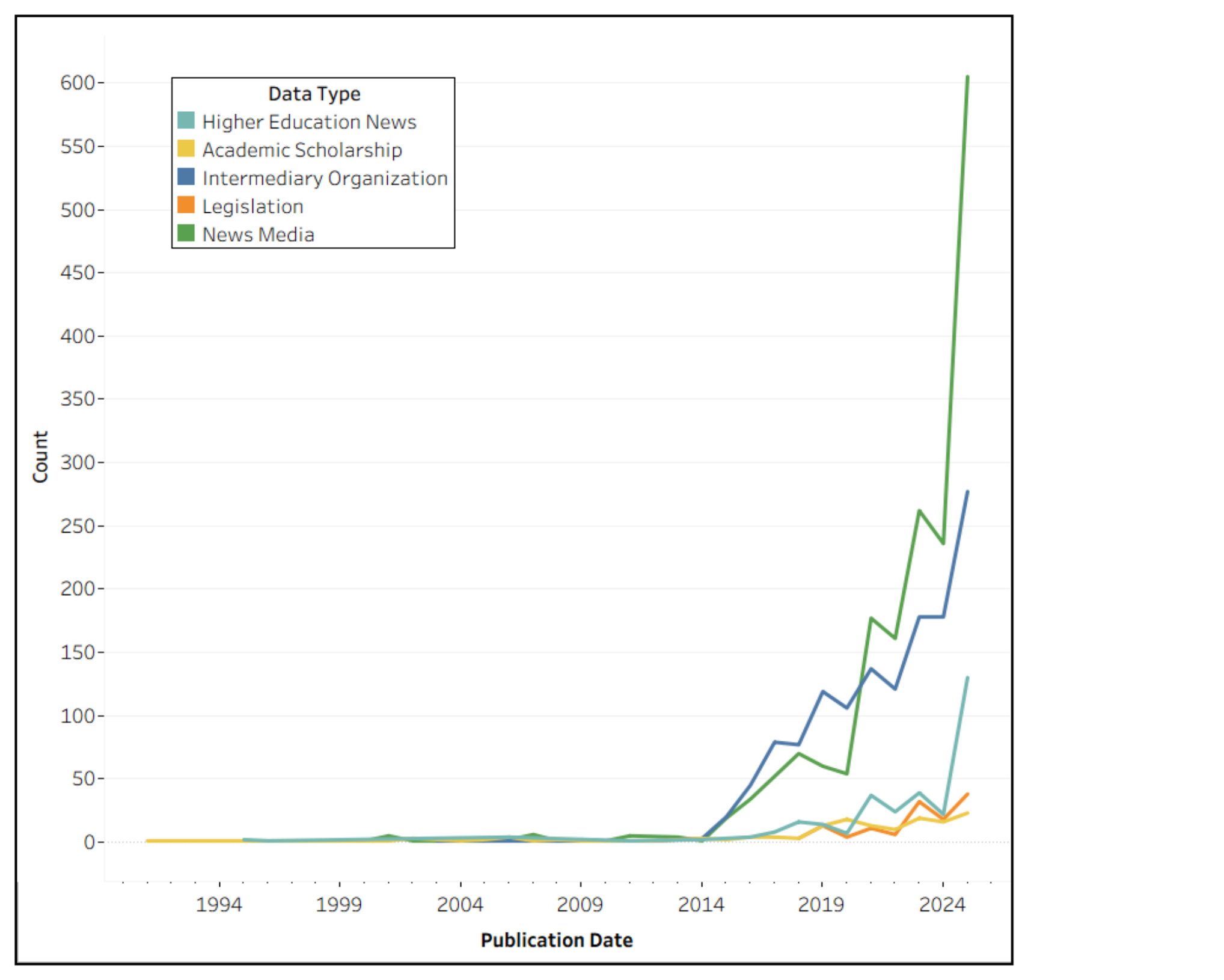
What makes these four social worlds matter is their overlapping areas of influence and their capacity to shape policy and legislation. The report traces how divergent matters of concern have gathered as a conservative political assemblage and render viewpoint diversity a policy issue. Legislation represents the culmination of those efforts.
Beginning with Florida in 2018, several state legislatures have introduced, debated, amended, and passed bills concerning viewpoint diversity in higher education (see Table 5). These measures direct colleges and universities to promote viewpoint diversity on campus while restricting diversity, equity, and inclusion programs. One qualification is important here: legislative drafters have often relied on the term intellectual diversity, so a corpus restricted to viewpoint diversity captures only a portion of the relevant legislative activity, heavily undercounting legislative activity here. The bills collected here are nonetheless instructive, and the pattern they show is consistent.
Table 5 indicates that legislative activity accelerated in 2022 and has since expanded across the country. Florida, Utah, and Kentucky account for the largest volume of legislative action, and all three have Republican-controlled legislatures.
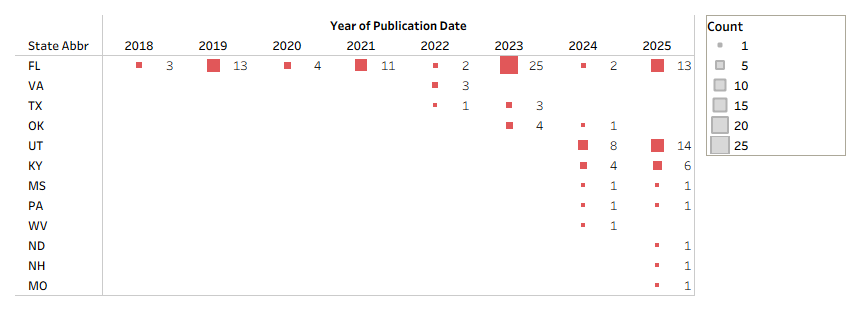
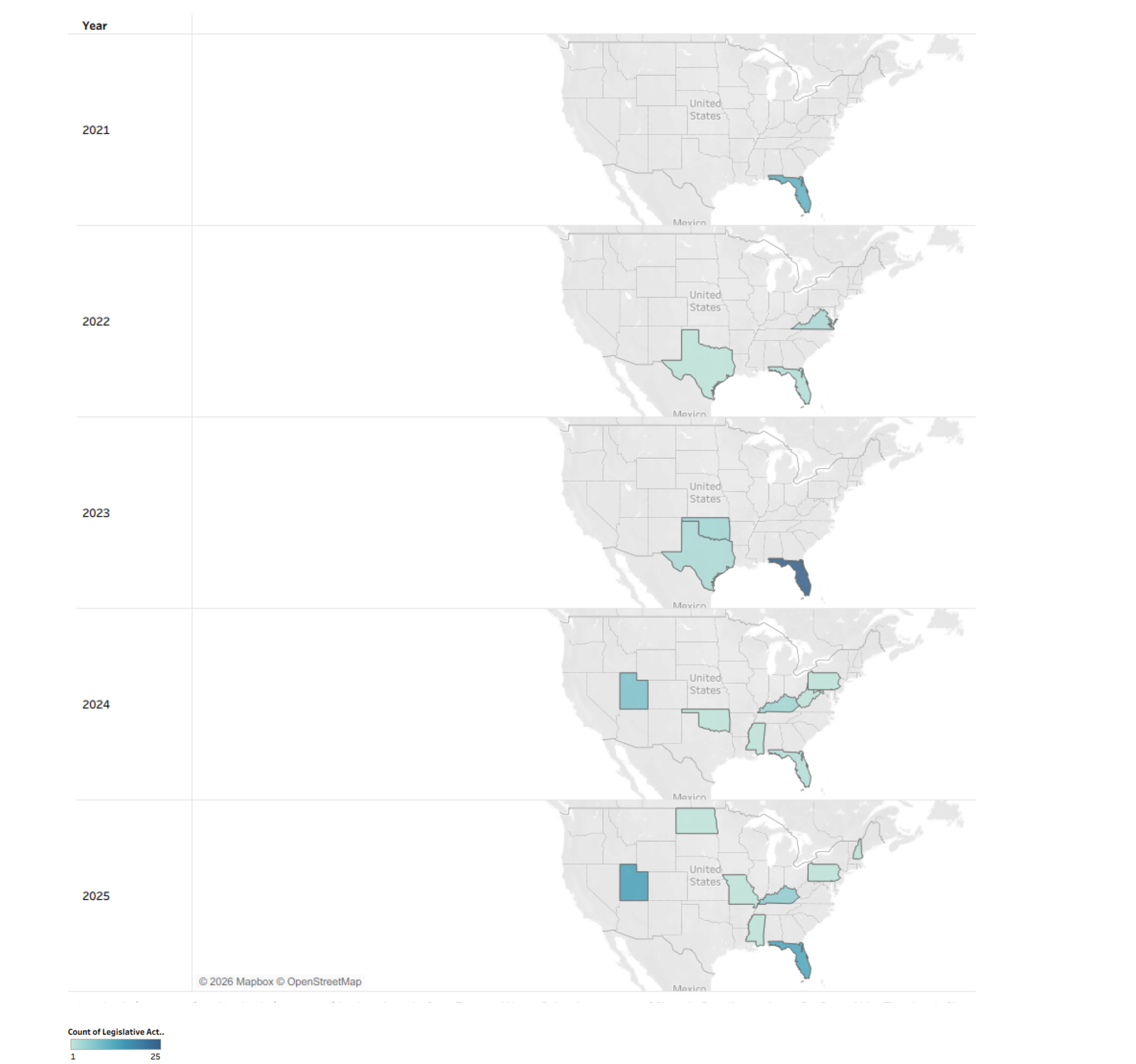
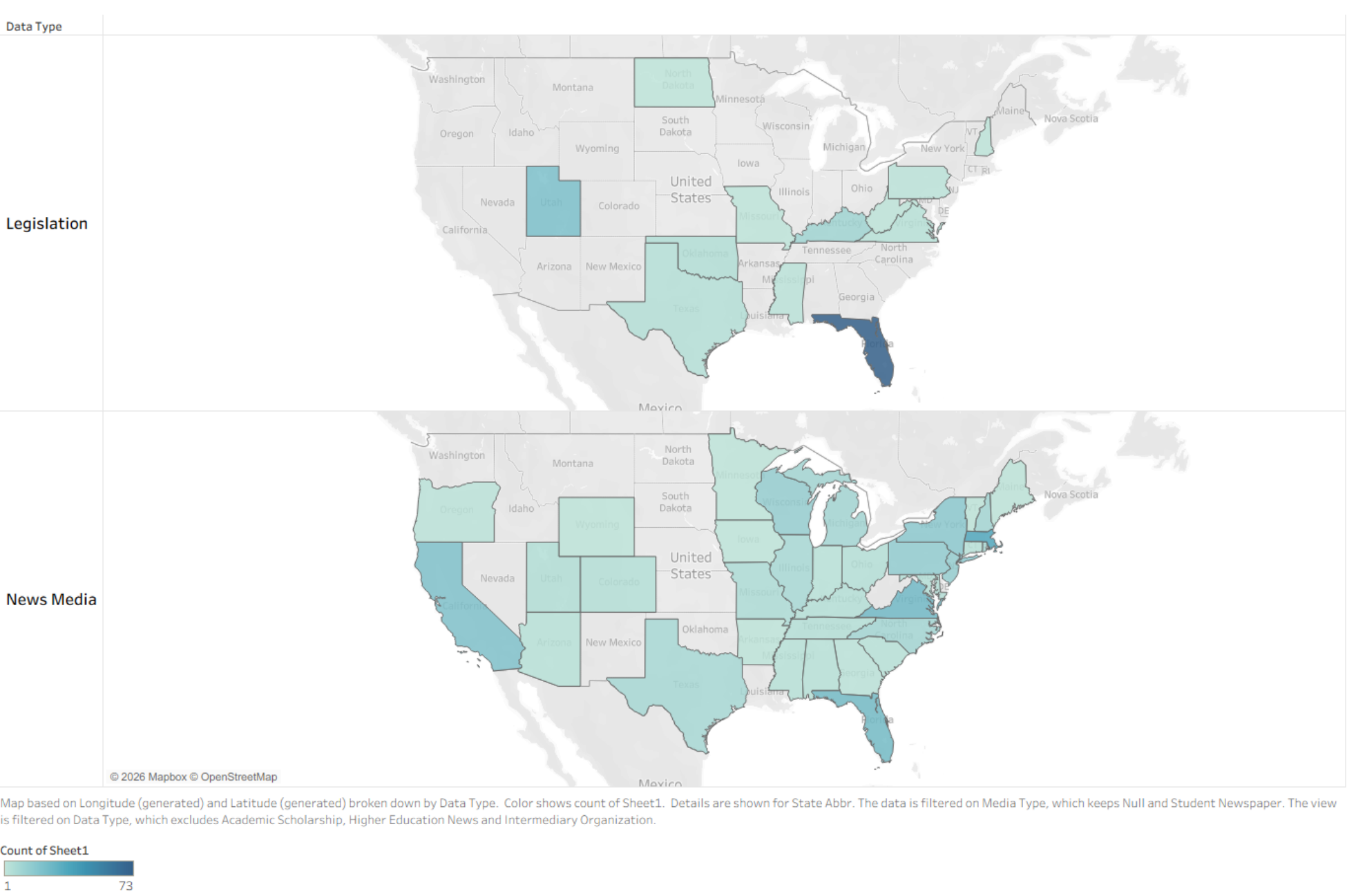
Figure 2 shows the geographic distribution of legislative activity between 2021 and 2025. Most states in which such bills have been introduced or enacted are under Republican legislative control and lean conservative, though a small number of battleground states appear as well, among them Pennsylvania, Virginia, and New Hampshire. Legislative activity on viewpoint diversity has expanded considerably over this period, and it has drawn strong responses from campuses and from intermediary organizations on the left.
Politics of Discourse on Viewpoint Diversity
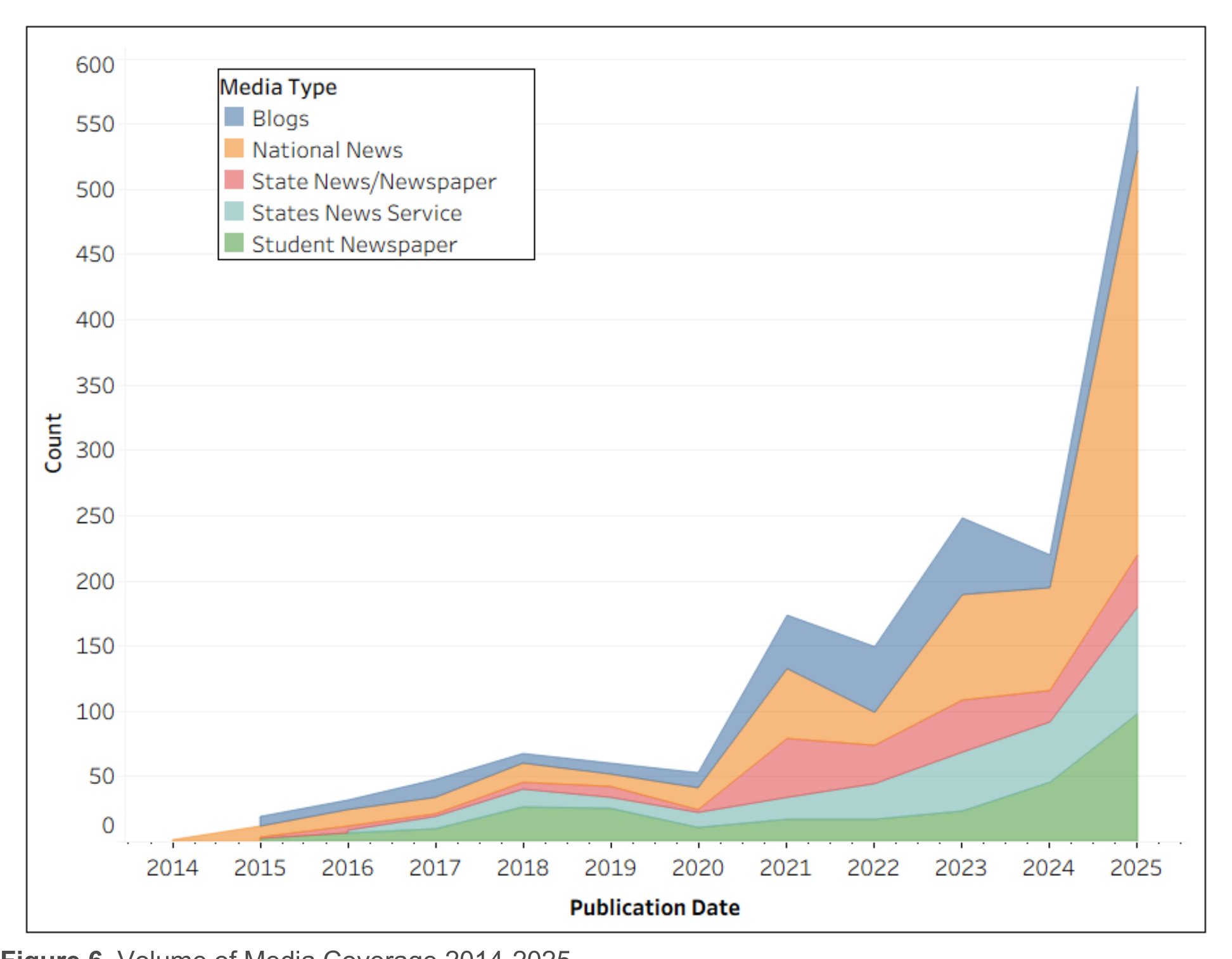
Since 2014–2015, the production of discourse on viewpoint diversity has increased continuously and has expanded beyond academic conversation to broader publics. As Figure 3 shows, the initial expansion was driven largely by intermediary organizations and media. In 2014, sources using the term included the Chronicle of Higher Education and Inside Higher Ed, together with intermediary organizations such as the Foundation for Individual Rights and Expression, the Foundation for Economic Education, the Middle East Forum, and Reason. By 2015 the list had grown to include Heterodox Academy, the National Association of Scholars, the Federalist Society, and the Acton Institute, as well as Fox News and The New York Times. Heterodox Academy, founded in 2015, played a catalytic role in this expansion as Heterodox Academy affiliated authors appeared in other intermediary organizations and media contents, though the data show it was already under way the year before.
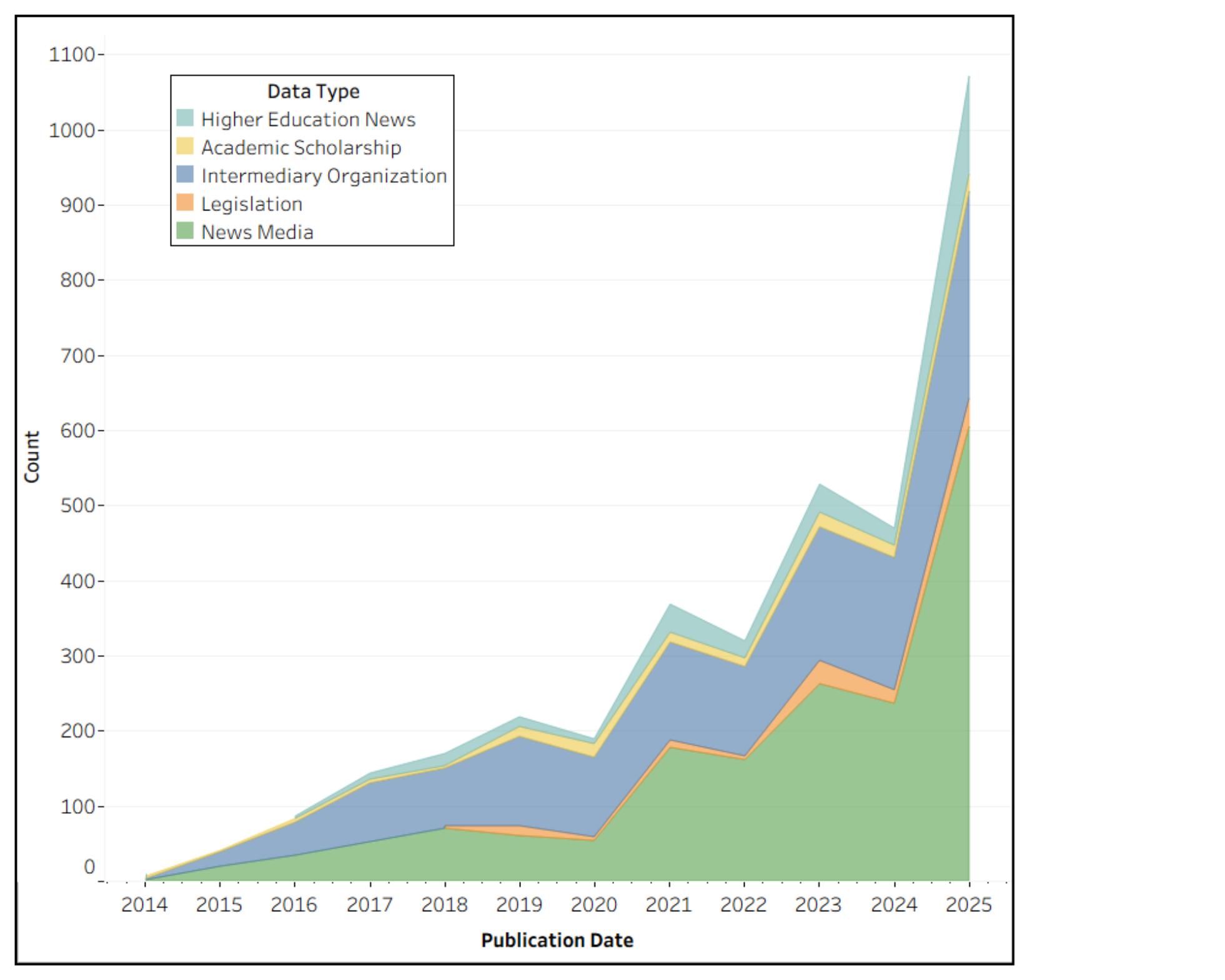
Note. For this graph, Chronicle of Higher Education and Inside Higher Ed are separated as a category.
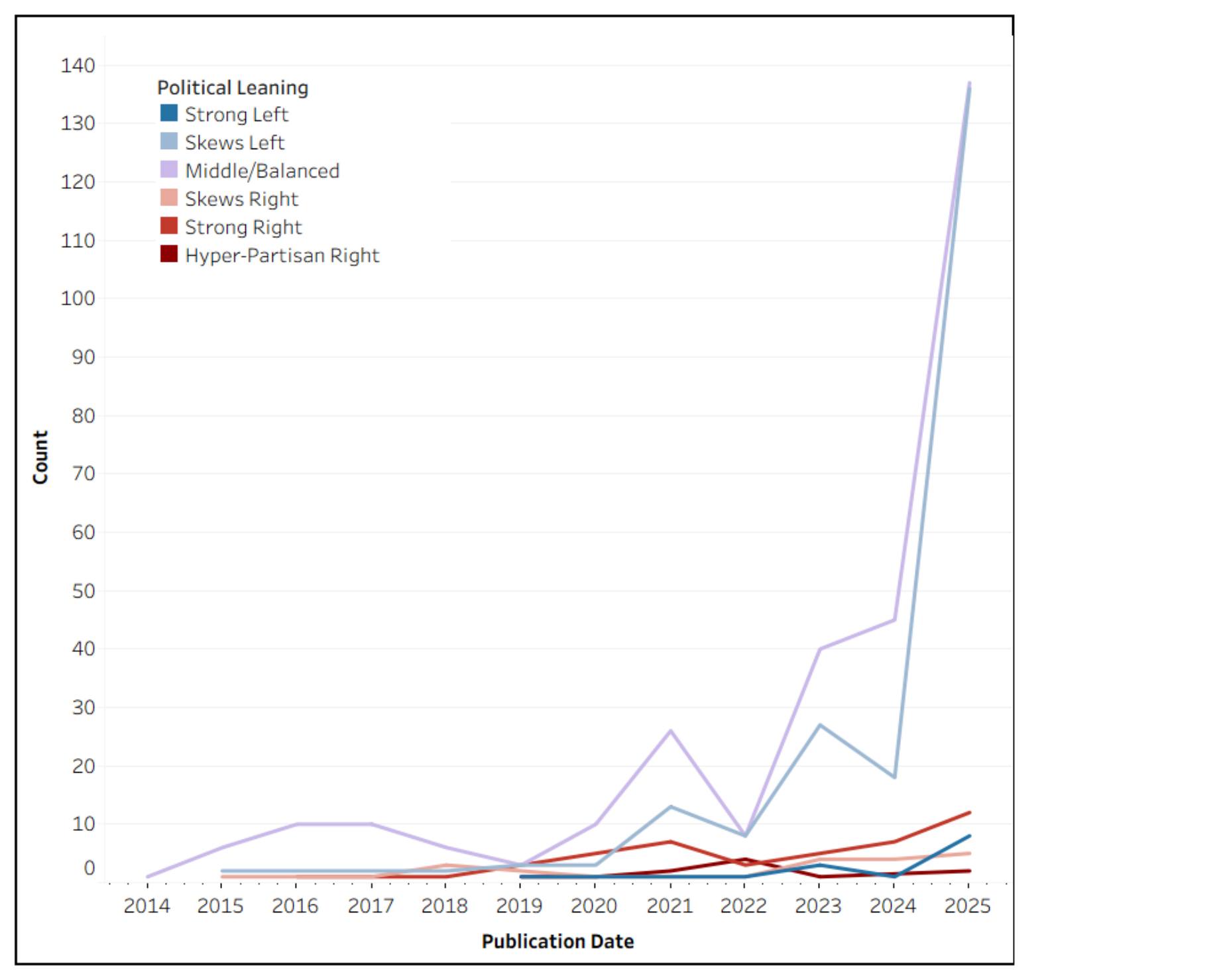
Discourse volume expanded during 2020–2024, under the Biden administration, and rose sharply again in 2025, during the second Trump administration. These two expansions register how far the term has been politicized. The 2025 surge is driven by media coverage, unsurprising, given that viewpoint diversity emerged that year as a major policy instrument, invoked in decisions to distribute or withhold federal funds and in legislation intended to promote viewpoint diversity in higher education. To examine the political dynamics of this production, political leaning was analyzed for intermediary organizations and for national news media.
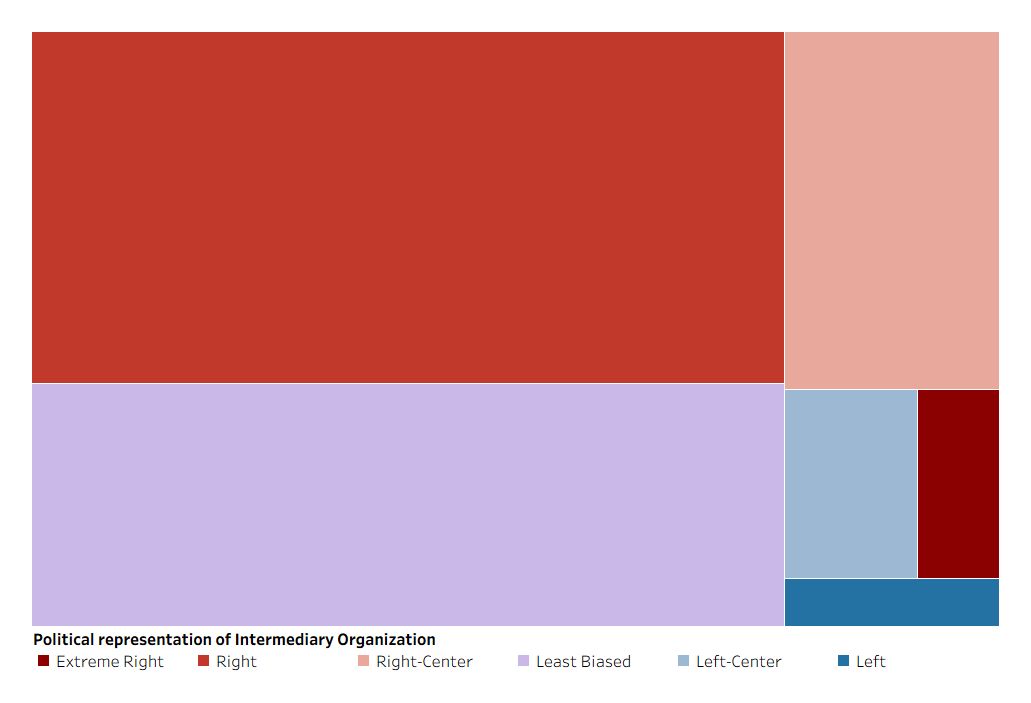
Intermediary organizations discussing viewpoint diversity leaned predominantly right, as Figure 4 shows. The largest volume of discourse was produced by right-leaning organizations, followed by those least-biased (Heterodox Academy among them), then right-center, left-center, extreme right, and left. Two cautions apply. First, this distribution should be read against the corpus boundary described earlier; actors who engage these debates under other vocabularies, critics in particular, are underrepresented by design. Second, the least-biased category is substantially composed of a single organization, Heterodox Academy, which alone accounts for 86 percent of it. Overall, the preponderance of conservative policy organizations is consistent with the successful mobilization of viewpoint diversity as policy under the Trump administration, and it lends context to critiques of viewpoint diversity as a right-wing instrument against higher education.35 Notably, a supplementary search of 412 left-of-center education-policy organizations confirmed that this scarcity is not primarily an artifact of the sampling strategy; the rating procedure, moreover, was biased against this conclusion.
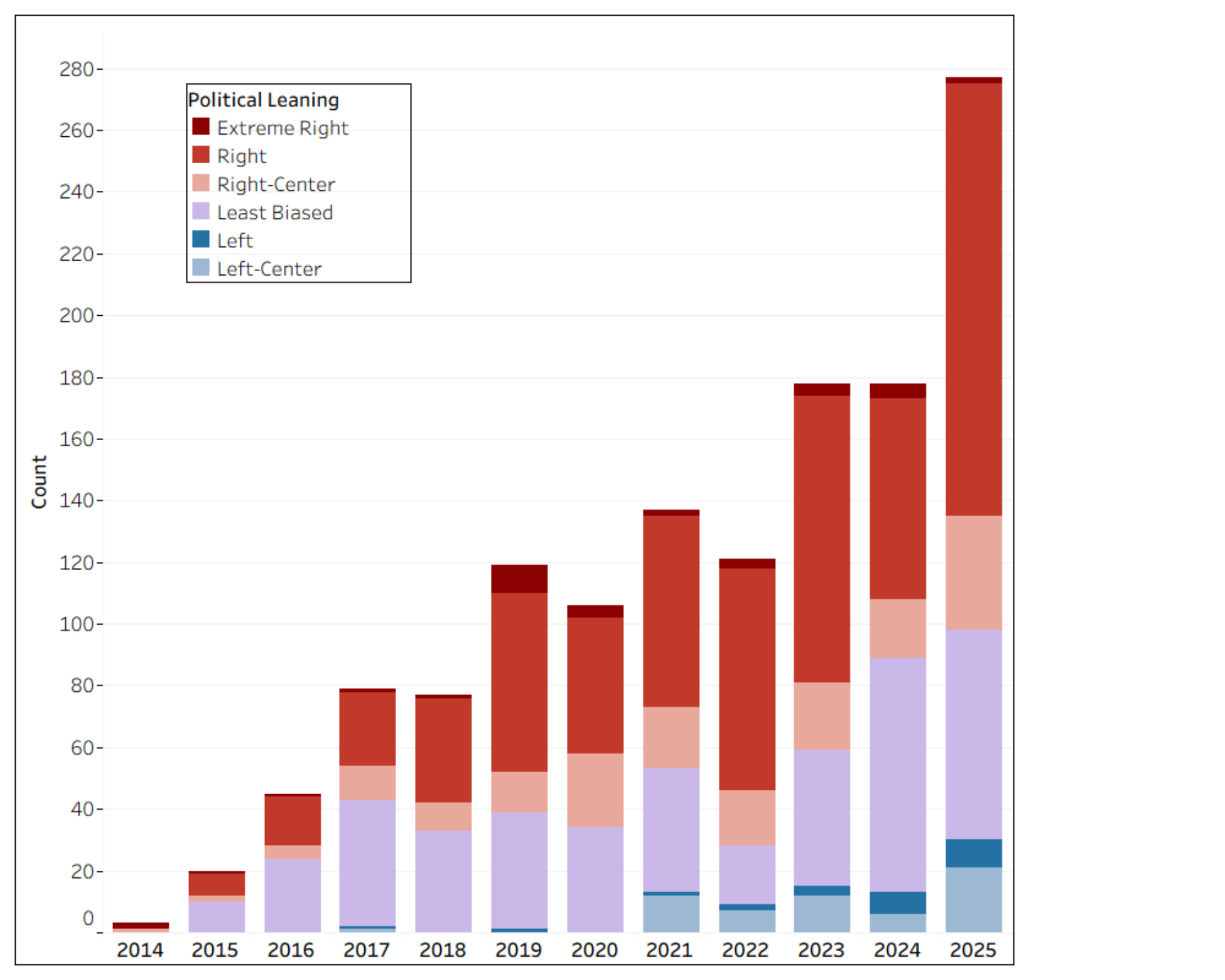
More intermediary organizations have published on viewpoint diversity since 2023, as Figure 5 shows, coinciding with the growing number of bills introduced or passed across the country. Left-leaning coverage within intermediary organizational spaces has also grown since 2023, though it remains small relative to the output of right-leaning and least biased organizations, a comparison itself conditioned by the corpus boundary noted before.
Similar trends appear across media coverage (see Figure 6): national, state, and campus newspaper attention has grown since 2014, with the sharpest increase in 2025, as the term entered the policy sphere. Most striking is the rise in national news coverage, which indicates that the topic is reaching broader publics. Together these trends show the mediatization and politicization of viewpoint diversity in the public sphere.
The legitimacy of intermediary organizations is grounded largely in the expertise of the actors they bring into their policy circles, often as fellows, policy directors, or researchers. Accordingly, the disciplinary background of every named author of a collected intermediary organization artifact was coded. Table 6 reports the frequency with which each professional social world appears in the corpus. Where no author was named, legitimacy was attributed to the organization itself; where the author was an independent writer or an actor from one organization writing for another, the artifact was coded to a policy actor.
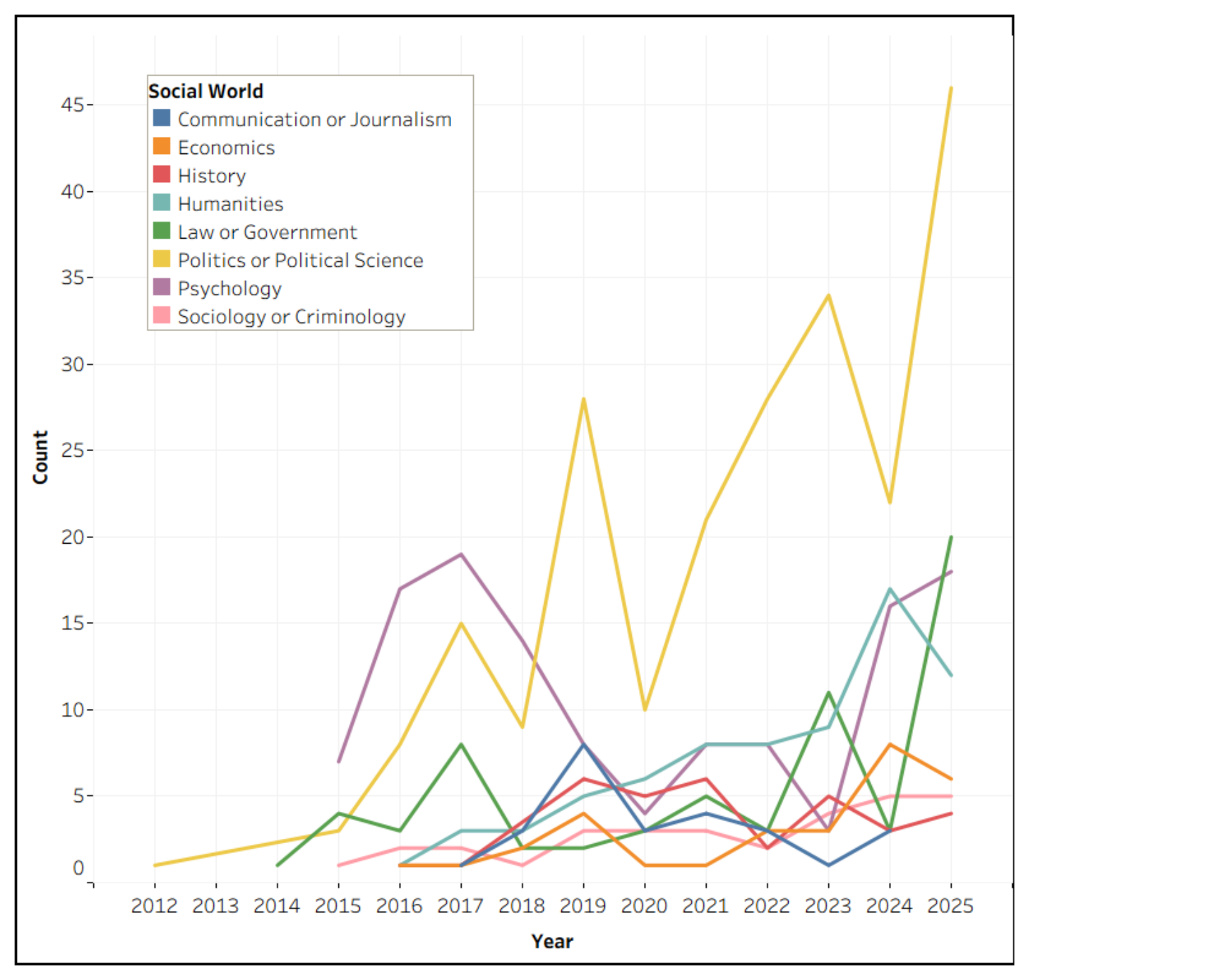
As Table 6 shows, the most frequent named-author disciplinary backgrounds were politics or political science, followed by psychology and its variants (social psychology, cultural psychology, psychiatry), the humanities, law or government, history, and economics. Named academic credentials, however, account for a minority of the total. In 722 instances no individual author was named, and institutional standing rather than individual expertise underwrote the text; a further 210 texts came from policy actors without academic affiliation. Together these two categories comprise 58 percent of authorship instances within the intermediary organizational discourse, where the majority of this discourse carries no direct connection to academic credentials at all. This is important as it highlights the growing communicative infrastructure that speaks of viewpoint diversity detached from expertise.
| Social World | Count |
|---|---|
| Organization | 722 |
| Politics or Political Science | 225 |
| Policy Actor | 210 |
| Psychology | 123 |
| Humanities | 76 |
| Law or Government | 66 |
| History | 32 |
| Economics | 31 |
| Sociology or Criminology | 28 |
| Communication or Journalism | 25 |
| Higher Education Administrator | 20 |
| Education | 11 |
| Anthropology | 8 |
| Business | 8 |
| Sciences | 8 |
| Social Work | 6 |
| Life Sciences | 6 |
| Engineering | 2 |
The composition of the experts has also shifted over time (See Figure 7). Between 2014 and 2018 the discourse was dominated by authors with psychology backgrounds, while since 2018 authors from politics and political science have predominated, with law and the humanities growing steadily. This shows how disciplinary boundaries are diffused beyond specific fields, and from fields of study onto the institution of higher education. That is, a critique within a field has expanded into larger critiques of institution itself yet grounded in legitimacy of field-specific expertise.
Among named authors, production is highly concentrated. Samuel Abrams, a fellow of the American Enterprise Institute, was the largest individual contributor with 127 articles, followed by John Tomasi, current president of Heterodox Academy, with 59; Gabrielle Anglin, communications director of the American Council of Trustees and Alumni, with 36; and Sean Stevens (then-chief researcher at the Heterodox Academy) and Jonathan Haidt36 (co-founder of the Heterodox Academy), with 29 and 27, respectively. That the third-largest body of work belongs to a communications director underscores the pattern in Table 6, that credentials are not always the source of legitimacy in this discourse, even among its prolific named contributors.
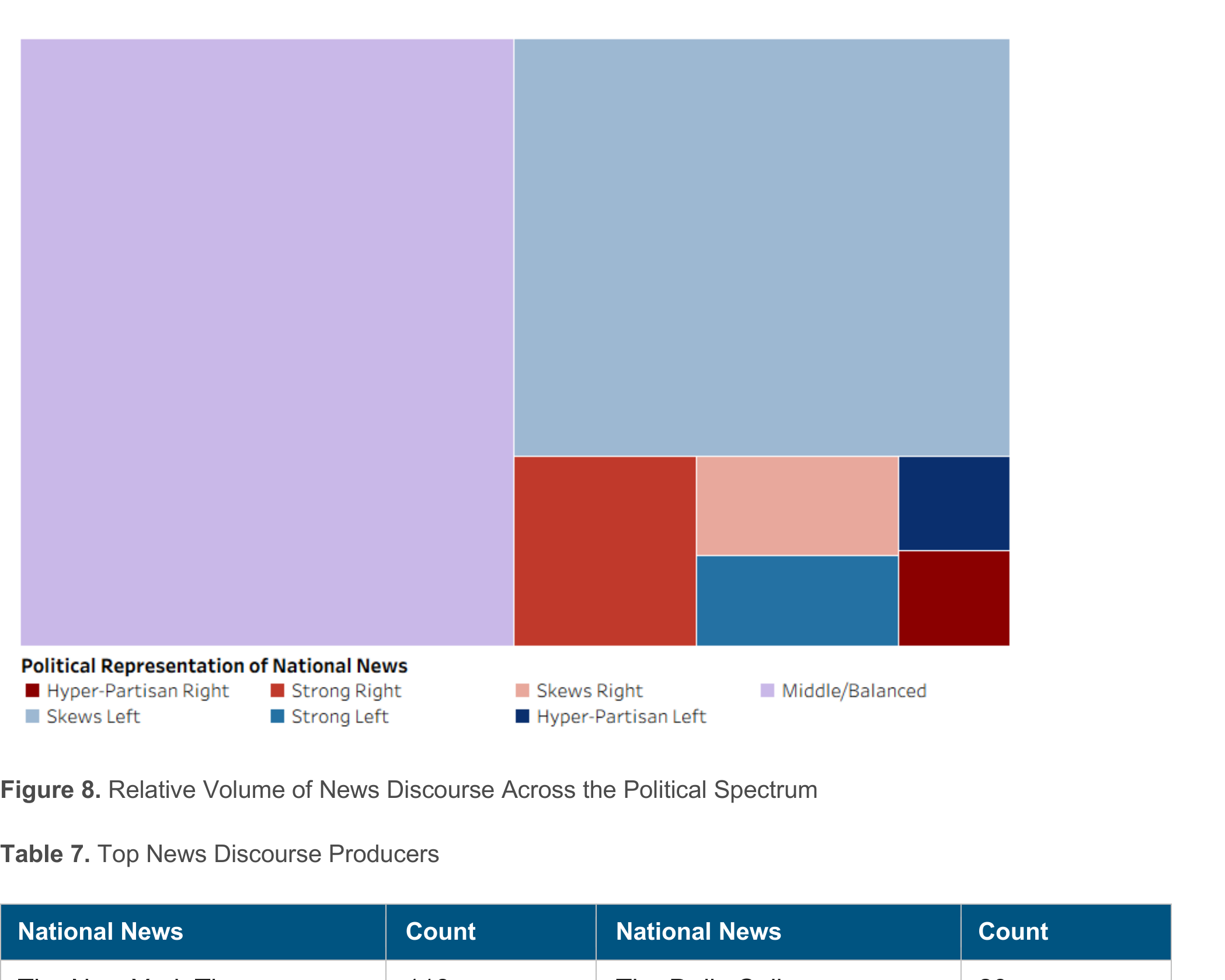
Unlike intermediary discourse, the largest volume of national news discourse was produced by outlets that were middle/balanced (see Figure 8) and left-center outlets covered viewpoint diversity more than all other left- and right-leaning national outlets combined, driven principally by The New York Times, The Hill, and The Atlantic (see Table 7).
| National News | Count | National News | Count |
|---|---|---|---|
| The New York Times | 118 | The Daily Caller | 20 |
| Reason (Magazine) | 78 | Fox News | 17 |
| CNN | 40 | The Associated Press | 16 |
| Atlantic Online | 30 | Newsweek.com | 13 |
| TheHill.com | 28 | The New Republic | 11 |
| PR Newswire | 27 | Al Jazeera English | 11 |
| The Deseret News | 27 |
Note. Any < 10 excluded; CQ Transcripts excluded.
Given that the central concerns of the movement have been around inclusion of conservative perspectives, the divergence between intermediary output and national news coverage is suggestive. One reading is that the movement has not needed public mobilization through news media to advance its agenda on the right (see Figure 9), i.e. intermediary organizations may not require public legitimation among conservative audiences, particularly given the negative construction of higher education within the GOP over the past fifteen years. Mobilization on the left, by contrast, would require public support, which may help explain why coverage has been driven largely by middle/balanced and left-leaning outlets.
In particular, the second Trump administration has deployed viewpoint diversity in policies that critics contend have suppressed campus speech and conditioned public funding on ideological criteria. The sharp rise in middle/balanced and left-leaning coverage in 2025 can therefore be read as a response to the policy landscape: the concern is not viewpoint diversity itself, or what it entails, but what it is doing to college campuses. The significance of these divergences lies not in what viewpoint diversity is, but in what it does.
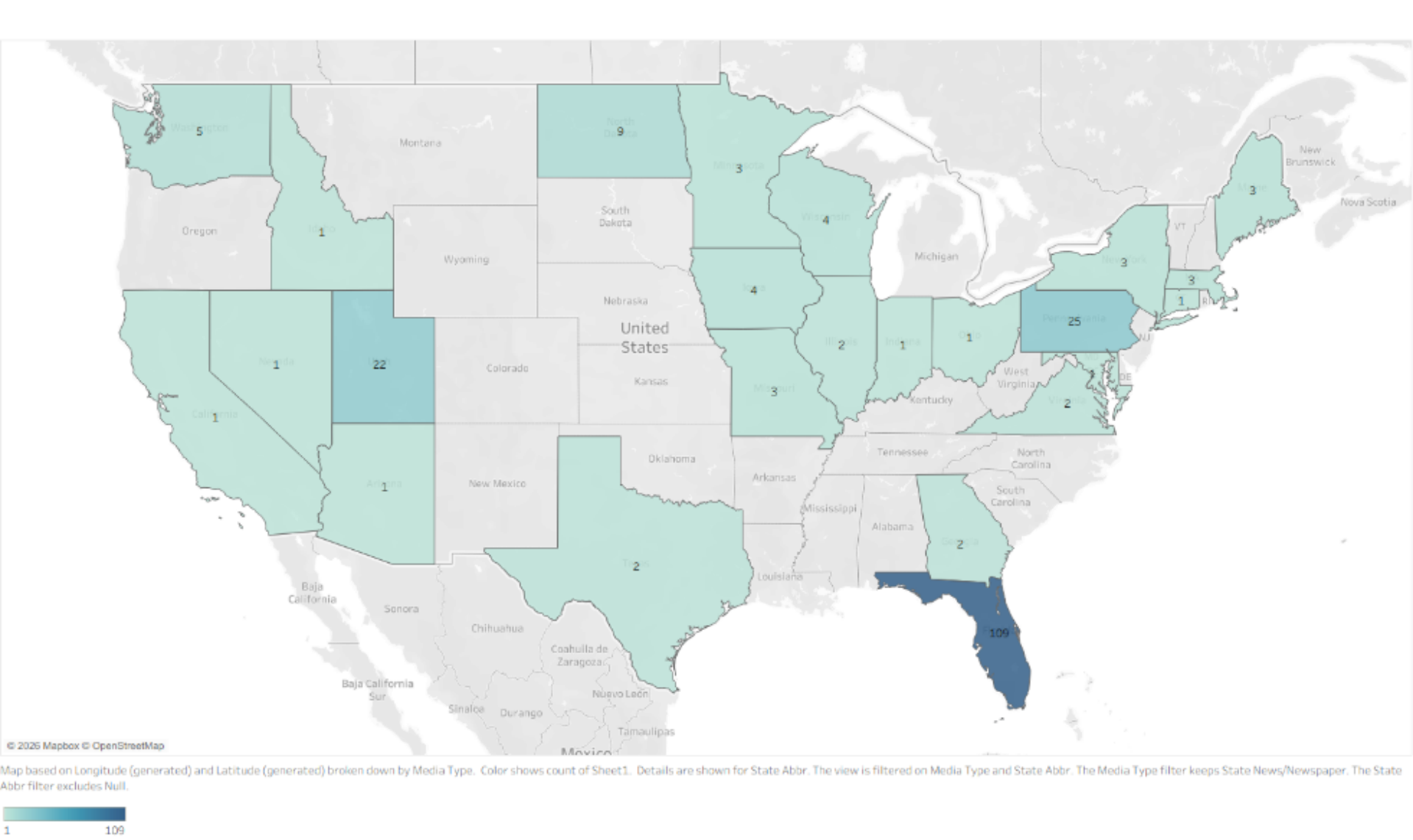
State news coverage is concentrated in states with active legislative efforts: Florida and Utah rank among the highest, joined by the battleground state of Pennsylvania (see Figure 10). State coverage coincides with legislative activity and indicates that viewpoint diversity has entered state political discourse. Florida shows the largest volume of legislative activity, consistent with Governor Ron DeSantis's sustained effort to reshape higher education in the state.37
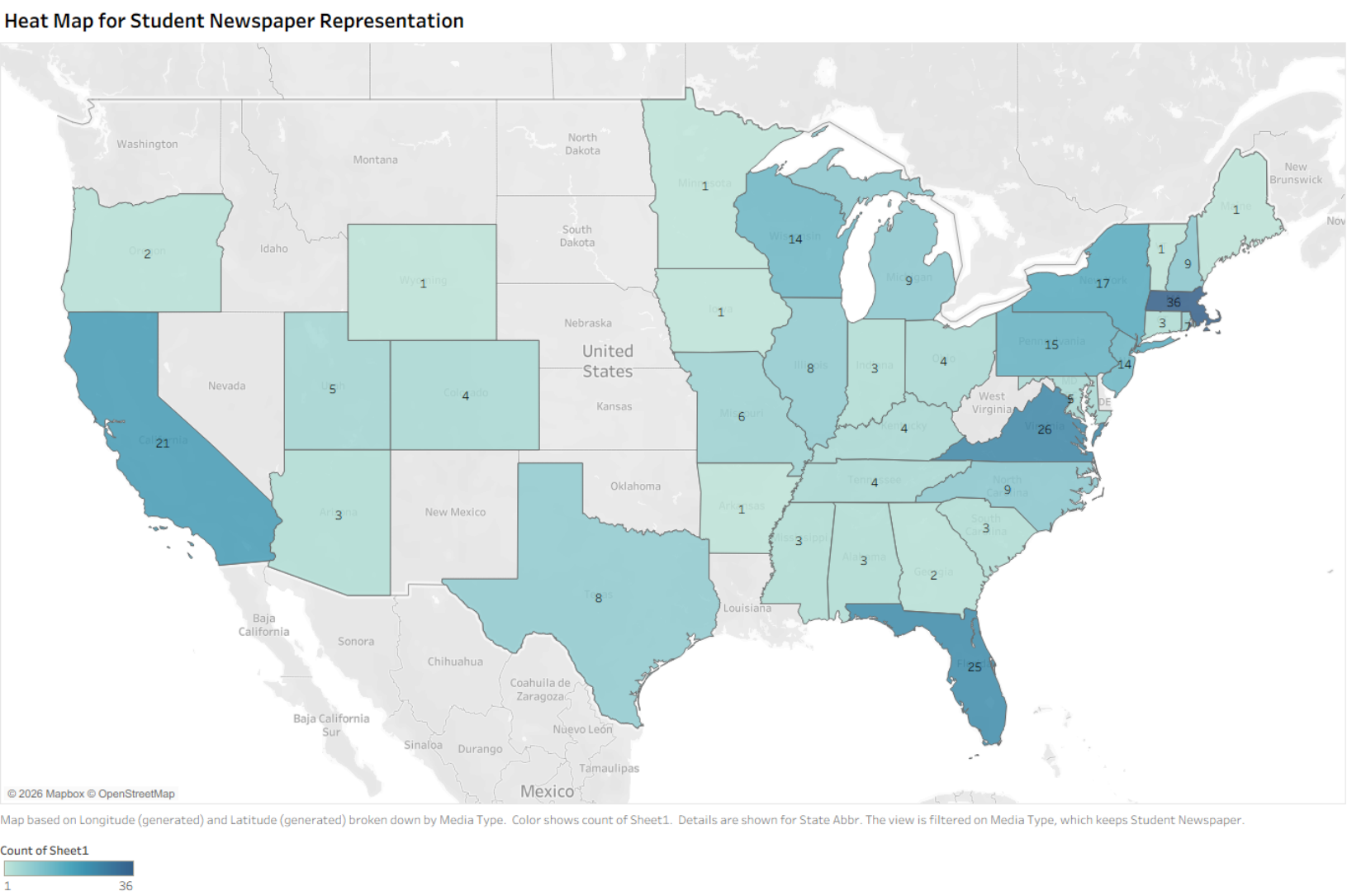
While national and state coverage bear on public mobilization, another important public consists of higher education insiders, i.e., faculty, administrators, and students. The geographic distribution of student newspaper coverage (see Figure 11) indicates how far viewpoint diversity has become a talking point among students. Campus coverage does not align closely with legislative activity (see Appendix C) and corresponds more nearly to state political salience. The states with the most coverage are Massachusetts, Pennsylvania, Florida, and California; states with many institutions but also states where major elite institutions have come under scrutiny by the Trump administration. The five campus newspapers publishing most on the topic are The Harvard Crimson, The Cavalier Daily (University of Virginia), The Daily Princetonian, The Cornell Daily Sun, and The Dartmouth, largely papers of elite institutions, including several affected by the administration's targeting of federal funding.
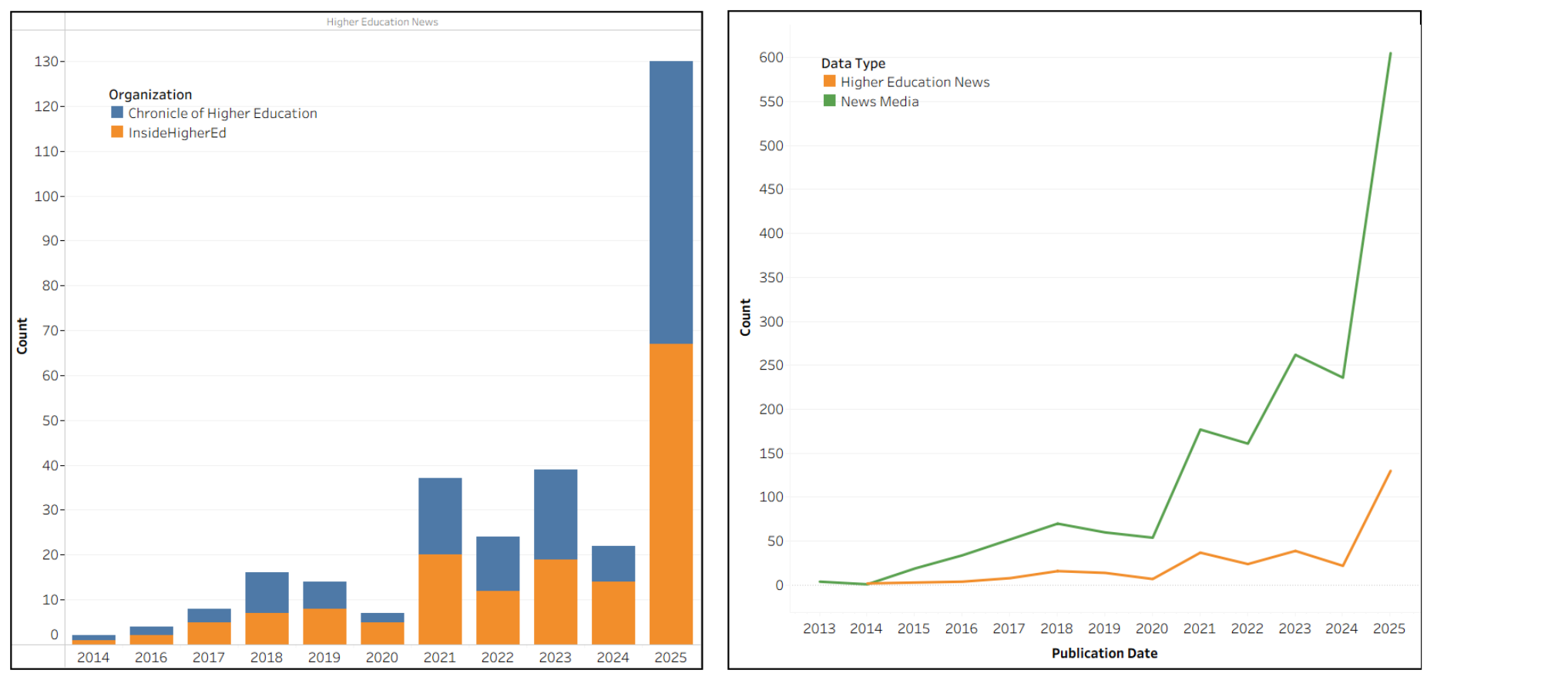
The two prominent higher education trade outlets have also published continuously on viewpoint diversity. In 2025 alone, the Chronicle of Higher Education and Inside Higher Ed published a total of 130 articles on the topic, at broadly comparable levels over time (see Figure 12). Trade coverage paralleled the wider news media trends (see Figure 6) and frequently featured writers and speakers from major intermediary organizations, Heterodox Academy among them, a point at which two of the study's social worlds visibly interpenetrate.
Viewpoint diversity, in sum, has been moving across all four social worlds and is reshaping higher education, directly, in the form of policy, and indirectly, as media framings carry the issue to publics beyond the academy.
Conclusion
This project set out to map the infrastructure of discourse production on viewpoint diversity through the end of 2025. By shifting attention from debates over the facts of viewpoint diversity to the question of who speaks for it, the findings illuminate the politics of knowledge production and mobilization in this arena. Four conclusions stand out.
First, the discourse on viewpoint diversity presents itself in a genre of expertise, yet it is driven substantially by communications infrastructure. While proponents and critics contest the validity of surveys, intentions, and arguments, and point to a growing research literature, much of the discourse produced by intermediary organizations is published without a named author or written by policy actors without advanced academic credentials. Together, these two categories account for the majority of authorship instances in the intermediary corpus. A parallel pattern appears in news media, where distribution services such as States News Service and PR Newswire rank among the larger contributors. Across both social worlds, a substantial share of the discourse is organizational voice presenting itself in the genres of news and expertise.
Second, the report establishes the central role of conservative intermediary organizations in advancing viewpoint diversity as a policy agenda. Recent critiques of viewpoint diversity often point to the innately conservative character of the movement or accuse organizations like Heterodox Academy of right-wing activism.38 Focusing on the assembly of actors and concerns, this project approaches the question differently. An assemblage is defined by its effects, or what it does, rather than by the character and intentions of the individual actors that comprise it. This report traces those actors, each with agendas and concerns of their own, as they have gathered into a conservative political assemblage. The findings therefore lend support to the perspective that viewpoint diversity has emerged as such an assemblage, without assuming that every actor within it intends its goals.39 In this sense, the research shows not what viewpoint diversity is but what viewpoint diversity does, treating critique as a matter of concern rather than a matter of fact.
The methodology has limitations for rendering a fully accurate picture of this discursive landscape, documented throughout the report; the corpus is bounded by a single phrase, political-leaning ratings depend on third-party instruments, and collection methods varied across sources. The central finding, however, withstood deliberate attempts to weaken it. Borderline cases were rated in the direction that understates conservative presence; a supplementary search of 412 left-of-center education-policy organizations were conducted to ensure that the scarcity of left-leaning discourse was not a mere artifact of sampling. The asymmetry held.
Third, expanding media attention shows that viewpoint diversity has become a public agenda. Media coverage of viewpoint diversity has grown over time and nearly doubled in 2025, while more left-leaning intermediary organizations and outlets have entered the discursive arena. This coverage is not uniformly critical; some of it is written in support of viewpoint diversity. What matters is less the valence of the coverage than its framing. As viewpoint diversity reaches broader publics, it arrives already sorted as a liberal-versus-conservative issue, one more front in a partisan conflict over higher education. Whatever the term once indexed, this is what it now indexes in public.
Fourth, that partisan framing is recent and the shifting use of the term reflects a change in what viewpoint diversity indexes. The move from matters of fact to matters of concern matters precisely because the content of viewpoint diversity discourse is varied, and the term's ambiguity allows it to gather diverse agendas. Heterodox Academy, for example, defines viewpoint diversity “as an instrumental good, not an absolute good — valuable to the extent it contributes to teaching, learning, discovery and the exposure of falsehoods.”40 That formulation, read against the reasoning of Grutter v. Bollinger (2003), in which the Supreme Court upheld race-conscious admissions on the grounds that engaging across differences serves the educational mission, is strikingly close in logic.41 Yet as this research shows, the term has since been taken up within a conservative political assemblage, first in state legislation, beginning with Florida in 2018 and accelerating from 2022, and by 2025 in federal funding and accreditation policy, promoting viewpoint diversity while constraining DEI, and shifting the term's index.
While commentators and experts are consumed with defending who is right or wrong, this research sheds light on the process itself, how the educational case for difference is converted into an instrument for advancing partisan politics or symbolic capitalism.42 Whether through DEI initiatives or viewpoint diversity, both camps ground their case in the claim that engaging across difference matters to higher education and its pursuit of the public good, the alignment between Heterodox Academy's definition and Grutter's reasoning shows as much. Yet that educational goal is undermined whenever higher education is enlisted for partisan ends through us-versus-them framings, a risk that runs in both directions, though the assembly documented in this report has been built largely from one. Is there advocacy to be done for protecting free speech and academic freedom on campus not as partisan issues, but as principles that protect higher education from partisan politics itself?
Appendix A: List of Intermediary Organizations
I reviewed the following organizations’ websites for the term “viewpoint diversity” between August 2025 and June 2026, using the website’s search engines or web crawlers:
- Alabama Policy Institute
- Alaska Policy Forum
- Albert Shanker Institute
- American Association of Colleges and Universities (AAC&U)
- American Association of Law Schools (AALS)
- Association to Advance Collegiate Schools of Business (AACSB)
- Association of American Medical Colleges (AAMC)
- American Association of State Colleges and Universities (AASCU)
- Association of American Universities (AAU)
- American Association of University Professors (AAUP)
- Academic Freedom Alliance (AFA)
- American Council on Education (ACE)
- American Civil Liberties Union (ACLU)
- American Council of Trustees and Alumni (ACTA)
- Acton Institute
- Alliance Defending Freedom (ADF)
- Alliance for Justice
- Alumni Free Speech Alliance (AFSA)
- American Federation of Teachers (AFT)
- Americans for Democratic Action (ADA)
- American Legislative Exchange Council (ALEC)
- American Enterprise Institute (AEI)
- American Institute for Economic Research (AIER)
- The Aspen Institute
- Arkansas Policy Foundation
- Association of Public and Land-grant Universities (APLU)
- Badger Institute
- The Baffler
- Beacon Center of Tennessee
- Bipartisan Policy Center
- Bluegrass Institute for Public Policy Solutions
- Braver Angelas
- BridgeUSA
- The Brookings Institution
- The Buckeye Institute
- Caesar Rodney Institute
- California Policy Center
- Center for American Progress
- The Center for Education Reform (CER)
- Center for Economic and Policy Research (CEPR)
- Cardinal Institute
- Cascade Policy Institute
- Cato Institute
- Center of the American Experiment
- The Center on Budget and Policy Priorities (CBPP)
- The Century Foundation
- Council for Graduate Schools
- Citizens Renewing America
- College Presidents for Civic Preparedness
- The College Fix
- Commonwealth Foundation
- Constructive Dialogue Institute
- Council of Colleges of Arts & Sciences
- Dēmos
- EdTrust
- Economic Policy Institute
- Empire Center for Public Policy
- Empower Mississippi
- Ethics and Public Policy Center (EPPC)
- Foundation for Government Accountability
- Foundation for Individual Rights and Expression (FIRE)
- Foundation for Economic Education
- Free Black Thought
- Freedom Foundation
- Freedom Foundation of Minnesota
- Free Speech Coalition
- Frontier Institute
- Garden State Initiative
- Georgia Public Policy Foundation
- Georgia Center for Opportunity
- Goldwater Institute
- Grassroot Institute of Hawaii
- Great Plains Public Policy Institute
- The Heritage Foundation
- The Hertog Foundation
- Hudson Institute
- Heterodox Academy
- Idaho Freedom Foundation
- Independence Institute
- The Independent Institute
- Illinois Policy Institute
- Indiana Policy Review Foundation
- Institute for Citizens & Scholars
- Institute For Humane Studies
- Institute for Policy Studies
- Institute for Reforming Government
- Interfaith America
- Iowans for Tax Relief Foundation
- Josiah Bartlett Center for Public Policy
- Kansas Policy Institute
- The Claremont Institute
- The Jack Miller Center
- The James Madison Institute
- The James G. Martin Center for Academic Renewal
- The John Locke Foundation
- The Leadership Institute
- Libertas Institute
- MacIver Institute for Public Policy
- Maine Policy Institute
- Manhattan Institute for Policy Research
- Mackinac Center for Public Policy
- The Middle East Forum
- Minding the Campus
- Mississippi Center for Public Policy
- Moral Courage College
- Mountain States Policy Center
- National Association of Independent Colleges and Universities (NAICU)
- National Association of Scholars (NAS)
- National Center for Public Policy Research
- The National Education Association (NEA)
- Nevada Policy Research Institute
- New America
- New Pluralists
- Niskanen Center
- Palmetto Promise Institute
- Pelican Institute for Public Policy
- Pioneer Institute
- Platte Institute for Economic Research
- The Preamble Center for Public Policy
- Oklahoma Council of Public Affairs
- Open Debate
- Opportunity Arkansas
- Pacific Legal Foundation
- Pacific Research Institute
- PEN America
- Progressive Policy Institute
- The R Street Institute
- The Reason Foundation
- Thomas Jefferson Institute
- Rhode Island Center for Freedom and Prosperity
- Rio Grande Foundation
- The Roosevelt Institute
- Show-Me Institute
- South Carolina Policy Council
- Speech First
- Sphere Education Initiatives (Sphere-Ed)
- Sutherland Institute
- Texas Public Policy Foundation
- The Center for Renewing America
- The Council of Independent Colleges (CIC)
- The Federalist Society
- The Foundation for Research on Equal Opportunity
- The Ford Foundation
- The Fund for American Studies
- The Gerald R. Ford Presidential Foundation
- Third Way
- Turning Point USA
- United for a Fair Economy
- Virginia Institute for Public Policy
- Washington Policy Center
- Wisconsin Institute for Law & Liberty
- Wyoming Liberty Group
- Yankee Institute for Public Policy
- Young Americans for Freedom (YAF)
Additional Left-of-Center Organizations from InfluenceWatch Website:
- National Student Clearinghouse
- Education Law Center (ELC)
- Florida Education Association (FEA)
- American Association of University Women (AAUW)
- The 74 Media (The 74) – np
- American Educational Research Association (AERA)
- California Faculty Association (CFA)
- Arkansas Education Association (AEA)
- Great Lakes Center for Education Research and Practice
- Utah Education Association (UEA)
- Community Alliance for Public Education (CAPE)
- Montana Federation of Public Employees
- Tennessee Education Association
- Washington Teachers Union (WTU)
- New York State United Teachers (NYSUT)
- Parents Together Action
- California Federation of Teachers (CFT)
- Leading Educators (LE)
- Zinn Education Project
- Younger Family Fund
- United Teachers of New Orleans
- Saint Paul Federation of Educators
- Alliance for Quality Education
- Illinois Education Association (IEA)-NEA
- Learning Policy Institute
- Fairfax Education Association
- Louisiana Federation of Teachers
- Defense of Democracy
- United Teachers of Dade (UTD)
- United Teachers Los Angeles (UTLA)
- Philadelphia Federation of Teachers
- Wisconsin Education Association Council
- Broward Teachers Union (BTU) Local 1975
- Action Now Initiative (ANI)
- Alliance for Educational Justice (AEJ)
- Network for Public Education (NPE)
- Climate Action 100+
- Leadership for Educational Equity Foundation
- Association for Advancement of Sustainability in Higher Education (AASHE)
- World Education Services (WES)
- B Lab
- Chalkbeat
- Alliance for Public Schools Foundation
- Heising-Simons Action Fund
- Broad Foundation
- Opportunity Institute
- Charles Stewart Mott Foundation
- Education Minnesota
- National Parents Union
- The Invest in Education Foundation
- Educators for Excellence
- National Association for the Education of Young Children
- National Center for Fair and Open Testing (FairTest)
- Gideon’s Army
- Stand for Children Inc.
- Sexuality Information and Education Council of the United States (SIECUS: Sex Ed for Social Change)
- Sponsors for Educational Opportunity (SEO)
- EAB
- Henry Luce Foundation
- Lannan Foundation
- Montana Education Association-Montana Federation of Teachers (MEA-MFT)
- Texas 2036
- Mississippi Association of Educators
- National Education Association (NEA) Advocacy Fund
- Teaching for Change
- America’s Promise—The Alliance for Youth
- National Equity Project
- Collaborative for Academic, Social, and Emotional Learning (CASEL)
- Leadership for Educational Equity
- Democrats for Education Reform (DFER)
- Children’s Defense Fund
- Elkhart Education Foundation
- 482 Forward
- Empire State Voices
- Arrow Impact
- The Leadership Academy
- Arizona Education Association (AEA)
- Avodah: The Jewish Service Corps.
- Neola
- Great Minds (Common Core, Inc.)
- Learning for Justice
- EL Education
- Public Advocates Inc.
- Posse Foundation
- Local Progress Policy Institute
- National Council of Teachers of Mathematics (NCTM)
- Liberated Ethnic Studies Model Curriculum Consortium (LESMCC)
- Southern Education Foundation (SEF)
- North Carolina Association of Educators (NCAE)
- The Gay, Lesbian, Straight Education Network (GLSEN)
- Oklahoma Education Association
- Youth Policy Institute
- California School Employees Association
- Educational Credit Management Corporation (ECMC) Foundation
- Maryland State Education Association (MSEA)
- Spencer Foundation
- Education Reform Now (ERN)
- Center for an Urban Future (CUF)
- Rethinking Schools
- Stuart Foundation
- Discovery Education
- Branch Alliance for Educator Diversity (BranchED)
- State Priorities Partnership (SSP)
- NewSchools Venture Fund
- Far Star Action Fund
- Generation Ready Inc.
- BIC Foundation
- Los Angeles LGBT Center
- Kentucky Resources Council (KRC)
- Bowers Consulting Firm
- United States Student Association
- James M. and Cathleen D. Stone Family Foundation
- Give Forward Foundation
- Stolte Family Foundation (SFF)
- American Federation of School Administrators
- Wallace Foundation
- National Education Association-New Hampshire (NEA-New Hampshire)
- College Track
- National Association for Media Literacy Education (NAMLE)
- Massachusetts Teachers Association (MTA)
- Oregon Education Association (OEA)
- Association of Raza Educators (ARE)
- The Achievement Network
- Bay and Paul Foundations
- Demand Progress Education Fund
- RE-Center: Race & Equity in Education
- Greater New Orleans Foundation
- The Hunt Institute
- Skillman Foundation
- National Council of Teachers of English (NCTE)
- Council for a Strong America
- National Parent Teacher Association (National PTA)
- Leona M. and Harry B. Helmsley Charitable Trust
- 365 Diversity
- The Islamic Networks Group
- World University Service of Canada (WUSC)
- The Knowledge House (TKH)
- Annenberg Institute for School Reform
- El Paso Community Foundation
- National Student Legal Defense Network
- Center for Urban Teaching (CfUT)
- The J M Foundation
- Teachers College Reading and Writing Project (TCRWP)
- Paul and Daisy Soros Fellowships for New Americans
- National Public Education Support Fund (NPESF)
- Youth Mentoring Action Network
- Hispanic Scholarship Fund
- Student Borrower Protection Center (SBPC)
- Esmée Fairbairn Foundation
- National Association of Colleges and Employers (NACE)
- Philanthropy Advocates
- South Carolina Education Association (SCEA)
- OnSight Public Affairs
- DA Global Access Network (DA Global)
- Improve Your Tomorrow (IYT)
- Jacobs Foundation
- Resource Center of Dallas
- National Association of System Heads (NASH)
- Texas Federation of Teachers
- Vermont-NEA
- Insight Education Group Inc.
- Alliance to Reclaim our Schools (AROS)
- National Education Association-Alaska (NEA-Alaska)
- AASA, the School Superintendents Association
- United Educators of San Francisco
- 50CAN (Coalition for Achievement Now)
- Institute for Educational Leadership Inc. (IEL)
- Building Assets, Reducing Risks (BARR Center)
- United Association for Labor Education (UALE)
- Council of Chief State School Officers (CCSSO)
- Center for Civic Action
- ParentsTogether Foundation
- National Council for History Education
- Parent Coalition for Student Privacy (PCSP)
- Ohio Federation of Teachers (OFT)
- Turnaround for Children Inc. (TFC)
- Our Schools USA
- Children’s Defense Fund Action Council
- Latinos for Education
- New Haven Ecology Project
- Mid-Atlantic Equity Consortium, Inc.
- Journey for Justice Alliance
- Lumity
- Asian Counseling and Referral Service (ACRS)
- Black Teacher Collaborative (BTC)
- United Auto Workers Local 4811 (UAW 4811)
- Jeff T. Green Family Foundation
- Girls Inc
- Blue Rose Compass
- Children Now
- Thabyay Education Foundation
- Jewish Community Action (JCA)
- Sikh Coalition
- Ten Strands
- Metropolitan Center for Research on Equity and the Transformation of Schools
- National Board for Professional Teaching Standards
- Greater Good Science Center
- 10,000 Degrees
- National Training Institute for Applied Behavioral Science
- Saphron Initiative
- National Association for Multicultural Education (NAME)
- California Calls Education Fund
- Fund for Education Excellence
- Unite Oregon (Center for Intercultural Organizing)
- Center for Racial Justice in Education
- National Association for Equal Opportunity in Higher Education (NAFEO)
- McKay Family Foundation (Oregon)
- Moleskine Foundation Inc. (MF)
- Nevada State Education Association (NSEA)
- Mainstream Coalition
- America Achieves
- Campus Progress
- Stony Brook Foundation
- Providence Student Union
- National Association of Independent Schools (NAIS)
- Maine Education Association
- National Education Equity Lab
- Lake County Community Foundation
- Education for Liberation Network
- Midwest and Plains Equity Assistance Center (MAP)
- Our Oregon
- Delaware State Education Association (DSEA)
- California Native Vote Project (CNVP)
- Center for Conflict Resolution (CCR)
- The Conscious Kid
- Scholarly Publishing and Academic Resources Coalition (SPARC)
- Adjusted Equity Solutions
- Teacher Union Reform Network (TURN)
- National School Boards Association
- National SEED Project
- Campaign for Our Shared Future
- Breakfree Education
- Honesty for Ohio Education (HFOE)
- Asian American Advocacy Fund (AAAF)
- POWER Interfaith
- Tandem Partners in Early Learning
- D.C. Area Educators for Social Justice
- Student Debt Crisis Center (SDCC)
- Human Achievement Alliance (HAA)
- Center for Racial Equity in Education (CREED)
- Collaborative for Student Success
- Community Aid and Development Corporation (CAD)
- National Center for Teacher Residencies (NCTR)
- National Network of State Teachers of the Year
- Newsela
- Due East Educational Equity Collaborative
- Morningside Center for Teaching Social Responsibility
- Logan Consulting Services LLC
- Pacific Educational Group
- New Hampshire Outright
- Center for Culturally Responsive Teaching and Learning
- Center for Black Educator Development (CBED)
- Education Leaders of Color (EDLOC)
- National Alliance for Partnerships in Equity
- Consortium for Educational Change (CEC)
- Education Elements Inc.
- DC Action
- NAFSA: Association of International Educators
- AFT Michigan
- Nebraska State Education Association (NSEA)
- National Center for Youth Law (NCYL)
- Voices for Racial Justice (VRJ)
- Joint Venture Silicon Valley Network
- Epoch Education
- Education Truth Project (ETP)
- Employment Technology Fund
- The Mothers’ Agenda NY (MANY)
- LiberatED LLC
- Heinemann
- Mississippi Low-Income Child Care Initiative
- Connecticut Voices for Children
- National Council on Teacher Quality
- Black Minds Matter
- Mass Alliance
- National Council on Teacher Quality (NCTQ)
- Californians Dedicated to Education Foundation
- Glasgow Group
- National Education Association of New Mexico
- Colors+
- New Teacher Center
- Parents Across America
- National Public Education Action Fund
- Center for Equity and Inclusion
- National Crime Victim Law Institute (NCVLI)
- Rise Inc.
- All Our Kin
- Cape Town Open Education Declaration
- Independent Schools Association of the Central States (ISACS)
- From Prison to Promise
- Association for Community Empowerment Solutions (ACES)
- North Carolina Citizens for Protecting Our Schools
- Postsecondary National Policy Institute (PNPI)
- NAF (naf.org)
- The Invest in Education Coalition
- Defending the Early Years
- Arizona Students Association (ASA)
- Alliance for Education
- Nicole Anderson and Associates Consulting
- Akoben
- Alliance of Rhode Island Southeast Asians for Education (ARISE)
- El Centro
- Bright Beginnings
- Higher Ed, Not Debt
- National Educators United
- ONE Archives Foundation
- Oakland REACH
- Class Size Matters
- Racing To Equity
- Hamkae Center
- Northwest Association of Independent Schools (NWAIS)
- Central Florida Jobs with Justice
- We The 45 Million
- Rachael and Ben Vaughan Foundation
- Full Circle Consulting LLC
- New England Association of Schools and Colleges (NEASC)
- Hanley Foundation
- Reissa Foundation
- Advocates for Children and Youth
- State Education Resource Center
- CORE Districts
- The Equity Collaborative
- Demand Safe Schools Coalition
- Advancing Equity in Childhood Education
- Children’s Advocacy Alliance
- Educational Equity Consultants, LLC
- One World Consulting
- Wyoming Education Association (WEA)
- Southern Association of Independent Schools (SAIS)
- Kentucky Youth Advocates
- Minnesota Education Equity Partnership
- Teens Take Charge
- The Maryland Catholic Conference (MCC)
- Enid Lee Consultants
- Campaign for Our Shared Future Action Fund
- Council of School Attorneys
- EDEquity Inc
- Citizen Schools
- Scholar First
- National School Boards Action Center
- Baltimore Algebra Project
- Hudson Link for Higher Education in Prison
- Girls Opportunity Alliance (GOA)
- Change is Simple
- Equity Literacy Institute
- Karuna Center for Peace Building
- Black Student Fund
- Michigan Student Power Alliance (MSPA)
- EDquity Consulting
- The Minor Collective LLC
- National Center for College and Career (ConnectED)
- Men of Color in Educational Leadership (MCEL)
- Kids Forward
- Cultures Connecting LLC
- Kingmakers of Oakland
- Center for Leadership Equity and Research
- Fleur Larsen Facilitation
- Anti-Racism Collaborative
- FourPoint Education Partners LLC
- Racial Equity Consultants
- Community Responsive Education (CRE)
- West Virginia Education Association
- Diversity Center of Northeast Ohio (DCNEO)
- Derute Consulting Cooperative
- Camden Parent Union (CPU)
- New York Bar Foundation
- Center for Collaborative Education
- OER Digest
- UChicago Urban Labs
- Transform the Collective Inc.
- Coalition of Schools Educating Boys of Color (COSEBOC)
- The Equity Lab
- Massachusetts Library Staff Association (MLSA)
- Child First Authority
- Save Our Schools NJ Community Organizing
- The Leadership Collaborative
- MINNDEPENDENT
- Mercer Family Foundation (Oregon)
- Foundation @ FCOE
- Association of Independent Schools in New England (AISNE)
- Grow Your Own Illinois
- One Ohio Now
- Independent Schools Association of the Southwest (ISAS)
- Make it Plain Consulting
- National Association for Bilingual Education
- We Are (also known as Working to Extend Anti-Racist Education)
- Ideas42
- ACCAI-UNN
- Past Present Future Consulting & Media LLC
- Better Days 2020
- Texas Impact Education Fund
- Natural Inclination
- Connecticut Public Interest Research Group (ConnPIRG Students)
- Surge Institute
- Maryland School for the Deaf Faculty and Staff Association (MSDFSA)
- EduSigner LLC
- Silver Lining Mentoring (SLM)
- Students Organizing for Sustainability International
- Quaker Earthcare Witness
- Golden Bridges Foundation
- Schmid & Company
- North Dakota United
- Innovations for Youth (i4Y)
- Hackman Consulting Group
- Modern Impact Solutions
- Arizona Educators United (AEU)
- Monarch Training and Development, LLC
- Elliott Educational Services LLC
- Foundation for the Mid South (FMS)
- Systemic Educational Equity LLC
- Voices for Utah Children
- Youth Caucus of America, Inc.
- Chiariello Consulting
Appendix B: Academic Magazines and Journals Included in the Corpus
- Organization Journal
- Perspectives on Psychological Science
- Theory & Society
- The Independent Review
- Christian Education Journal
- California Law Review
- The Yale Law Journal
- Synthese
- Scientific American
- Psychological Inquiry
- Contemporary Sociology
- Yale Law & Policy Review
- The American Sociologist
- Stanford Law Review
- Society
- Political Studies Review
- Journal of Applied Philosophy
- International Political Science Review
- International Journal of Christianity & Education
- Harvard Law Review
- Duke Law Journal
- Contexts
- Columbia Law Review
- Behavioral and Brain Sciences
- World Politics
- World Futures Review
- Theological Studies
- The University of Chicago Law Review
- The Radical Teacher
- The New Atlantis
- The Linacre Quarterly
- The Journal of Positive Psychology
- The Journal of Blacks in Higher Education
- The Counseling Psychologist
- The Business Lawyer
- The Baffler
- The Anthropocene Review
- Sociological Methods & Research
- Social Research
- Social Psychological and Personality Science
- Singapore Journal of Legal Studies
- Saeculum
- Review of Public Personnel Administration
- Review of Education, Pedagogy & Cultural Studies
- Research on Social Work Practice
- Race & Class
- Punishment & Society
- Public Understanding of Science
- Public Personnel Management
- Psychology of Women Quarterly
- Psychology Learning & Teaching
- Psychological Science in the Public Interest
- Psychological Reports
- Psychoanalytic Inquiry
- Proceedings of the National Academy of Sciences of the United States of America
- Political Studies
- Political Research Quarterly
- Political Insight
- Phi Delta Kappan
- Personality and Social Psychology Bulletin
- Nature Human Behaviour
- National Civic Review
- Metaphilosophy
- Memory Studies
- Management Communication Quarterly
- Liberal Education
- Laws
- Law, Culture and the Humanities
- Kölner Zeitschrift für Soziologie und Sozialpsychologie
- Journal of Teaching in Social Work
- Journal of School Choice
- Journal of Management
- Journal of Higher Education Policy & Management
- Journal of Correctional Education
- Journal of College Student Development
- Journal of Applied Research in Memory and Cognition
- Jmir Formative Research
- Israel Studies
- International Studies
- International Sociology
- Independent Review
- IFLA Journal
- Human Relations
- History of the Human Sciences
- Higher Education Politics & Economics
- Health and Human Rights
- European Journal of Personality
- Ethnicities
- Educational Policy
- Education Sciences
- Education and Culture
- Dialogues in Human Geography
- Current Psychology: A Journal for Diverse Perspectives on Diverse Psychological Issues
- Critical Education
- Contemporary Issues in Early Childhood
- Composition Studies
- Clinical Psychology: Science and Practice
- Clearing House
- Christian Higher Education
- Canadian Journal of Political Science / Revue canadienne de science politique
- Brooklyn Law Review
- British Educational Research Journal
- Berkeley Technology Law Journal
- Australian & New Zealand Journal of Psychiatry
- Area
- Anthropological Theory
- American Journal of Bioethics
- American Annals of the Deaf
- Acta Educationis Generalis
- Acta Analytica
- Academe
Appendix C: Heat Maps for Geographic Coverage of Student Newspapers and Legislation
- Reuben, J. A. (1996). The making of the modern university: Intellectual transformation and the marginalization of morality. University of Chicago Press. ↩︎
- American Association of University Professors. (1940). 1940 Statement of principles on academic freedom and tenure with 1970 interpretive comments. https://www.aaup.org/reports-publications/aaup-policies-reports/policy-statements/1940-statement-principles-academic; Cain, T. R. (2012). Establishing academic freedom: Politics, principles, and the development of core values. Springer. ↩︎
- See https://www.aaup.org/issues-higher-education/political-attacks-higher-education. ↩︎
- Schickler, E., & Rodriguez, E. M. (2026). The college campus and the culture war: The development of party polarization on higher education, 1980–2025. Studies in American Political Development. Advance Online Publication. https://doi.org/10.1017/S0898588X26100327. ↩︎
- For a compilation of these views and developments, see Tomasi, J., & Schweizer, B. (Eds.). (2026). Viewpoint diversity: What it is, why we need it, and how to get it. Heresy Press. ↩︎
- Musa Al-Gharbi. (2020, January 14). 100 Years of Viewpoint Diversity Activism: Failure - HxA. Viewpoint Diversity. https://heterodoxacademy.org/blog/callosal-failure-viewpoint-diversity-movement ↩︎
- Quinn, R. (2025, September 2). The battle for “viewpoint diversity.” Inside Higher Ed. https://www.insidehighered.com/news/deep-dives/2025/09/02/battle-viewpoint-diversity. See also American Council on Education. (2026). Negotiators pass draft rules to overhaul college accreditation. American Council on Education. https://www.acenet.edu/News-Room/Pages/Draft-Rules-Passed-to-Overhaul-Accreditation-.aspx ↩︎
- U.S. Department of Education. (2025). U.S. Department of Education releases seven priorities under the Fund for the Improvement of Postsecondary Education. http://www.ed.gov/about/news/press-release/us-department-of-education-releases-seven-priorities-under-fund-improvement-of-postsecondary-education ↩︎
- Allen, J. (2025, April 16). After Harvard rejects US demands, Trump adds new threat. Reuters. https://www.reuters.com/world/us/after-harvard-rejects-trump-demands-columbia-still-talks-over-federal-funding-2025-04-15/ ↩︎
- Quinn, R. (2026, June 5). Iowa undergrads will have to take history courses picked by civics centers. Inside Higher Ed. https://www.insidehighered.com/news/quick-takes/2026/06/05/iowa-undergrads-will-now-take-courses-picked-civics-centers ↩︎
- Schuessler, J. (2024, September 14). Should a ‘diverse’ campus mean more conservatives? The New York Times. https://www.nytimes.com/2024/09/14/arts/viewpoint-diversity-universities-conservatives.html ↩︎
- A Chronicle of Higher Education 2025 festival roundtable on viewpoint diversity described its goal as “More university leaders, politicians, and academics are calling for greater viewpoint diversity in higher education to better teach students and prepare them for a world where views are often conflicting. But what does viewpoint diversity really mean? Is there a consensus on how it should be defined and measured? And what is realistic in how campuses are held accountable for it?” [emphasis added] See https://connect.chronicle.com/chronfest25-agenda.html ↩︎
- Siraganian, L. (2025, October 10). Viewpoint diversity is a MAGA plot. The Chronicle of Higher Education. https://www.chronicle.com/article/viewpoint-diversity-is-a-maga-plot ↩︎
- Tomasi, J. (2026). The heterodox view of viewpoint diversity. In J. Tomasi & B. Schweizer (Eds.), Viewpoint diversity: What it is, why we need it, and how to get it (pp. 3–15). Heresy Press. Tomasi is the current president of the Heterodox Academy. ↩︎
- Latour, B. (2004). Why has critique run out of steam? From matters of fact to matters of concern. Critical Inquiry, 30(2), 225–249. https://doi.org/doi:%252010.1086/421123. Also, Latour, B. (2005). Reassembling the social: An introduction to actor-network-theory. Oxford University Press. ↩︎
- Of which there are many: republican vs. democrat; conservative vs. liberal; right vs. left. ↩︎
- Artifact is used throughout this report as the unit of analysis for an entry in the database, be it a webpage, a legislative activity, a copy of a news article, or a research article, representing one discourse entry into the larger discursive space on the topic. ↩︎
- For a genealogy of ‘diversity of viewpoints’ see: Strossen, N. (2026). Viewpoint diversity as a core constitutional value, central to liberty, equality, and democracy. In J. Tomasi & B. Schweizer (Eds.), Viewpoint diversity: What it is, why we need it, and how to get it (pp. 17–33). Heresy Press. ↩︎
- Keller, R., Hornidge, A.-K., & Schünemann, W. J. (2018). The sociology of knowledge approach to discourse: Investigating the politics of knowledge and meaning-making. Routledge; Clarke, A. E., Friese, C., & Washburn, R. S. (2017). Situational analysis: Grounded theory after the interpretive turn. SAGE Publications. ↩︎
- The reference to mapping in the title refers to this activity, as I try to create a map, or big picture, of the landscape of discourse on viewpoint diversity. A big picture has the advantage of seeing nodes and connections more clearly, though it leaves out details—which I hope to explore in future research on this topic. ↩︎
- Some of these categories are broad and could be broken down further. However, for the purpose of this research, these broad categories are arguably still valid for the analytical purpose of obtaining a macro view of the infrastructure of discourse production. ↩︎
- Not one organization's site. ↩︎
- Because site search functions and exhaustive crawling do not return identical results, artifacts from some organizations may be undercounted relative to others. Whether this variation tracks political leaning has not been tested. ↩︎
- Claude was used to help with Python codes to retrieve pages with viewpoint diversity in them. ↩︎
- SourceWatch was used to obtain the list of affiliate and associate members of the State Policy Network; at retrieval, the list was marked as last updated in June 2024. Affiliate members, the network's state-level policy organizations, were included in full, as they constitute the organizational form most directly connected to the state legislative activity examined in this report. Associate members, a broader category of nationally oriented organizations, were included only where they appeared in cross-references, on the same basis as other national organizations. Because associate members are likewise conservative-aligned, their fuller inclusion would be expected to add right-leaning discourse to the corpus; the omission therefore runs against, rather than in favor of, the report's central finding. ↩︎
- Notably, professional associations were excluded from the list. Most other omitted organizations were foundations that did not have their own websites. For Google Search, the term “viewpoint diversity" was searched together with the operator site:[organization domain]. While this method is not as exhaustive as using crawlers, the very limited search results among 412 websites is reassuring that the real volume could not be changing the results in meaningful ways. Of course, using InfluenceWatch to obtain the list of left leaning intermediary organizations in the supplementary search is bounded by InfluenceWatch's coverage and categorization. ↩︎
- Claude was used to create and debug Python codes to extract dates and names. In each instance, I randomly cross-checked a sample to make sure the code’s reliability. ↩︎
- While there is no individual accurate source of media bias ratings, the media Bias Fact Check claims non-partisan methodologies and independent funding and has been found to align in its findings with other resources. The Penn State News Literacy Initiative highlights Media Bias Fact Check as a proper resource for checking bias in media. See https://newsliteracy.psu.edu/news/mediabiasfactcheck-com-as-a-tool-for-lateral-reading ↩︎
- https://mediabiasfactcheck.com/influence-watch/. See also https://www.politico.com/news/2026/06/20/capital-research-center-conservative-watchdog-nonprofits-trump-00968002 ↩︎
- Social world is a Straussian concept that is central to situational analysis. See Clarke, A. E., Friese, C., & Washburn, R. S. (2017). Situational analysis: Grounded theory after the interpretive turn. SAGE Publications. ↩︎
- See Ness, E. C., & Gándara, D. (2014). Ideological think tanks in the states: An inventory of their prevalence, networks, and higher education policy activity. Educational Policy, 28(2), 258–280. https://doi.org/10.1177/0895904813515328 ↩︎
- Kurtz, S. (2003, October 14). Reforming the campus. National Review. https://www.nationalreview.com/2003/10/reforming-campus/ ↩︎
- Duarte, J. L., Crawford, J. T., Stern, C., Haidt, J., Jussim, L., & Tetlock, P. E. (2015). Political diversity will improve social psychological science. Behavioral and Brain Sciences, 38. https://research.ebsco.com/linkprocessor/plink?id=d749fe1c-c916-3e22-83bf-4844926c8d3e ↩︎
- The increase could also be attributed to rise in indexing of webpages generally. However, the magnitude of change is not plausibly an artifact of indexing. ↩︎
- Siraganian, L. (2025, October 10). Viewpoint diversity is a MAGA plot. The Chronicle of Higher Education. https://www.chronicle.com/article/viewpoint-diversity-is-a-maga-plot; Scatamburlo-D’Annibale, V. L. (2025). Make the academy great again: Right-wing think tanks and the “crisis” in universities. Critical Education, 16(3), 20–40. https://doi.org/10.14288/ce.v16i3.187079 ↩︎
- Notably, Jonathan Haidt’s authorship appears in the Heterodox Academy, but also in Foundation for Individual Rights and Expression, Manhattan Institute for Policy Research, National Association of Scholars, and the Cato Institute. Samuel Abrams’s work appears in the American Enterprise Institute, but also in Foundation for Individual Rights and Expression, James G. Martin Center for Academic Renewal, National Association of Scholars, Minding the Campus, and the Heterodox Academy. ↩︎
- Schoorman, D., & Gatens, R. (2023). A threat to democracy: Florida’s agenda to dismantle public higher education. AAUP Journal of Academic Freedom, 14(1). https://www.aaup.org/JAF14/threat-democracy-floridas-agenda-dismantle-public-higher-education ↩︎
- Siraganian, L. (2025, October 10). Viewpoint diversity is a MAGA plot. The Chronicle of Higher Education. https://www.chronicle.com/article/viewpoint-diversity-is-a-maga-plot; Siraganian, L. (2025). Seven theses against viewpoint diversity. Academe, Fall 2025. https://www.aaup.org/academe/issues/fall-2025/seven-theses-against-viewpoint-diversity; see also al-Gharbi for a note on Heterodox Academy’s standing for non-partisan politics, al-Gharbi, M. (2020, February 25). On Heterodox Academy and effective advocacy. Musa Al-Gharbi. https://musaalgharbi.com/2020/02/25/heterodox-academy-effective-advocacy/ ↩︎
- Aligned with Latour’s idea that “"the inquirer is always one reflexive loop behind those they study." See Latour, B. (2005). Reassembling the social: An introduction to actor-network-theory. Oxford University Press. ↩︎
- Mashek, D. (2017, December 18). 2019 HxA Director’s Address—Heterodox Academy [Heterodox Academy]. https://heterodoxacademy.org/blog/2019-hxa-director-address ↩︎
- See Milem et al., for research on educational benefits of diversity: Milem, J. F., Chang, M. J., & Antonio, A. L. (2005). Making diversity work on campus: A research-based perspective (Making Excellence Inclusive Initiative). Association of American Colleges and Universities. Also, Bulman-Pozen, J. (2006). Grutter at work: A title VII critique of constitutional affirmative action. The Yale Law Journal, 115(6), 1408–1448. https://doi.org/10.2307/20455657 ↩︎
- Musa al-Gharbi defines symbolic capitalism in relationship to a professional class who profits from controlling means of “symbolic (re)production,” like, rhetorical tools, data, and intellectual analyses; See al-Gharbi, M. (2024). We have never been woke: The cultural contradictions of a new elite. Princeton University Press.. ↩︎