
Free Speech Movement Lesson (2024)
1. From the Free Speech Movement Teacher Session
From the Free Speech Movement teacher session I did in October 2024: the lesson, the student facing materials, and the slides.
These I co-designed with Ryan Mills (social studies teacher and vice principal at Edward R. Murrow High School in Brooklyn) and Stacie Bresilver Berman (veteran high school teacher who is currently my colleague in social studies at NYU). I have also attached an article I wrote back on the Free Speech Movement’s 50th anniversary because it provides teachers with a concise overview of the FSM, which many will need since they tend not to know the history of this student movement.
1.1 Lesson
Free Speech Movement 1964
Introduction: This lesson prompts students to interrogate UC Berkeley students’ rationale for protesting restrictions on free speech and campus political activity at UC Berkeley in 1964 and consider how they might apply the lessons from the Free Speech Movement in the present.
As stated on the UC Berkeley Free Speech web page, “The Free Speech Movement began in 1964 when UC Berkeley students protested the university’s restrictions on political activities on campus. Small sit-ins and demonstrations escalated into a series of large-scale rallies and protests demanding full constitutional rights on campus. This led to the university overturning policies that would restrict the content of speech or advocacy. Today, the Movement stands as a symbol of the importance of protecting and preserving free speech and academic freedom.”1
Over the past year, students on campuses across the country have clashed with administrators and, in some cases, the police as they gathered to protest the Israel-Hamas war, the United States’ policies regarding the war, and universities’ role in the Middle East. These protests, universities’ reactions to them, and the implications for students involved on all sides, brought up new questions about academic freedom, students’ rights on campus, and the extent to which free speech is guaranteed.
In this two day lesson, students will use letters submitted to Judge Crittenden to evaluate Berkeley students’ reasons for protesting in 1964 and determine whether they believe the Berkeley students were justified. Equipped with this information, students will make connections between the past and the present, considering the justifications for student protests in 2024. ###
Note to Teachers: We understand that everyone’s circumstances are different and that the materials and activities in this lesson might need to be modified to meet your students’ needs and align with your school’s structures. We encourage you to make any modifications or adjustments you need in order to effectively use this lesson in your class. That might include adjusting the pacing/timeline, adding/revising questions or instructions, adding/removing documents and/or images, etc. These materials are yours to use as you need! We hope you’ll let us know how it goes if you have the opportunity to use all or part of these materials with your students.
1.2 Lesson Plan
Essential Question: To what extent should students have unrestricted rights to protest on college campuses?
Objectives: After this lesson, students will be able to:
- Explain the Free Speech Movement of 1964, including the timeline of events and reasons for the protest.
- Evaluate Berkeley students’ reasons for participating in the Free Speech Movement and determine the extent to which those reasons are justified, using evidence from primary sources to support their claims.
- Assess the extent to which student protesters’ actions in 2024 were justified, based on their analysis of rationales from the past.
1.3 Standards
Content:
12.G2 CIVIL RIGHTS and CIVIL LIBERTIES: The United States Constitution aims to protect individual freedoms and rights that have been extended to more groups of people over time. These rights and freedoms continue to be debated, extended to additional people, and defined through judicial interpretation. In engaging in issues of civic debate, citizens act with an appreciation of differences and are able to participate in constructive dialogue with those who hold different perspectives.
- 12.G2b The Constitution aims to protect, among other freedoms, individual and group rights to freedom of speech, freedom of the press, freedom of assembly, freedom of petition, and freedom of religion. The extent to which these ideals exist in practice and how these protections should be applied in a changing world continues to be an issue of ongoing civic debate.
- 12.G2e Rights are not absolute; they vary with legal status, with location (as in schools and workplaces), and with circumstance. The different statuses of United States residency bring with them specific protections, rights, and responsibilities. Minors have specific rights in school, in the workplace, in the community, and in the family. The extension of rights across location, circumstance, age, and legal status is a subject of civic discourse.
Skills:
Key Ideas and Details:
- 11-12.1: Cite specific textual evidence to support analysis of primary and secondary sources, connecting insights gained from specific details to an understanding of the text as a whole.
- 11-12.2: Determine the central ideas or information of a primary or secondary source; provide an accurate summary that makes clear the relationships among the key details and ideas.
- 11-12.3: Evaluate various explanations for actions or events and determine which explanation best accords with textual evidence, acknowledging where the text leaves matters uncertain.
Integration of Knowledge and Ideas:
- 11-12.7: Integrate and evaluate multiple sources of information presented in diverse formats and media (e.g., visually, quantitatively, as well as in words) in order to address a question or solve a problem.
- 11-12.8: Evaluate an author’s premises, claims, and evidence by corroborating or challenging them with other information.
- 11-12.9: Integrate information from diverse sources, both primary and secondary, into a coherent understanding of an idea or event, noting discrepancies among sources.
Motivation: Protest Images
Show students a series of images of campus protests (images on slides). Teachers can decide if they prefer to show images from recent student protests at Columbia or student protests from Berkeley in 1964. For each image, ask students the following:
- Should students have the right to protest in the manner depicted in this image on a college campus?
- What additional information would you want to have to fully make that determination?
After reviewing the images, ask students:
- Based on these images, what types of protest should universities permit? When might it be acceptable for universities to restrict student speech/protest?
Materials:
- Berkeley Students’ Statements to Judge Crittenden (Typed PDFs)/(Website)
Procedures:
- Free Speech Movement Context
- Students will watch “Free Speech Movement: 50 Years” from the San Francisco Chronicle, which will provide them with context on the Free Speech Movement. After the video, the class will discuss the following questions (students will take notes in their packets):
- What actions led to the Free Speech Movement at UC Berkeley?
- What was the result of the Free Speech Movement? Why did students involved consider it a victory?
- Why might students in the 1960s have considered speech a right that needed to be protected?
- The teacher will introduce Mario Savio and his role in the Free Speech Movement. Students will read excerpts/quotes from Savio to learn more about the movement’s goals and ideas about Free Speech. Students will discuss the following questions as a full class, in small groups, or through a turn and talk:
- How does Mario Savio describe the importance of Free Speech?
- What conclusions can you draw about the Free Speech Movement based on the ideas that Savio expressed?
- To what extent do you agree with Savio’s ideas about Free Speech? Explain your answer.
- The class will discuss the significance of the Free Speech Movement and the ways in which it was a product of its time and supported protests in its aftermath.
- Students will watch “Free Speech Movement: 50 Years” from the San Francisco Chronicle, which will provide them with context on the Free Speech Movement. After the video, the class will discuss the following questions (students will take notes in their packets):
- Group work (student statements):
- Divide students into groups of four. Before students begin working, provide the following context on the students’ statements:
- In 1967, three years after the Free Speech Movement protests on Berkeley’s campus, the 800 students who were arrested for unlawful assembly and trespass when they occupied Sproul Hall during the 1964 protest came to trial. Judge Rupert Crittenden, who presided over the first trial, requested that the students write letters explaining their involvement in the Free Speech Movement and the occupation. Crittenden expected the students to write apology letters, but many used the opportunity to explain and justify their actions. These letters now serve as a record of the students’ experiences and rationale for participating in the Free Speech Movement.
- Each student will read a statement from a different Berkeley student, from a collection written by the 800 students arrested for occupying Sproul Hall in 1964.
- After each student reads their letter, they will decide on a rating from 1-5 regarding the extent to which they think the Berkeley student’s actions were justified and explain their rating based on the primary sources and information about the FSM.
- Within the group, each student will share their ratings and rationale for the individual Berkeley student whose statement they read. The group will discuss their individual reactions and then collectively come up with a written statement defending/condemning the protesters with supporting evidence for their positions. They will present this statement to the class.
- Divide students into groups of four. Before students begin working, provide the following context on the students’ statements:
- Presentations: Mock Disciplinary Hearing
- The teacher will explain to students that they’re holding a mock disciplinary hearing where the students will serve as both “lawyers” and the board determining whether or not the students’ actions were justified. Each group will share their statement with the class. As students speak, the teacher will keep notes on the reasons that the protesters were or were not justified; students should also keep track of these reasons in their packets.
- After all groups present students will determine whether or not the Berkeley students’ actions were justified, considering all of the evidence and the ways that their classmates presented the cases (students can consult the list generated by the statements each group shared to inform their decision making). They will then come to consensus as a class about whether or not the FSM protesters were justified in their actions.
- Teachers will prompt students: You are the disciplinary board deciding whether or not the Berkeley students’ actions were justified. Based on your group work, all of the information that your group and your classmates shared, and the list we generated as a class, what is your final ruling on the students actions? (Student volunteers/call on students to respond).
- Following this discussion, in their packets, students will independently write their reasons for their decision. Some students will share their explanation with the class.
- Debrief/Discussion
- Student protests on campus are not isolated to the Free Speech Movement or the 1960s. Based on students’ study of the Free Speech Movement, the teacher will lead a full class discussion applying what students learn to the larger concept of free speech on campuses. Students will respond to the following questions:
- Which forms of expression should be protected by ‘free speech’ on campus?
- To what extent should the context of the protest impact whether it is protected or not? (War, race, hate, etc.)
- What should be the most important consideration for a University: freedom of thought/expression or maintaining a safe learning environment?
- Do the benefits of limiting free speech in an educational setting outweigh the implications?
- Student protests on campus are not isolated to the Free Speech Movement or the 1960s. Based on students’ study of the Free Speech Movement, the teacher will lead a full class discussion applying what students learn to the larger concept of free speech on campuses. Students will respond to the following questions:
Assessment Options:
Choose one option:
- Write your own “justification letter” supporting protesters as if you are a Columbia protester OR
- Write your own statement as the President of Columbia University to limit the protesters.
In your response, please include
- Your position on the extent to which you believe that any university should protect the freedom of speech on college campuses in the US.
- Articulate the circumstances and reasoning that you believe student expression should and/ or should not be protected.
- Include a counterargument to what you believe the opposing side might argue.
- Include specific references to information from the resources or class discussion in your letter or statement.
NOTE: This letter or statement is about the role of free speech and university policy, not the details of the conflict that has inspired the spotlight to focus on Columbia University today.
- Civic Literacy Essay
Extension Activity:
In the wake of the Free Speech Movement at UC Berkeley and student protests at Columbia, both universities issued new policies on student protests on campus. Students will review both of these policies and determine if they think the policies are an effective response to the protests and the universities’ reactions to the protest. Students will also have the opportunity to edit both policies, applying their ideas about campus activism, to address any ways in which they think the policies do not effectively establish guidelines for campus protest.
- Teachers will divide students into pairs or small groups. Half of the students will read the Berkeley policy and half will read the Columbia policy.
- Students will share the key points and main ideas from the document that they read with the rest of the group.
- In their pairs/groups, students will discuss the following prompt:
- To what extent does each policy effectively respond to the respective campus protests and circumstances surrounding those protests?
- To what extent does this policy protect students’ rights?
- Based on their answers, students will edit the policies (if there are time constraints, they can choose to edit one policy) to make them more effective and better support students’ right to peaceful protest and the university’s responsibilities to its students.
- In their pairs/groups, students will discuss:
- What are the differences between the original policy and your edited policy?
- How might your edited policy preserve students’ rights and/or ensure that all students’ needs are met (including those who don’t participate in protests)?
Civic Literacy Essay
Historical Context: Freedom of Speech
Throughout United States history, many constitutional and civic issues have been debated by Americans. These debates have resulted in efforts by individuals, groups, and governments to address these issues. These efforts have achieved varying degrees of success. One of these constitutional and civic issues is freedom of speech.
Task: Read and analyze the documents. Using information from the documents and your knowledge of United States history, write an essay in which you
- Describe the historical circumstances surrounding this constitutional or civic issue
- Explain efforts to address this constitutional or civic issue by individuals, groups, and/or governments
- Discuss the impact of the efforts on the United States and/or American society
Describe means “to illustrate something in words or tell about it”
Explain means “to make plain or understandable; to give reasons for or causes of; to show the logical development or relationship of”
Discuss means “to make observations about something using facts, reasoning, and argument; to present in some detail”
Document 1
Congress shall make no law respecting an establishment of religion, or prohibiting the free exercise thereof; or abridging the freedom of speech, or of the press; or the right of the people peaceably to assemble, and to petition the Government for a redress of grievances.
- Based on this document, identify one freedom guaranteed by the First Amendment to the Constitution of the United States. [1]
Document 2a
In 1964, the Free Speech Movement erupted at the University of California, Berkeley, igniting a fierce struggle for civil liberties and academic freedom that reflected the broader social upheaval of the era. Born from frustrations over restrictive campus policies prohibiting political activities, the movement galvanized students, inspired by the civil rights movement and driven by a desire to challenge the conformity of the Cold War climate. Initial protests began with a sit-in at the administration building in September, escalating dramatically after the police arrested student leader Mario Savio. Thousands joined the cause, demanding the right to engage in political discourse on campus. This burgeoning activism not only reshaped Berkeley but also laid the foundation for future student movements across the nation, emphasizing the crucial role of young voices in the fight for free expression and social change.
Source: Smith, Jane. Voices of Change: The Free Speech Movement at Berkeley, 1964. Academic Press, 2023.
Document 2b
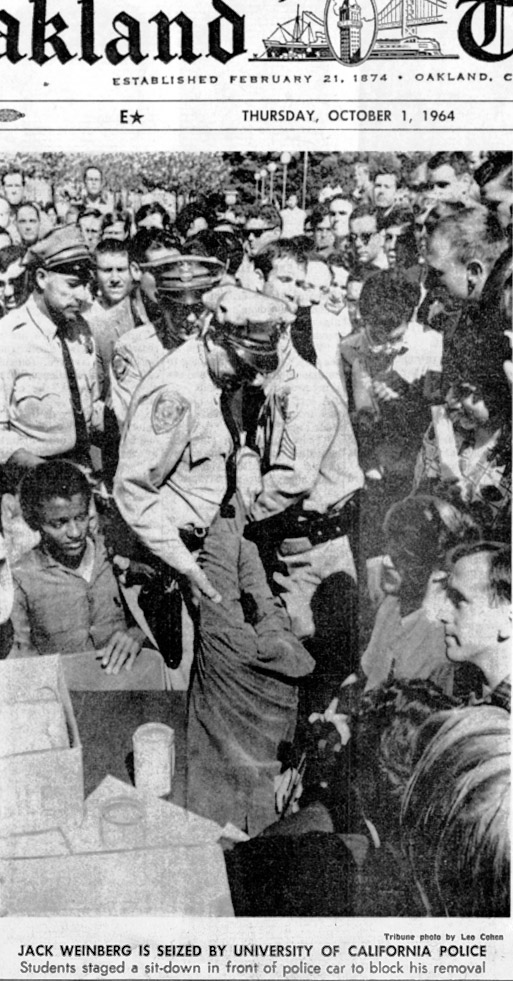
Source: Oakland Times, October 1st, 1964
- Based on these documents, what is one historical circumstance that led to the restriction of individual rights during the 1960s? [1]
Document 3
Berkeley Students Stage Sit‐In To Protest Curb on Free Speech
BERKELEY, Calif., Dec. 2—Demonstrating students took possession of the University of California administration building today.About 1,000 supporters of the Free Speech. Movement moved into the corridors of Sproul Hall about noon. Some were still there late tonight. Many slept and others read while still others sang. There was no attempt by the campus police,to remove them.
The doors to Sproul Hall were locked at 7 P.M., Pacific standard time (10 P.M., Eastern standard time), as is customary, with many of the demonstrators still inside. Guards at the doors permitted those who wanted to to leave, and a steady stream of departures joined a crowd of about 1,000 outside.
“The time has come for us to put our bodies on the machine and stop it,” said Mario Savio, a student leader, in a speech on the steps of the building as the demonstration began. “We will stay until the police remove us.”
Mr. Savio, a philosophy major and a frequent speaker in the several months of demonstrations, rejected the plea of the student body’s president, Charles Powell, not to demonstrate further. Mr. Powell had pleaded with a crowd of several thousand gathered in the plaza by the modernistic Students’ Union Building “do not do this thing.”
Joan Baez, the folk singer, helped draw the crowd, as she has at other demonstrations on the campus.
- Based on this document, what is one effort made by the students to raise awareness of the freedom of speech. [1]
Document 4a
“We organized sit-ins, rallies, and teach-ins, using every creative method we could think of to get our message across. It wasn’t just about protesting; we held discussions, wrote flyers, and even created art to express our beliefs. Each action brought more students together, and we realized our collective voices could make a real impact. We were challenging the system, and it felt powerful.”
Document 4b
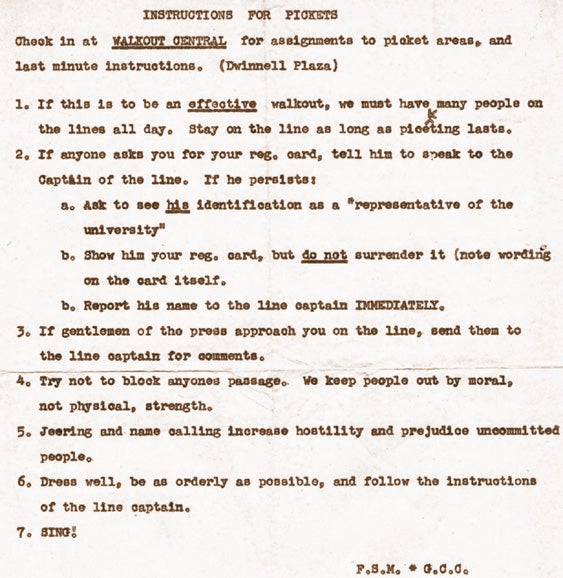
Instructions for Pickets: transcription
INSTRUCTIONS FOR PICKETS
Check in at WALKOUT CENTRAL for assignments to picket areas, and last minute instructions. (Dwinell Plaza)
- If this is to be an effective walkout, we must have many people on the lines all day. Stay on the line as long as picketing lasts.
- If anyone asks you for your reg. card, tell him to speak to the Captain of the line. If he persists:
- Ask to see his identification as a "representative of the university"
- Show him your reg. card, but do not surrender it (note wording on the card itself.
- Report his name to the line captain IMMEDIATELY.
- If gentlemen of the press approach you on the line, send them to the line captain for comments.
- Try not to block anyones passage. We keep people out by moral, not physical, strength.
- Jeering and name calling increase hostility and prejudice uncommitted people.
- Dress well, be as orderly as possible, and follow the instructions of the line captain.
- SING!
F.S.M. * G.C.C.
Source: Instructions for Pickets, unsigned. Undated (probably December 4 or 5),
- Based on this document, what is one effort made by the students to raise awareness of the freedom of speech. [1]
Document 5
The “People of the State of California v. Mario Savio” (1965) case arose from the events at UC Berkeley, where Savio was a prominent leader in the FSM.
In this case, the California Supreme Court ultimately upheld the students’ right to engage in free speech on campus, reinforcing the idea that universities could not impose overly restrictive regulations on political activities. The court recognized the importance of academic freedom and the necessity for students to express their views and engage in political discourse.
- How did the decision in “People of the State of California v. Mario Savio” impact individual rights? [1]
Document 6
The Free Speech Movement (FSM) established a powerful legacy of civil disobedience that has influenced countless social movements since the 1960s. Activists, inspired by the tactics used during the FSM, employed nonviolent resistance strategies such as sit-ins, marches, and protests to challenge authority and advocate for their rights. These methods highlighted the effectiveness of collective action in drawing attention to injustices and mobilizing public support. The FSM demonstrated that peaceful yet determined resistance could disrupt the status quo and lead to meaningful change. This approach not only galvanized students across the nation but also set a precedent for future movements, including the anti-war protests, the women’s rights movement, and LGBTQ+ activism. By showcasing the power of grassroots organizing and nonviolent protest, the FSM reinforced the idea that individuals could challenge oppressive systems and advocate for social justice through collective, peaceful action.
- According to Michael Anderson, what is one impact of the efforts of the Free Speech Movement? [1]
1.4 Student Facing Materials
The Free Speech Movement and Campus Speech in the 21st Century
1. Background Information: The Free Speech Movement (1964)
The Free Speech Movement (FSM) was a college campus phenomenon inspired first by the struggle for civil rights and later fueled by opposition to the Vietnam War. The Free Speech Movement began in 1964, when students at the University of California, Berkeley protested a ban on on-campus political activities. The protest was led by several students, who also demanded their right to free speech and academic freedom. The FSM sparked an unprecedented wave of student activism and involvement. ...the center of the activity on the UC Berkeley campus was in Sproul Plaza… In defiance of the ban on on-campus political activities, graduate student Jack Weinberg set up a table with political information and was arrested. But a group of approximately 3,000 students surrounded the police car in which he was held, preventing it from moving for 36 hours. Photographs show Weinberg in the car, both Mario Savio and Jack Weinberg on top of the surrounded car speaking to the crowd, and the car encircled by protesters and police. Through civil disobedience, knowingly violating campus rules, Berkeley students successfully challenged restrictions on student speech and gave rise to an era of vibrant student protest during the socially and politically turbulent era of the late 1960s and early 1970s.
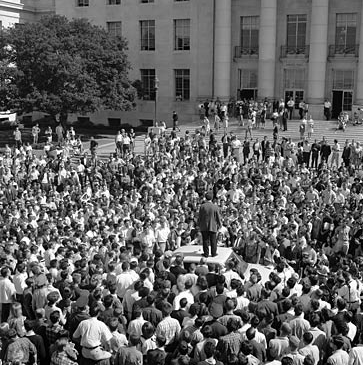
(Source: “The Free Speech Movement,” Calisphere, University of California, accessed February 13, 2019, https://calisphere.org/exhibitions/43/the-free-speech-movement/#overview.)
Questions:
- What actions led to the Free Speech Movement at UC Berkeley?
- What was the result of the Free Speech Movement? Why did students involved consider it a victory?
- Why might students in the 1960s have considered speech a right that needed to be protected?
2. Mario Savio: Quotes on Free Speech
“We are asking that there be no, no restrictions on the content of speech save those provided by the courts… And people can say things in that area of freedom which are not responsible… we’ve finally gotten into a position where we have to consider being responsible, because we now have the freedom within which to be irresponsible. And I’d like to say at this time…I’m confident that the students and the faculty of the University of California will exercise their freedom with the same responsibility they’ve shown in winning their freedom.”
“We will never intentionally bring disgrace upon this our university. By our words and actions we will endeavor to honor the ideals of those who have come before us, and to deepen and strengthen this community in which we are privileged to speak.”
“Here is the real contradiction: the bureaucrats hold history as ended. As a result significant parts of the population both on campus and off are dispossessed, and these dispossessed are not about to accept this ahistorical point of view…. The university is the place where people begin seriously to question the conditions of their existence and raise the issue of whether they can be committed to the society they have been born into. After a long period of apathy during the fifties, students have begun not only to question but, having arrived at answers, to act on those answers. This is part of a growing understanding among many people in America that history has not ended, that a better society is possible, and that it is worth dying for.”
“The most beautiful thing in the world is the freedom of speech… those words are…burned into my soul, because for me free speech was not a tactic, not something to win for political [advantage].… To me freedom of speech is something that represents the very dignity of what a human being is.… It is the thing that marks us as just below the angels. I don’t want to push this beyond where it should be pushed, but I feel it.”
Discuss and respond to the following questions:
- How does Mario Savio describe the importance of Free Speech?
- What conclusions can you draw about the Free Speech Movement based on the ideas that Savio expressed?
- To what extent do you agree with Savio’s ideas about Free Speech? Explain your answer.
3. Group Work: Berkeley Student Testimony
In 1967, three years after the Free Speech Movement protests on Berkeley’s campus, the 800 students who were arrested for unlawful assembly and trespass when they occupied Sproul Hall during the 1964 protest came to trial. Judge Rupert Crittenden, who presided over the first trial, requested that the students write letters explaining their involvement in the Free Speech Movement and the occupation. Crittenden expected the students to write apology letters, but many used the opportunity to explain and justify their actions. In this activity, you will read a selection of the students’ letters and decide, based on their explanations, whether you think their actions were justified.
Step 1: Individual Work
Each member of the group will be responsible for reading one Berkeley student letter. After you read the letter, on a scale of 1-5 (1= Not at all justified; 5= Extremely justified) rate the extent to which you believe the student’s actions during the Free Speech Movement were justified. Use the space below to explain your rating, including evidence from the letter and your knowledge of the Free Speech Movement and the protests of the 1960s.

Step 2: Collaborative Work
Each member of the group will share their individual rating and reasons for that rating. Considering the explanations and decisions of every member of the group, discuss your positions on whether or not the Berkeley student protesters were justified and come to consensus on your group’s decision. You might decide that the actions were completely justified or not at all justified, or you might be in the middle, believing that the students’ actions were justified in some ways but not others. This is not a yes/no question! Your group’s statement should represent where you stand as authentically as possible. Once you arrive at consensus, create a statement that represents your decision and share it in the box below. Include at least one piece of evidence from each of the letters you read.
We believe that the Berkeley students were/were not justified because…
Selection of Student Letters
Letter 1:
Your Honor: This letter is in reply to your request for a short statement regarding my reasons for actions I took leading to my arrest on December 2-3, 1964. My reasons for participating in non-violent civil disobedience were basically three. Primary among them was my great concern for the Civil Rights movement in the bay area. Next was my sincere belief that the formal protests lodged by the students in their attempt to insure the right of free speech and to protect individuals from being singled out for representing us all, were being totally and arbitrarily ignored by the administration. The third reason for my decision to disobey the law in favor of a higher law, is my concern for the rights of individuals under the Constitution of the United States. I felt that the right of the individual was being overlooked and in this case it was most important that it not be.
I would like to impress upon you the fact that my decision to break the law was not an easy one, and I am well aware that I must now face whatever retributive action is taken. Breaking the law is not a thing of which I am proud. On the contrary, I regret that I was put in a position where the choice was necessary. However, regardless of the consequences, I felt then, and still do feel that what I did was necessary. I hope that you will accept my apologies, but understand that I was trying, just as were the forces which arrested me, to uphold the laws of my country which are very dear to me.
In case it might make any difference in your decision concerning my sentence, I would like to bring to your attention that I have been accepted into the VISTA program and I shall enter it as soon as I know when I shall be available.
Letter 2:
I participated in civil disobedience in Sproul Hall in early December of 1964 because I felt that the Administration of the University of California had left open no other path. I believed that negotiations should come first — and they were attempted. Yet the Administration constantly showed such intransigence throughout the semester in relation to the question of student freedoms and political rights that the negotiations were never successful. I would not have supported any violent action, and none was over taken by the students. To believe in civil disobedience as an ultimate and final approach to an otherwise unsolvable problem is not wrong, rather it is noble. I will always hold in the highest regard all of those people who sat in with me that day. Our civil disobedience alerted the entire academic community to the wrongs being perpetrated against us. The faculty and some of the Administration recognized our grievances and respected our position. The student body was almost entirely with us. I would do it again if a similar situation arose where liberties granted to us by our Federal Constitution were being violated, and there remained no other alternative route to justice.
Letter 3:
Your Honor: I sat in at Sproul Hall on December 3, 1964 because I felt that said action was a legitimate expression of our right to petition the University for redress of grievances. I was attempting to persuade the Administration to change their unfair and unconstitutional rules governing political action and advocacy on the Berkeley campus.
Letter 4:
After I was asked in October to represent the University Church Council on the executive committee of the Free Speech Movement, I began to follow the developments in the campus dispute very closely and to do promotional work among the campus religious communities for the objectives of the FSM. I backed the movement from the beginning because I felt that this incident was one of many by the bay area power structure to curb the direct action activities of civil rights groups. It seemed very likely that those interests which were hurt by this activity could be in a position to put pressure on the University to “keep these kids out of trouble.” This seemed especially likely in view of the constitution of the board of Regents. When the political and religious groups who considered that their first and fourteenth amendment rights had been impinged upon by the school administrative rulings, formed the FSM organization in order to petition the University to cease its unlawful activities, the administration used every possible means to threaten or blackmail the students into silence. When it became quite clear that the administration would remain unwilling to respond to the legitimate rights and leaders were continually being singled out for punishment, it appeared that the only course of action left was to so embarrassed the University by the adverse publicity acquired by the sit-in that it would be forced to consider seriously and responsibly the student demands.
We may have been successful, if so the sit-in was justified. The trespass law that we were charged with breaking was insignificant in view of the democratic right that we had been denied. We were right, unfortunately we were found guilty of trespassing.
Those of us who went limp did so because we refused to cooperate in this evasion of the real question involved, that of constitutional rights, to that of the illegality of students in protesting against their own university in their own university. I also went limp because I could not cooperate with the officers whose attitude was shameful, brutal and stupid.
These were my reasons for participating in the Free Speech Movement, perhaps less clear are the reasons why a trial should be conducted in a civil rights case in almost complete disregard of the relevant political issue — Free Speech.
Letter 5:
Honorable Rupert Crittenden: The reason I sat-in at Sproul Hall on December third of last year was my belief that this action was the only means of protest left those students who believed the fund and membership solicitation ban as being improper. I believed that all legitimate means of petitioning grievances had been used and that civil disobedience in the form of a demonstration was the only tactic left available. I sat-in realizing my civil disobedience and the probable results, but I considered my actions as part of a political tactic and not for the purpose of disrupting the University.
Letter 6:
Dear Judge Crittenden:
My decision to participate in the Sproul Hall sit-in was not an easy one to make and it took me quite awhile to reach this decision.
Actually, from the beginning I was in accord with the aims of the Free Speech Movement. I deplored the action of the Administration in abridging the civil liberties I thought each citizen was entitled to; liberties we had enjoyed on campus with no interference for some time.
However, my concern was with the methods being used, since I had never before participated in any protest action. Therefore, when the incidents prior to the Sproul Hall sit-in occurred, I was just a watchful bystander. It took me two and one half months of debating with myself, discussing it with friends, reading up on the controversy, and thinking it through before I decided that morally there was nothing else to do but commit myself at that point.
I was helped along in my decision not so much by the Free Speech Movement actions and speeches, but rather by the actions of the Administration. By the latter’s complete mishandling of this whole unfortunate incident, and mostly by their refusal to leave open legitimate channels of communication between students and the Administration, I sincerely felt that they had actually forced the sit-in upon themselves.
When I realized that the Administration had failed to consider the Faculty Committee report seriously (which was favorable to the students’ requests), and was going to suspend the several students it had formerly given its word not to suspend, I honestly felt I must take my first stand. And so I sat-in for at this point I saw no other alternative except a dead end. It was either sit-in and try to uphold the principles of American freedom I so dearly believed in or give up completely, go home, and forget that any injustice to American democracy had occurred.
This might sound a bit dramatic to one not so intimately involved in campus life, but for me Cal was and is the most important part of my life at the present time. It was a terrible blow to me as a naturalized citizen who cherished the principles of American freedoms so much, to see a great university which I had respected so much try to steal these rights. I felt our FSM had to succeed for if this kind of abridgement of rights could occur in an institution of learning such as Berkeley, there was no telling where it could spread.
Therefore, I let myself be put under arrest. Something that I greatly wished to avoid. Something that I am sure most of us were terrible, terribly unhappy about.
The Sproul Hall sit-in, the subsequent arrests, and all the trouble on campus were very regrettable occurrences. Had I thought there was another solution, I would have tried that rather than sit-in. Yet, in the final analysis, I feel the Administration left us no choice.
4. Presentation Notes
| The Berkeley students were justified because: | The Berkeley students were not justified because: |
|---|---|
5. The Verdict!
Based on all of the evidence presented and discussed, the Berkeley students were/were not (circle one!) justified in occupying Sproul Hall in 1964. I enter the following evidence in support of my verdict:
6. Extension Activity: Berkeley and Columbia Policies on Student Expression
Berkeley
A Message on the Proposed Solution to the Free Speech
Controversy (December 8, 1964)
From: Faculty Members of the University of California at
Berkeley
To: Colleagues and Friends in the State-wide University,
Members of Other Colleges and Universities, Fellow Citizens
On December 8, 1964, the Academic Senate (Berkeley
Division) of the University of California proposed a solution
to the current free speech controversy. By a vote of 824
to 115, the Senate, which is composed of faculty, deans,
and directors, endorsed five propositions presented by its
Committee on Academic Freedom.
The propositions are as follows:
1. In order to end the present crisis, to establish the
confidence and trust essential to the restoration of normal
University life, and to create a campus environment that
encourages students to exercise free and responsible
citizenship in the University and in the community
at large, the Committee on Academic Freedom of the
Berkeley Division of the Academic Senate moves the
following propositions:
2. That there shall be no University disciplinary measures
against members or organizations of the University
community for activities prior to December 8 connected
with the current controversy over political speech and
activity.
3. That the time, place, and manner of conducting political
activity on the campus shall be subject to reasonable
regulation to prevent interference with the normal
functions of the University; that the regulations now in
effect for this purpose shall remain in effect provisionally
pending a future report of the Committee on Academic
Freedom concerning the minimal regulations necessary.
4. That the content of speech or advocacy should not be
restricted by the University. Off-campus student political
activities shall not be subject to University regulation. On-
campus advocacy or organization of such activities shall
be subject only to such limitations as may be imposed
under section 2.
5. That future disciplinary measures in the area of political
activity shall be determined by a committee appointed by
and responsible to the Berkeley Division of the Academic
Senate.
6. That the Division urge the adoption of the foregoing
policies and call on all members of the University
community to join with the faculty in its efforts to restore
the University to its normal functions.
Columbia
Columbia New Rules on Expression (2024) [excerpted]
The University recognizes only two kinds of limitations
on the right of freedom of expression, and both are to be
narrowly construed.
First, the University reasonably regulates the time, place,
and manner of certain forms of public expression. In
keeping with the University’s dedication to the principle of
uninhibited discourse, these regulations do not turn on the
content of any message that might be expressed. Rather,
they are necessary not because they would prevent any
opinion from being stated or heard, but, to the contrary,
because they protect the rights of free speech, free press, and
academic freedom…. The right to demonstrate, for example,
cannot come at the expense of the right of others to counter-
demonstrate, to teach, or to engage in academic pursuits
requiring uninterrupted attention….
Second, the University may restrict expression that
constitutes a genuine threat of harassment, that
unjustifiably invades an individual’s privacy, or that falsely
defames a specific individual….
1. A person is in violation of these Rules when such person
individually or with a group, incident to a demonstration,
including a rally or picketing:
(1) (simple violation) engages in conduct that places
another in danger of bodily harm;
(2) (serious violation) causes or clearly attempts to cause
physical injury to another person;
(3) (simple) uses words that threaten bodily harm in a
situation where there is clear and present danger of such
bodily harm;...
(5) (simple) causes minor property damage or loss, or
endangers property on a University facility;
(6) (serious) misappropriates, damages, or destroys books
or scholarly material or any other property belonging to
the University…
(7) (simple) interferes over a short period of time with
entrance to, exit from, passage within, or use of, a
University facility but does not substantially disrupt any
University function;...
(9) (serious) enters or remains in a University facility
without authorization at a time after the facility has
been declared closed by the University; (Comment: The
University shall make all reasonable attempts to publicize
this declaration to the fullest extent possible.)...
(11) (serious) holds or occupies a private office for his own
purposes;…
(14) (serious) disrupts a University function or renders its
continuation impossible;
(15) (serious) illicitly uses, or attempts to use, or makes
threats with a firearm, explosive, dangerous or noxious
chemical, or other dangerous instrument or weapon;
(16) (simple) fails to self-identify when requested to do so
by a properly identified Delegate;...
(18) (simple) fails to obey the reasonable orders of a
properly identified Delegate regulating the location
of demonstrators or others within the vicinity of a
demonstration to assure unimpeded access to or
use of a facility or to avoid physical conflict between
demonstrators and others;...
(20) (serious) fails to disperse from an assembly upon
order of a properly identified Delegate when such order
results from serious violations of these Rules by members
of the assembly and the Delegate so states in his order to
disperse.
| Berkeley | Columbia |
|---|---|
| Main Ideas/Key Points of this Policy: | Main Ideas/Key Points of this Policy: |
| To what extent does this policy effectively respond to the respective campus protests and circumstances surrounding those protests? | To what extent does this policy effectively respond to the respective campus protests and circumstances surrounding those protests? |
| To what extent does this policy protect students’ rights? | To what extent does this policy protect students’ rights? |
| What are the differences between the original policy and your edited policy? | What are the differences between the original policy and your edited policy? |
| How might your edited policy preserve students’ rights and/or ensure that all students’ needs are met (including those who don’t participate in protests)? | How might your edited policy preserve students’ rights and/or ensure that all students’ needs are met (including those who don’t participate in protests)? |
- “Free Speech,” UC Berkeley, accessed October 13, 2024, https://www.berkeley.edu/free-speech/. ↩︎