
How do university administrators respond to incidents of hate speech on campus?
What is the issue?
In the wake of the 2016 presidential election, college campuses experienced a rise in hate speech: expressive communication used to threaten, demean, abuse, and ultimately provoke hatred against minoritized populations. These incidents harm students of color and other marginalized populations.
While university administrators cannot censor or prevent these incidents from happening, how they respond remains politically contested. Political actors, for example, invoke the First Amendment to frame university responses as overreach that tramples individual liberties and conservative viewpoints rather than as efforts to promote racial inclusion. In this political environment, colleges face profound challenges for promoting racial inclusion.
We asked: How do university administrators negotiate and institutionalize principles of open expression and inclusion as they respond to hate speech incidents amid external pressures and constraints?
What have we learned?
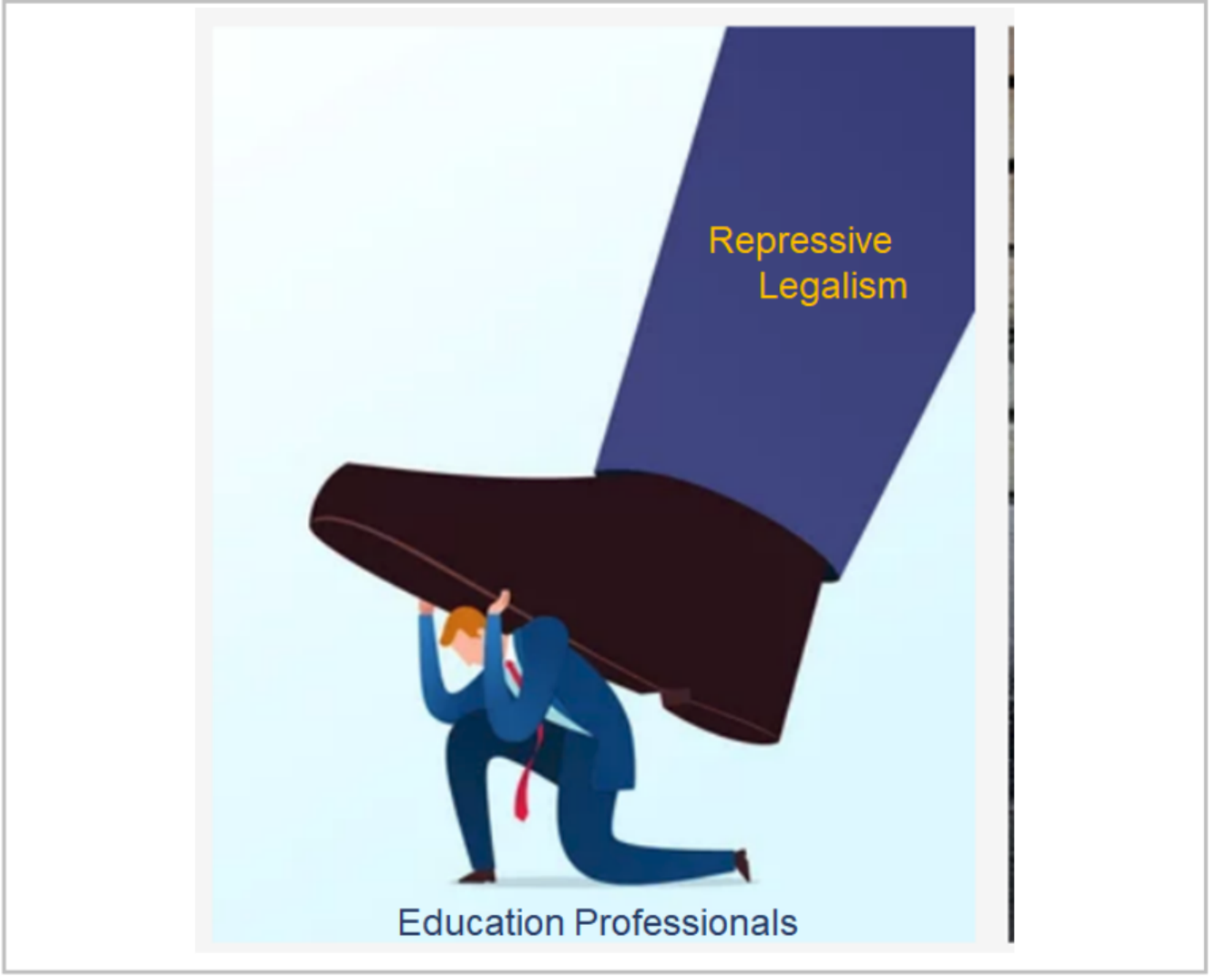
The study revealed an under-explored, but prevalent dynamic undermining racial equity and inclusion in education: how administrators’ perceptions of the legal environment, including advocacy organizations that threaten litigation or legislators that propose restrictive bills, shape their actions to undermine racial inclusion. We termed this dynamic "repressive legalism."
In the aftermath of hate speech, many students of color felt unsafe and unable to focus on academics. They wanted administrators to openly acknowledge this harm and to help the campus community connect these incidents to systemic racism. Students believed these legally permitted administrative responses would help restore their sense of safety. Many administrators saw the value in these responses, but were concerned that advocacy organizations or a conservative legislature would deem them as not "neutral" and as "chilling" the speech of alleged perpetrators of hate speech. Concerned about the threat of lawsuits or restrictive legislation, they did not engage in these lawful responses. Administrators’ acquiescence to these coercive pressures—at the cost of inclusion-promoting responses and their professional judgment—represents “repressive legalism."
Who should know and what should they do?
Researchers, educators, and practitioners across K-16 education sectors can use the concept of repressive legalism to illuminate areas where external coercive pressures from the legal environment shape perceptions and unnecessarily constrain actions that promote inclusion.
Civil Rights groups and education and policy organizations should build coalitions with education professionals and help provide cover from external political pressures. These organizations should issue their own messaging and legal guidance to counteract the effects of repressive legalism and ensure university administrators are equipped with the knowledge to act in the best interests of their students and institutional mission.
To advance the mission of higher education, in the aftermath of hate speech-related incidents, university administrators should center the physical, emotional, and academic needs of students of color and others who are harmed. Universities should advance educational initiatives and curricula that focus on improving understandings of social oppression for campus communities, including the extended and violent history of White supremacy in the U.S. and its relationship to higher education and hate speech.
Limitations/Caveats
This study took place at a public university that faced legal challenges and a conservative legislature. This context provided fertile ground for exploring the research question but may limit the portability of findings to other public institutions with different contexts or at private colleges. Future research should examine how the dynamic of repressive legalism may manifest in other contexts and in relation to other educational topics.
Acknowledgments and contributions
This study was generously funded by the Spencer Foundation. The findings represent the perspectives of the authors alone. This research and communication of findings would not have been possible without co-authors, thought partners, and research team members (past and present): Brianna Davis Johnson, Dwuana Bradley, Ellen Berrey, John Roberts, Eliza Epstein, Lesley Hernandez Silva, Nicole Ngaosi, and Noor Khalayleh. We are also deeply indebted to the 16 administrators and 28 student leaders of color who participated in the study.
Explore more about this project
Garces, L. M., Johnson, B., Ambriz, E., & Bradley, D. (2021). Repressive legalism: Understanding how university administrators’ responses to hateful incidents on campus relate to inclusion policy. American Educational Research Journal. https://doi.org/10.3102/00028312211027586
Garces, L. M., Ambriz, E., Johnson, B., & Bradley, D. (2022). Hate speech on campus: How student leaders of color respond. Review in Higher Education. https://muse.jhu.edu/article/848616
Garces, L. M., Ambriz, E., & Pedota, J. (2022). Legal challenges to bias response teams on college campuses. Educational Researcher. https://journals.sagepub.com/doi/10.3102/0013189X221088307
Fernandez, F. & Garces, L. M. (2023). The influence of repressive legalism on admissions. In O. Poon. & M. N. Bastedo (Eds.). Rethinking College Admissions: Research-Based Practice and Policy. Harvard Education Press.
Garces, L. M. (June 21, 2023). Two cautions for educators to consider in the aftermath of affirmative action decisions. Ed Trust, https://edtrust.org/resource/two-cautions-for-educators-to-consider-in-the-aftermath-of-affirmative-action-decisions/
Explore more about this topic
American Council on Education. (2018). Campus Inclusion and Freedom of Expression: Hateful Incidents. https://www.acenet.edu/Documents/To-The-Point-Hateful-Incidents.pdf
PEN America. (n.d.). How to respond to expressions of hate on campus. https://campusfreespeechguide.pen.org/resource/how-to-respond-to-expressions-of-hate-on-campus/
Ben-Porath, S. R. (2017). Free speech on campus. University of Pennsylvania Press.
Chemerinsky, E., & Gillman, H. (2017). Free speech on campus. Yale University Press.
Cole, E. R., & Harper, S. R. (2017). Race and rhetoric: An analysis of college presidents’ statements on campus racial incidents. Journal of Diversity in Higher Education, 10, 318–333. http://dx.doi.org/10.1037/dhe0000044
Miller, R. A., Guida, T., Smith, S., Ferguson, S. K., & Medina, E. (2017). Free speech tensions: Responding to bias on college and university campuses. Journal of Student Affairs Research and Practice, 55(1), 1-13. https://doi.org/10.1080/19496591.2017.1363051
Contact Information
Liliana M. Garces, Ed.D., J.D. (liliana_garces@utexas.edu)
Jaqueline Pedota (jpedota@utexas.edu)
Evelyn Ambriz, Ph.D. (ea229@cornell.edu)
Suggested Citation
Garces, L.M., Pedota, J., & Ambriz, E. (2023). How do university administrators respond to incidents of hate speech on campus?