
Principles Before PR: Rebuilding Trust and Protecting Free Expression with University Communications
1. Introduction
In December 1915, the American Association of University Professors published its founding Declaration of Principles, a manifesto defining and defending academic freedom. More than just an argument for faculty speech rights, the declaration outlines the ideal relationship between a university and the public — and how universities must maintain public trust.
According to the declaration, a university should be “an inviolable refuge” from the “tyranny of public opinion”; an “intellectual experiment station” that nurtures new ideas, conserves the best of the past, and calms public opinion with critical thought. The public must trust professors to practice “the disinterested expression of the scientific temper and of unbiased inquiry,” not simply teach “echoes of the opinions of the lay public.” Without that assurance, the university’s “proper influence on public opinion is diminished and vitiated.”1
That same month, employees of 10 midwestern colleges and universities met in Columbus, Ohio, to exchange ideas about publicity.2 They later founded the American Association of College News Bureaus.3 Although small, the organization engineered an impressive turnaround in public opinion, according to remarks by one journalism dean in 1942:
A quarter of a century ago colleges were looked upon to some extent as being a thing apart from the democratic, American way of life. … Today the college student and the college graduate are part of the warp and the woof of every day life and the college is imbedded [sic] deeply with the ideal of democratic life—in fact cannot be separated from our other important social institutions.
How has this most desirable result been accomplished? Largely through the efforts of the college publicity men and women telling the American people about the true aims, purposes and objectives of the colleges…4
Universities in 2026 find themselves in another 1915 moment. Public confidence in universities has fallen in the past decade. Brazen attacks on academic freedom and campus expression dominate the news cycle on a regular basis. The enrollment cliff, combined with growing apathy about college degrees, is already here.
Just like in 1915, universities hope that marketing will make Americans trust them again. A 2026 Inside Higher Ed poll found that the dominant approach universities are using to rebuild public trust is “stand-alone public relations and marketing—messaging about the value of the institution to the broader community and about individual student return on investment.”5
However, topics such as community impact and value are not new to university publicity campaigns, and no one would argue that universities had paused their public relations in the 2010s. Americans’ confidence in universities plummeted despite ongoing public relations efforts, not for any lack of them. To regain and keep public trust, university communicators need to understand why past public relations efforts failed to prevent the trust crisis — or even contributed to it.
This report explores how university public relations failed to stop the erosion of public confidence. It begins by discussing the proper relationship between the university and the public, contrasting the ideas of two scholars who critiqued universities in the decades when public relations became a prominent campus activity. One of these scholars emphasized pleasing the public — serving the community and avoiding controversy — while the other urged radical independence and academic freedom. Elements of both approaches are found in university public relations today, but the concept of pleasing the public may be dominant.
Next, the report examines data reflecting confidence in universities, finding universities maintained high esteem in the public long after trust in other institutions had declined. Confidence in higher education fell only in the mid-2010s; confidence also became politically polarized, with conservatives trusting universities much less. Among those with the lowest confidence, the belief that universities are driven by political ideology is the most cited reason. While some commentators dismiss this concern as the result of right-wing propaganda, that dismissal places universities in a powerless position with little they can do to regain trust. This report explores whether the communications published by universities contributed to these political perceptions, and therefore whether universities can communicate more effectively.
Ten university communications leaders were interviewed for this report to learn more about how universities have made public relations decisions during the 2010s and 2020s. According to these interviews, communicators prioritize strengthening the reputation of their institutions, and in the current environment they often feel the need to protect the institution. Most of them have been involved with free-speech controversies, when their universities were pressured to (or actually did) restrict campus speech, but several of them strongly believe that their universities need to support free expression to improve civic engagement and trust.
During the 2010s, these communicators and their senior leaders faced pressure from faculty, students, alumni and other groups who wanted universities to make statements on political and social issues. When they yielded to this pressure, the number of requests increased, such that universities got into the practice of making statements on many issues unrelated to university business. Around 2023, many of these universities began developing policies to curtail the practice of making statements.
While they faced pressure to speak out on political issues, universities dramatically increased their public communications about diversity, equity and inclusion (DEI). Two separate analyses of DEI language on university websites show that this language increased as these concepts became more popular among some social and political classes, and especially when the Biden administration emphasized them, only to retreat from this language quickly when the Trump administration announced anti-DEI policies. DEI language became intertwined with politics even as universities used the language more.
The history of university statement-making and the data on DEI language show how university communications and public relations activities yielded to pressure from various sources, even adopting language and viewpoints from those who applied pressure. This may have strengthened the perception that universities are politically biased, but it also may have created confusion about the mission of higher education, as though the university should reflect the views of individuals or groups exerting pressure on them.
In June 2026, the American Association of Colleges and Universities released “The Trust Agenda,” a report outlining five recommendations to help higher education regain public trust.6 Two of those recommendations — “Tell a clearer story” and “Coordinate a mission-centered defense” — relate directly to the subject and recommendations of this report. Universities have a good story to tell about how they help individuals and society through education, research and artistic enrichment. Their missions thrive amid teaching, research and discourse unfettered by political micromanagement. Both the story and the mission can be overshadowed by political perceptions, especially when politics cloud a university’s public messages.
This report aims to help universities tell a clearer story and defend their missions through communications work and principles-first public relations. It highlights where university communications may have placed pleasing the public above some of higher education’s founding principles. The final section highlights ideas for putting those principles first.
Most discussions about free expression and public trust in universities focus on what happens in the classroom and on the quad. This is one of the first reports to focus on what happens in the communications office and the role that public relations leaders can play. Managing a university’s public relations in a polarized political climate presents unique challenges. It can be tempting to try establishing trust by stifling expression — hiding courses, research and other campus expression that may offend some members of the public. But by placing principles before PR, university communicators can help steel their institutions against attacks on their independence.
2. How Should a University Relate to the Public?
The Public Relations Society of America defines “public relations” as “a strategic communication process that builds mutually beneficial relationships between organizations and their publics.” The practice means “influencing, engaging and building a relationship with key stakeholders to contribute to the way an organization is perceived.”7
Therefore, public relations involves much more than press releases, billboards, TV commercials and magazines. A public relations strategy builds and defines relationships. A university’s public relations approach tells the public not only what the university is saying, but what relationship the university aspires to.
The AAUP 1915 Declaration of Principles envisioned universities serving as a source of scientific truth without restrictions. “In a democratic society,” it states, a university’s role “is to help make public opinion more self-critical and more circumspect, to check the more hasty and unconsidered impulses of popular feeling, to train the democracy to the habit of looking before and after.”
As the university public relations profession grew in the decades after the 1915 Declaration, competing philosophies emerged about how this relationship could be realized. Universities could aim to please the public — staying in the good graces of voters and politicians — or they could assert and earn radical independence. This section explores these two concepts from the perspective of two scholars who critiqued university public relations and discusses the practicality of each.
2.1 Please the Public
In the 1930s8 and 1940s,9 a UCLA political science professor named Charles H. Titus began advocating for more comprehensive public relations by universities. He noted that “pressures” were affecting universities from multiple angles: parents wondering about the economic return of a degree, alumni pressing for exciting football games, activists pushing ideology,10 and politicians cutting budgets.
As these pressures threatened higher education, “members of the public will either continue to give us spiritual and moral support, protecting education from extremists, or they will remain silent, allowing the wolves to howl and possibly destroy,” Titus wrote.
Titus’s vision for public relations started with public service by faculty and publicity campaigns about a university’s value to society — pieces of almost any university’s activities today. But he also proposed limiting free expression. Faculty speech presented many “opportunities for … damaging the reputation of the institution,” especially when professors commented on politics. He suggested “a somewhat narrower or restricted definition of academic freedom” forbidding faculty from speaking outside their fields. In contrast, the AAUP has long defended the right to “extramural utterances.”
Titus also called students “ambassadors of the college” whose behavior — such as on-campus parties, reckless driving or lack of courtesy while correcting older coworkers off campus — could make or break a school’s reputation.
You could call his approach “Please the public,” though he may have preferred “Serve the public.” His philosophy of public relations recognizes that the university cannot stand aloof as an impenetrable ivory tower. In order to earn and keep the public’s support, the university must ensure it benefits the public. To Titus, limiting expression to please the public would protect the core of academic freedom in the long run.
2.2 Radical Independence
Robert M. Hutchins, president and chancellor of the University of Chicago during that era, presented an alternate approach we could call “Radical independence.” According to Hutchins, universities spent too much time and energy fixating on public opinion. “The present primacy of public relations in the management of universities,” especially “the view that they must ingratiate themselves with the public, and in particular with the most wealthy and influential portions of it, … these notions are ruinous to a university.”
To Hutchins, a “true university” is a “center for independent thought.”11 Therefore, public opinion must not restrain academic freedom. The faculty should be “a group set apart to think independently and to help other people to learn to do so,” therefore “it is fatal to force conformity upon it.” Even if outspoken professors angered the public, Hutchins argued, the sacrifice was both worthwhile — and probably temporary; public opinion may swing in the faculty’s favor. Perhaps that is why Hutchins warned universities against pandering to fickle public opinion. “The trouble with flattering the spirit of the age is that it may turn around and bite you.” 12
Hutchins also criticized universities that “will do … anything the society will pay for,” such as building glamorous sports teams or government-dictated academic programs:
Every time a university takes another step in the direction of the service-station conception, or the public-entertainment conception, or the housing-project conception of the higher learning, every time it makes a concession to public pressure in order to get money … it increases the confusion in the public mind about what a university is and makes it more difficult to present any rational appeal for the independence that true universities are entitled to.
For all these reasons, Hutchins believed that public relations must be secondary in university activities. Rather than formulate programs and policies to win public approval, universities should generate support for the policies that best support their missions.
2.3 Which Relationship is Right?
Both Titus and Hutchins recognized important realities about a university’s relationship to the public. Hutchins’ philosophy is closer to AAUP’s original vision: A university that is steered by the scholarly pursuit of truth, not public opinion. Such a university would earn the public’s support by doing that job well, not sacrificing that job to appease momentary demands.
But Titus was more realistic. Radical independence for faculty may offer unique benefits — especially for the faculty, but also for a society that needs unbiased, independent thought. But the public does not always want Socratic critique, so too much focus on independence could lead to a loss of public support. A university without a budget cannot devote resources to the pursuit of truth.
Universities today face challenges with both of these approaches. Because they rely on tuition, donations and government funding, the prospect of being unpopular political pariahs feels existential. But so does the idea of sacrificing academic freedom in order to shore up popularity and political approval. But between the two philosophies, “please the public” seems more dominant today. As we see in the next section, university communicators place a high priority on protecting the reputation of their institutions and publicizing how their institutions advance popular concerns. The lack of confidence in higher education provides little traction for independence. However, some university communicators also express ideals for free inquiry, academic freedom and rigorous debate on campus. This suggests that communicators can support greater independence both through campus policy and in their public relations.
3. University Communications, Public Trust and Free Expression
Most discussions of trust in universities, academic freedom and free speech center on what happens in classrooms and on the quad, not the communications office. But a university’s communications policies and practices affect free speech, academic freedom and civic engagement in several ways. An in-depth analysis of the research on these connections is beyond the scope of this report, but several points are useful for establishing a foundation for discussion in later sections.
First, university social media policies, which often guide how an academic unit or faculty members engage on social media, stress protection more than speech. One study found that three-fourths of social media policies emphasized protecting the university’s reputation and only one-third expound on the value of academic freedom or free expression.13 Faculty members reading such policies may be unsure whether the university will stand by them as they engage online.
Second, official university communications on issues may stunt open dialogue. One study found that a third of faculty at R1 institutions had avoided speaking out on topics if their views differed from an official university pronouncement, and half opted out of professional activities due to perceived misalignment. Non-tenured and non-white faculty were more likely to report these effects.14 In a way, a university that speaks out may discourage faculty from speaking out.
Third, despite the risk of chilling speech, universities may be pressured to speak out because some consumers look for political alignment or social advocacy when choosing a brand. For more than a decade, some marketing consultants have advised that brands such as universities must align themselves with progressive politics to earn the loyalty of Gen Z.15 This advice fails to capture that the generation is politically diverse and not entirely devoted to making purchase decisions based on politics. Still, the advice can cause pressure on a university’s message, especially when some students ask a university to take political positions.
Fourth, university communications and PR professionals tend to respect academic freedom, but they also face pressures to limit crises and protect the institution’s brand reputation.16 17 18 It can be tempting to limit expression in order to prevent or control a crisis. Universities often restrict media access on campus in ways that could decrease a faculty member’s ability to speak freely.19 While it makes sense to provide resources to help faculty engage well with the media, oversight can discourage free discourse.
The research on links between university communications, free expression and civic engagement shows that a university and its communications leaders may support academic freedom and free speech, but threats to a university’s reputation can lead to policies and practices designed to protect rather than foster free expression. University communications leaders interviewed for this report confirmed the prevalence of these tensions.
3.1 Perspective from University Communicators
For this report, anonymous interviews were conducted with high-level communications leaders at public universities in 10 states divided across three political contexts — red (Republican-leaning), blue (Democrat-leaning) and purple (moderate or swing states). Interviews focused on the goals and purposes of their work, their experience with public pressure to communicate in certain ways, and experience with campus free-speech controversies. These communicators will be identified by letters of the alphabet below.
Based on the discussions in interviews, an anonymous survey was developed to gather additional information from university communicators. The survey asked additional questions, including about the respondent’s political views, the political views of their campus, their perceptions about the trust crisis, and several topics also covered in the interviews. Only 22 respondents completed the survey, so its data is not representative and statistically significant. However, it does provide additional qualitative data revealing how at least some communicators think. The survey will be cited below where it provides interesting points.
Several common themes emerged in the interviews and the survey.
3.1.1 Story-focused
University communicators see their prevailing purpose as storytelling — conveying the stories of the university to shape public perceptions.20 Research impact dominates the perceptions they hope to create with storytelling, with other top perception goals being the value of higher education, public service and workforce development.
COMMUNICATOR J, at a school in blue state, but a red region with many conservative-leaning donors, remarked that storytelling can help people better understand the university:
The reason for thinking through a storytelling lens is that, you know, a lot of people have no understanding of what goes on [at a university]. It’s behind the black box. And I think right now, the fact that there is very little understanding of what goes behind the black box actually makes higher ed as a whole vulnerable.
3.1.2 Eager to Protect
COMMUNICATOR J was not the only interviewee to acknowledge higher education’s vulnerability. Several communications leaders mentioned that protecting the institution is an important part of their role. This was true in the survey, too, where “Protect the institution’s reputation” was rated between “Very important” and “Mission-critical.”
Sometimes the desire to protect the institution causes the university to alter its communications and limit what it communicates. COMMUNICATOR J repeatedly used the phrase, “protect the work” to describe controlling university communications to avoid backlash. “The higher good is to protect the institution and protect the work. And if that means … that there are things I’m not sharing, then I can live with that.”
COMMUNICATOR A (red state) noted the importance of selective storytelling: “As we tell the story, we’re also protecting the reputation of the university, depending on what stories we choose to tell. You know, some stories might actually challenge the reputation of the university. … We’re clearly selective as we think about telling the story.”
This communicator added that decisions about what to share begin with looking for alignment with the university’s core messages. Several communications leaders talked about core messages, some referring to binders or packets of information on their desks that listed those core messages. Those core messages tend to be aligned with the desired perceptions listed earlier.
3.1.3 Pressured to Communicate
All of the communicators discussed the pressure they face from university constituents: students, faculty, staff, administrators, alumni, donors, and politicians (local and national) may expect the university to communicate in specific ways and on specific topics. Other times, constituents may wish for the university to avoid certain communications, even those that may limit faculty expression.
Another section of this report will discuss the experiences communicators reported regarding these pressures. In summary, the communicators recall how pressure and requests from constituents led their universities to make statements on political and social issues. The practice became overwhelming and divisive, leading their institutions to cease the practice, often at the encouragement of the communicators.
Likewise, they have had to coordinate the removal of web pages and language related to diversity, equity and inclusion during the Trump administration. Although most of them disagreed with the requirement to remove this content, they stressed that their institutions comply with the law.
3.1.4 Supportive of Academic Freedom
The desire to protect the institution did not motivate the communications leaders to want to censor faculty or students. In fact, every communicator interviewed declared they would not stop a faculty member from speaking with a news reporter, even on controversial topics that may attract political disfavor. A few said they would hesitate, though, because such an interview could make the professor a political target.
For example, COMMUNICATOR G (purple state) said, “We’re not in the business of muzzling our faculty in that area, because, of course, part of our mission is to … advance knowledge and share knowledge with the broader community.” However, if a reporter requested a faculty expert to discuss transgender medicine, COMMUNICATOR G might not arrange the interview “as much as a concern for the faculty member’s welfare as [for] … the university’s reputation.”
3.1.5 Advocates for Free Speech
Most communicators interviewed had navigated free speech controversies, from controversial speakers, protests, attempts (sometimes successful) to get speakers canceled, conflicts between students and faculty, and more. For some, institutional support for free speech was a matter of compliance with law. But several communications leaders expressed strong, eloquent support for free expression and for standing up for the university’s culture of free speech.
COMMUNICATOR E (blue state) recalled a time he and his chancellor attended a lecture by a prominent Republican. Despite personal disagreement with the speaker’s politics, the chancellor intervened when students attempted to shout down the speaker. He insisted that the speaker be allowed to proceed. COMMUNICATOR E shared this as a defining moment that exemplifies what higher education should be:
The story that we try to tell is, the university is a place for the free and open exchange of ideas… and that we don’t put any kind of … prerequisite on what ideas are the correct ideas, or what ideas are the incorrect ideas. … We welcome any and all scholars who come to campus. If those scholars are controversial in some way to some aspect of the community, we defend the university as a place for the exchange of these kinds of ideas.
The criticism and the polarization is undeniable. But we’ve really leaned into — what is the university meant to be? It’s not meant to be a place that predetermines how people should view the world. It should give people the tools that they can make a critical assessment of what they see and how they see it. … If you sell out on that, then you’re lost as an institution.
COMMUNICATOR H (blue state) expounded:
We want students to build skill around critical dialogue, critique, critical thinking. … We think of that as core to our mission, as a land-grant institution. We exist to bring people from different viewpoints and backgrounds together on a college campus, to learn how to be in the same room with each other. And so, despite their political differences, and even across those political differences, there are some things that we can work towards and agree on.
These perspectives show potential for university communicators to help reinforce and champion campus policies that protect free expression. But this potential may be latent. Less than ⅓ of survey respondents said they had received any training related to free speech or academic freedom. A search for resources available from the Council for the Advancement and Support of Education (CASE) on case.org found no resources providing a rigorous overview of these topics, although CASE does advocate for academic freedom.
3.2 Review of Communicators’ Perspectives
These interviews show that university communicators are committed to telling the stories of their universities and ensuring that the stories shape a positive public image of their institution. They also want their stories to protect their universities and academic freedom, even if that protection requires limiting the stories the university shares so faculty can continue their work. In general, they recognize the importance of free expression not only for legal compliance, but for advancing the university’s mission of research and teaching. They want to present their universities in ways that inspire confidence so that the public will support, rather than threaten, the university’s academic mission.
Two other things they have in common are the crisis of falling trust in universities and rising political polarization. These forces require communicators to respond not only to existential threats on universities, but also to growing demands from a divided public, with different political camps each wanting to remake universities in their image. The next two sections of this report explore these challenges.
4. The Trust Crisis and its Causes
In July 2026, Gallup reported more bad news for universities: the percentage of Americans expressing a great deal of confidence in universities had slipped below 40% again.21 In 2015, nearly 60% had expressed high confidence, but the share who have very little or no confidence has more than doubled over the past decade.
This type of data has not been kept for long. Although Gallup and the General Social Survey (GSS) have asked about confidence in trust in other institutions, such as the government, the media and the military, for decades, 2015 was Gallup’s first year asking specifically about universities. This raises a question of whether the trust crisis is new, long-running, or cyclical. Was 2015 a high watermark for trust, or was it a midpoint in an enduring decline?
Although the question of confidence in universities only appeared on major surveys more recently, historic data show that Americans held universities in high esteem even after trust in many other institutions started to slip. It appears that the level of trust in 2015 was similar to that which was held more than a decade earlier. This section explores this data to illustrate when trust declined and how partisan differences appeared in the data. It also discusses how this lack of esteem affects universities.
4.1 Trust in University Research
In 2000, the GSS asked respondents how much they trusted university research centers to provide correct information about the causes of pollution. 61% of respondents said they had “a great deal” or “quite a lot” of trust, making universities the most trusted source included in that question.22 There was very little political difference in the answers. Those who described their politics as “extremely conservative” were just as likely as their “extremely liberal” counterparts to express high levels of trust. This demonstrates the broad, high level of trust in universities at the turn of the century.
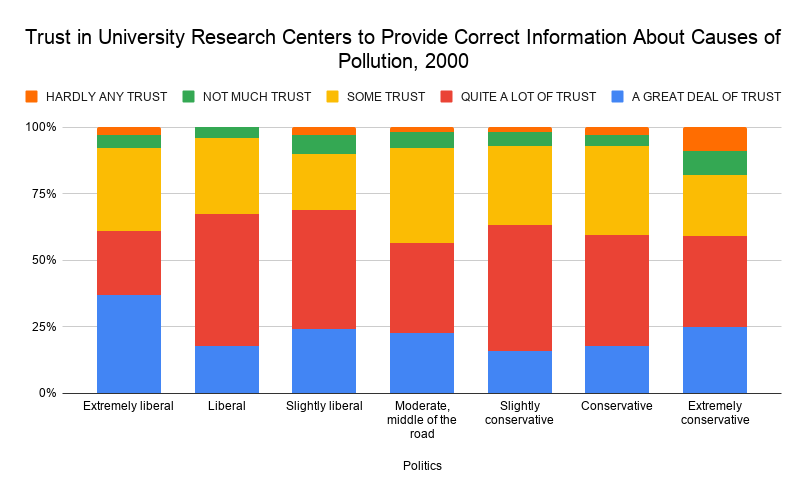
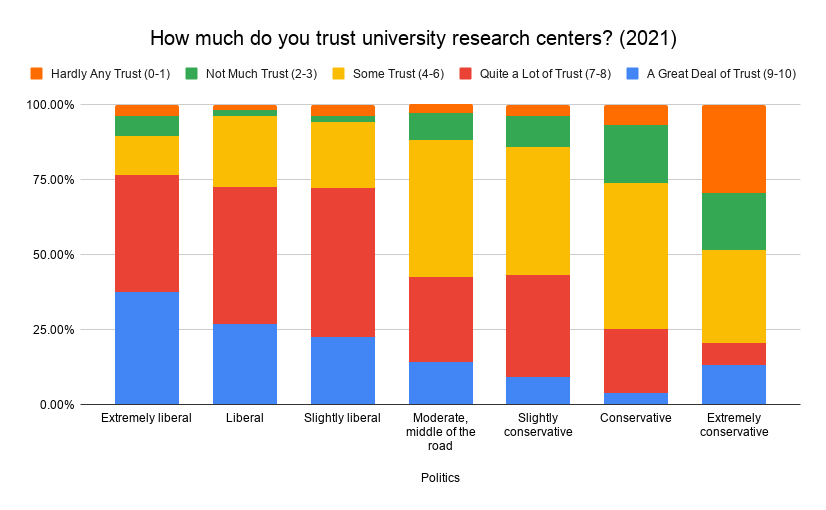
The picture changed dramatically by 2021, when the GSS asked a more direct question: “How much do you trust university research centers?”23 The new data show that fewer than 50% reported high levels of trust. Additionally, political polarization appeared. Those with liberal views reported more trust in university research centers than they had before, while conservatives and moderates reported less. Only about 20% of extreme conservatives showed high trust in research centers, compared to almost three times that 21 years before.
The polarization in trust toward university research centers likely reflects the connection between political identity and trust. From climate science to the coronavirus, skepticism toward scientific research became part of conservative identity, while trust in research became ingrained in liberal identity.24 Communicating university research effectively must grapple with these challenges.
4.2 Belief in Higher Education’s Importance
Data also shows that Americans valued universities through many decades before the 2010s. In 1990, a Gallup survey found that “58% felt that having more college educated people would improve society's ability to solve problem areas such as crime, drug abuse, and homelessness” and even more (75%) believed more college education was necessary to make advancements in medicine and technology.25
Sentiment was still positive in 2010, when a Gallup poll revealed that 75% believed a college education to be very important, and only 4% felt it is not too important. However, reviews were mixed. In 2011, over half of Americans believed colleges did a fair or poor job preparing students for the job market.26
By 2025, only 35% told Gallup that they believe college to be very important, and 25% believe it is not too important. This shift toward apathy was seen across people of all education levels and political views.27
4.3 General Confidence in Universities
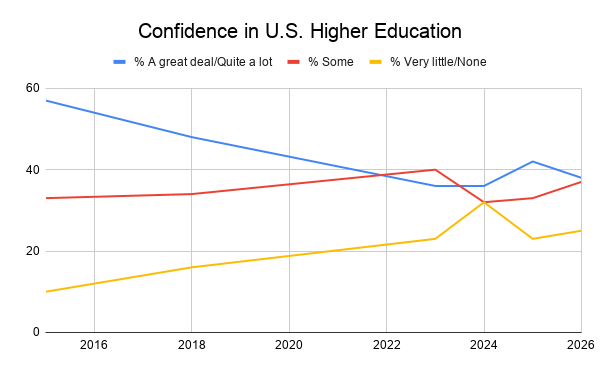
When Gallup began polling people about their confidence in universities in 2015, about 60% reported a high level of confidence.28 By 2026 that number had dropped to only 38%.29
Beginning with the 2024 data release, Gallup asked people the reasons for their level of confidence in universities. For those with low confidence, the top reasons were political agendas (including perceptions of indoctrination and liberal bias) and concerns about the curriculum (students not learning relevant skills). Cost was another factor, and perhaps the most bipartisan one. The same concerns were named in Gallup’s 2025 and 2026 surveys.
Meanwhile, those who expressed high confidence in universities cited the value of being educated and the quality of instruction and training available at universities.
Another source demonstrating the decline of trust is a 2025 Pew Research Center report showing that 70% of Americans believe higher education is heading the wrong direction,30 compared to just 61% in 2018. The public gave universities low scores on a variety of factors from keeping tuition low to preparing students for well-paying jobs.
4.4 More Polarized Trust
Recent surveys also show significant differences in confidence by political affiliation. According to Gallup, the percentage of Republicans with little trust in universities rose from less than 10% to about 50%. Distrust also rose significantly among independents while Democrats saw smaller but notable changes.
Pew’s data also reflects political polarization. From 2012 to 2015, about 54% of Republicans said universities had a positive effect on the U.S. But by 2017, the position had flipped: nearly 60% of Republicans said universities have a negative effect.31
In Pew’s poll, Democrats and Republicans diverged on questions of whether colleges shield students from ideas (Democrats, 31%, Republicans, 75%), whether professors preach their personal views (Democrats 17%, Republicans 79%) and whether students hear a full range of views (Democrats 60%, Republicans 26%). This trend continued in Pew’s 2025 survey, in which Republicans gave colleges much lower ratings for “Exposing students to a wide range of opinions” and “Developing students’ critical thinking and problem-solving skills.”
4.5 Lessons From Trust Crisis Data
This review of data about the trust crisis reveals several facts that university communicators must keep in mind.
- The trust crisis is new, not ever present. Universities enjoyed relatively strong levels of bipartisan confidence even years after other institutions, such as the media, had seen the public split along partisan lines.32 The decline in trust seems to have taken place in the 2010s.
- Political differences dominate. While people of all political ideologies have shown less trust in universities, Republicans/Conservatives and Independents/Moderates have shown the largest drop. The greatest opportunity to meaningfully increase confidence in universities is to rebuild confidence among these groups.
- Perceptions of political bias drive distrust. People who distrust higher education believe that universities are politically biased, engaging in indoctrination rather than education. As the AAUP’s 1915 Declaration stated, the university will lose public trust if the public believes professors are echoing public opinion.
- Communication and trust through political bubbles can be challenging. When many people on campus share similar politics, they might not notice political leanings in campus communications and may struggle to effectively reach those with different political views.
- Free expression challenges are linked with trust. Multiple surveys cite low trust resulting from universities’ restrictions on free expression, whether that be shielding students from hearing certain views or barring some campus speakers. Fostering free expression and highlighting civil debate could help to limit this perception.
4.6 Can We Trust the Trust Data?
Some observers have rejected the narrative of a trust crisis, arguing that partisan bias in academia is a mirage, or perhaps a partisan lean exists but it is not a problem. One president in Inside Higher Ed’s 2026 survey called the decline in trust “a red herring cultivated by the media and politicians like a cudgel to batter higher ed into submission to their orders.” One author claimed that the public was “duped by right-wing con artists” who “told them over and over that colleges are cesspools of left-wing indoctrination suppressing conservative ideas.”33
Some university communicators agree with those sentiments. In the anonymous survey conducted for this report, 41% of communicators said that some sort of political misinformation led people to lose trust in universities. One blamed “conservative billionaires buying media outlets and pushing far, right-wing agendas.” Another called it “a coordinated, intentional political campaign.” While the survey was not large enough to provide scientific insight, the qualitative data confirms that at least some of higher education’s storytellers blame distrust on lies.34
They are correct that assaults on higher education have been led by right-leaning influencers and politicians. Notably, Republican sentiment seems to have sharply turned against higher education around the time that Donald Trump was elected as a Republican president. Capitulating to a partisan narrative in hopes of regaining trust would sully a university’s trustworthiness, too.
But the AAUP Declaration also puts significant responsibility on universities — responsibility to maintain credibility by being a “refuge” from the “tyranny of public opinion,” avoiding indoctrination, and staying “uninvolved in party antagonisms,” among other responsibilities. Blaming the public for being fooled leaves universities with no recourse. Instead, universities should aspire to fulfill their responsibilities well and convey this success to the public.
The question of whether universities have lived up to these obligations is beyond the scope of this report. Instead, the chief question is whether university communications adequately represent the university as an institution that people of diverse political perspectives can trust. The next section shows that university communications have yielded to social and political pressure that actually prop up the narrative of political agendas in higher education.
5. Political and Social Pressure in University Public Relations
The previous section showed that confidence in universities remained strong into the early 2010s only to fall around the middle of the decade. This section explores two changes in university communications that happened around that time and may have contributed to some of the perceptions that caused the trust crisis.
One change is the practice of making statements about political and social issues. When Donald Trump was elected in 2016, enough university leaders sent pronouncements to their communities that the Chronicle of Higher Education remarked about their silence when Trump was reelected in 2024.35 Statements about international violence, natural disasters, and court decisions became commonplace on some campuses in the late 2010s and early 2020s. As discussed below, university communicators report how these statements often resulted from pressure and requests rather than strategic decisions. As a result, universities reflected political values and opinions of those who pressured them for statements.
Related to the rise of those official statements, universities increased their communications about diversity, equity and inclusion (DEI). Two different measurements show that DEI-related keywords increased on university websites after 2015, and the increase was sharper in Democratic-leaning states and in wealthier, more elite institutions. That alignment with politics may have caused universities’ DEI communications to come across as political statements rather than good-faith commitment to serving students. Both examples invite contemplation about how universities can more effectively communicate to a politically divided public.
5.1 University Statements on Political Issues
When interviewed about what they want their universities to be known for, communicators mentioned research, value, public service, workforce development, alumni success, free speech, economic growth, and athletics. Although they consult public opinion polling, none of the interviewed communicators mentioned a goal to align with anyone’s political values.36 “We have to be apolitical in the way that we appeal to any groups,” COMMUNICATOR E said.
But most of the communicators told similar stories about their universities getting into the practice of issuing official statements that often came across as political. While not new, the practice seems to have become more common in the mid-2010s as the Black Lives Matter movement gained traction.
Most communicators could not recall strategic intentions to start making statements on a regular basis. Usually, the process began with one request for the president or chancellor to speak out about an issue or event. More requests followed. COMMUNICATOR E noted, “I think we got into a cycle — and I can’t even remember how, you know, where it started, when it started ….”
Communicators were not always consulted about the decision of whether to make a statement. COMMUNICATOR H recalled a “charismatic president” who received emails asking for a statement, often including specific language to include. “We would get an email [from the president] that said, ‘Hey, we’re going to write an email about this, I’d like a draft in two hours.’” Several communicators noted that their presidents or chancellors wanted to be seen as thought leaders engaged with the topics of the day — even if the leader was not an expert in those topics.
Other times, communicators were consulted but overruled. COMMUNICATOR B (purple state) recalled advising a new president against commenting on a shooting in another state, arguing that this would “define” the presidency around issue commentary. The president proceeded with the statement, though, and more statements followed.
“In the absence of having a position on statements, it can be a pretty slippery slope,” COMMUNICATOR B said. “People wanted their cause to be in the spotlight, right? Groups wanted to know that someone cared about them,” COMMUNICATOR F (blue state) said. Soon, universities were asked to weigh in on tragedies, such as earthquakes or wars in foreign countries, decisions by the Trump administration, Supreme Court cases and more. COMMUNICATOR J said that because students felt impacted by these events, the university felt a need to speak to those students. “We made it germane to us.”
As the requests came in, communicators often watched to see whether peer institutions spoke out. “In many cases, we’re not appropriate to be the first person out, but you also don’t want to be too far behind the curve of when these communications come out, so that it looks like you’re just trying to play catch-up,” COMMUNICATOR I said. COMMUNICATOR C (red state) remarked, “We don’t want to seem like we’re the only ones who don’t care about Ukraine.” In addition to this peer pressure, universities faced moral pressure. COMMUNICATOR E remarked that phrases like, “If you’re silent, you’re complicit” made her blue-state university uncomfortable with not speaking out.
5.1.1 Implications of Statements-by-Request
The consequences of this practice for a university's public relations could be significant. By issuing statements upon request and using language prescribed by the requestors, universities may have created the perception that they as institutions were aligned with partisan political goals. When multiple universities published similar statements on the same issue, they contributed to the perception of an intellectual monoculture. Having presidents speak out on topics without being an expert in those topics may have undermined higher education’s professed ideal of expertise.
University statements also may have undermined trust indirectly by affecting free expression. As mentioned earlier, university statements have been shown to create a chilling effect. When faculty and students feel the need to hide their true views in order to not contradict a university statement, this may affect what free speech studies reflect about campus culture.37 When the pressure to make a statement was combined with pressure to cancel a speaker, acquiescing to that pressure only added to the idea that universities do not value free speech, another perception that has led to a loss of trust.
Another repercussion of statement-making was the ongoing expectation that universities would continue to weigh in on topics important to their constituents. The decision of whether to issue a statement, or not, itself became a statement of a cause’s importance or an incident’s remarkability or its alignment with university values. Constituents paid attention to whether or not a cause was recognized with a campus statement. The communicators interviewed said that the practice became unmanageable, leading them to seek a way out.
5.1.2 Why Universities Embraced Institutional Neutrality
The past several years have seen a major shift away from the practice of making statements. About 160 universities have publicly announced policies that rein in the practice of making statements since 2023.38 The Chronicle of Higher Education and the New York Times have noted that universities are keeping quiet, sometimes connecting the practice to a desire to avoid the ire of the Trump administration.
All of the communicators interviewed for this report had adopted at least informal measures like institutional neutrality, always before the second Trump administration began. For some, a new university president or new communications leader arrived, leading to “a willingness to think through this approach a little more carefully,” as COMMUNICATOR H said. Others emphasized that the complexity of juggling statement requests had become unmanageable, prompting them to advocate for ending the practice.
Some pointed out that as issues became more polarizing, giving statements became a reputational risk. COMMUNICATOR I said the October 7, 2023 attacks on Israel made it impossible to craft a statement that would not offend a significant portion of the campus community. “That’s when we started to, you know, be much more thoughtful and less enthusiastic about, and less quick to jump into, putting anything out,” she said.
COMMUNICATOR I discussed having a more “disciplined” approach toward how the university used its institutional voice. “Disciplined” implies abiding by principles rather than being led by circumstances or requests. Free expression and belonging were important factors, too:
It has just become more, you know, apparent that’s probably a better course of action for the spirit of being this neutral place where free speech is encouraged and supported. If our president and our leadership comes out with a strong opinion on one side, does that keep a faculty member from feeling like they’re part of a community that understands them and supports them? Is that alienating to a parent that’s thinking about this school for their students to attend, or where they’re, you know, sending their tuition dollars? The risk isn’t worth the payoff in many cases if it’s really not our issue to solve.
When universities were pressured to make statements, communications leaders noticed potential challenges before getting into the practice. Then they saw the repercussions — demands for more statements, the complex balancing act of juggling so many requests for statements, and the impact on the reputation of their universities. More open discussion about these repercussions could have helped bring discipline to the practice earlier, perhaps limiting the impact on public perceptions.
5.2 The Rise and Fall of Diversity, Equity and Inclusion Language
Around the same time that universities faced increased pressure to make public statements about issues, their websites began to see much more language related to diversity, equity and inclusion. Even when these non-partisan words became politicized and polarized, they proliferated on university websites in the 2010s before falling quickly as political winds turned. This section explores data on this trend and discusses its implications.
5.2.1 An Initial Look at DEI Language Growth
The most detailed examination of this language in university communications is a 2022 study39 that examined the presence of social justice terms (such as “anti-racism,” “privilege,” and “white supremacy”) on university science-focused web pages. Using Google search data, the study found about 60,000 science web pages with these keywords on the websites of 100 top research universities. By finding dates listed on these pages, the authors were able to plot 10,000 of these pages on a timeline showing when they may have been created or updated.
As Figure 4 shows, the report found that growth in social justice terms was flat in the early 2010s, increased starting in 2015, and skyrocketed in 2020.
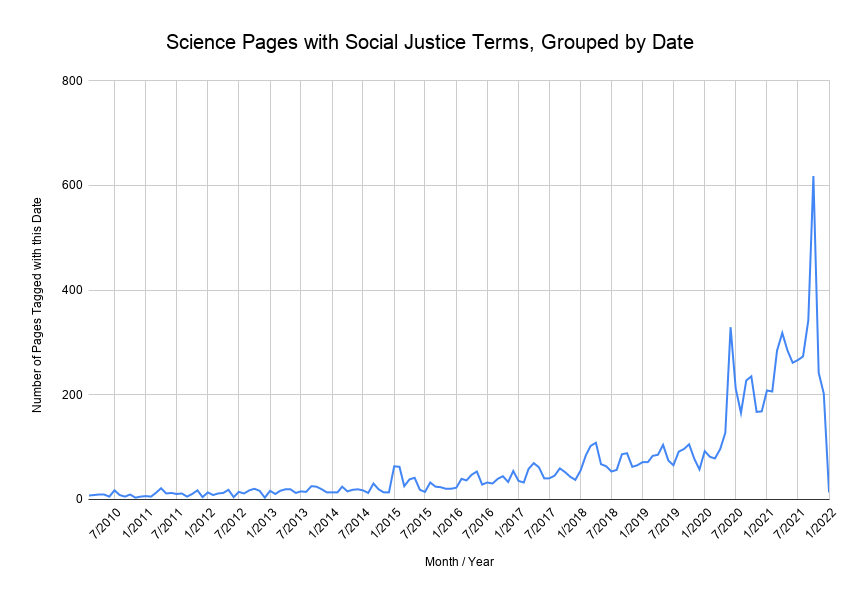
Another large increase took place in 2021, after President Biden issued an executive order naming equity as a central focus of his administration. Although the Biden administration did not force use of this language with threats (as the Trump administration has used to force elimination of DEI policies), some have tried defending their grants from Trump administration cuts by saying equity language was required when they applied for the grants.40
Since these findings were first reported, 28 states implemented legislation restricting DEI policies in universities.41 Many universities have edited their websites to remove or deemphasize some of these keywords due to pressure or requirements from state and federal officials. To measure this change, ChatGPT was used to create a computer program in the Python programming language to scan the pages plotted in the 2022 study. The program retrieved the content of the web pages and counted the keywords included in the original study. As of January 2026, all 10 key words had decreased by at least 40% on these pages. “Anti-racism” disappeared the most, dropping 67%.
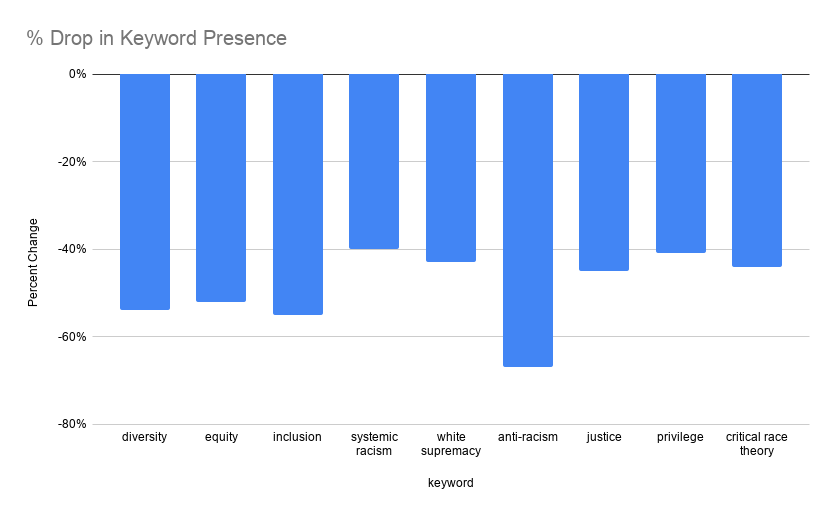
While this analysis is eye-opening, several shortcomings limit its usefulness. For one, the 2022 study relied on Google search data, meaning Google’s indexing practices and search algorithm may influence the data. By simply looking at the presence of words on pages, the study returned some false positives, such as when statements such as “the privilege of serving the college” resulted in a page flagged as though it discussed racial privilege. That study also assumed that a date on a web page indicated when it was created, when it actually could refer to an event at a different time..
Likewise, this report’s study of the removal of these keywords might overstate the removal because some of the pages marked deleted may have been moved to new URLs instead.
5.2.2 A More Detailed Timeline of DEI
To create a clearer and more defensible timeline of DEI language on university websites, a new study was conducted focused on archived university home pages — revealing how language on the same pages changed over time.
The Internet Archive at Archive.org saves copies of many web pages, and computer programs can query this data through an application programming interface (API). ChatGPT was used to create a program in the Python language that would use this API to retrieve Archive.org snapshots of 51042 university home pages from 2010 to 2026. On each page, the program counted the occurrence of four keywords: diversity, equity, inclusion and justice (DEIJ).
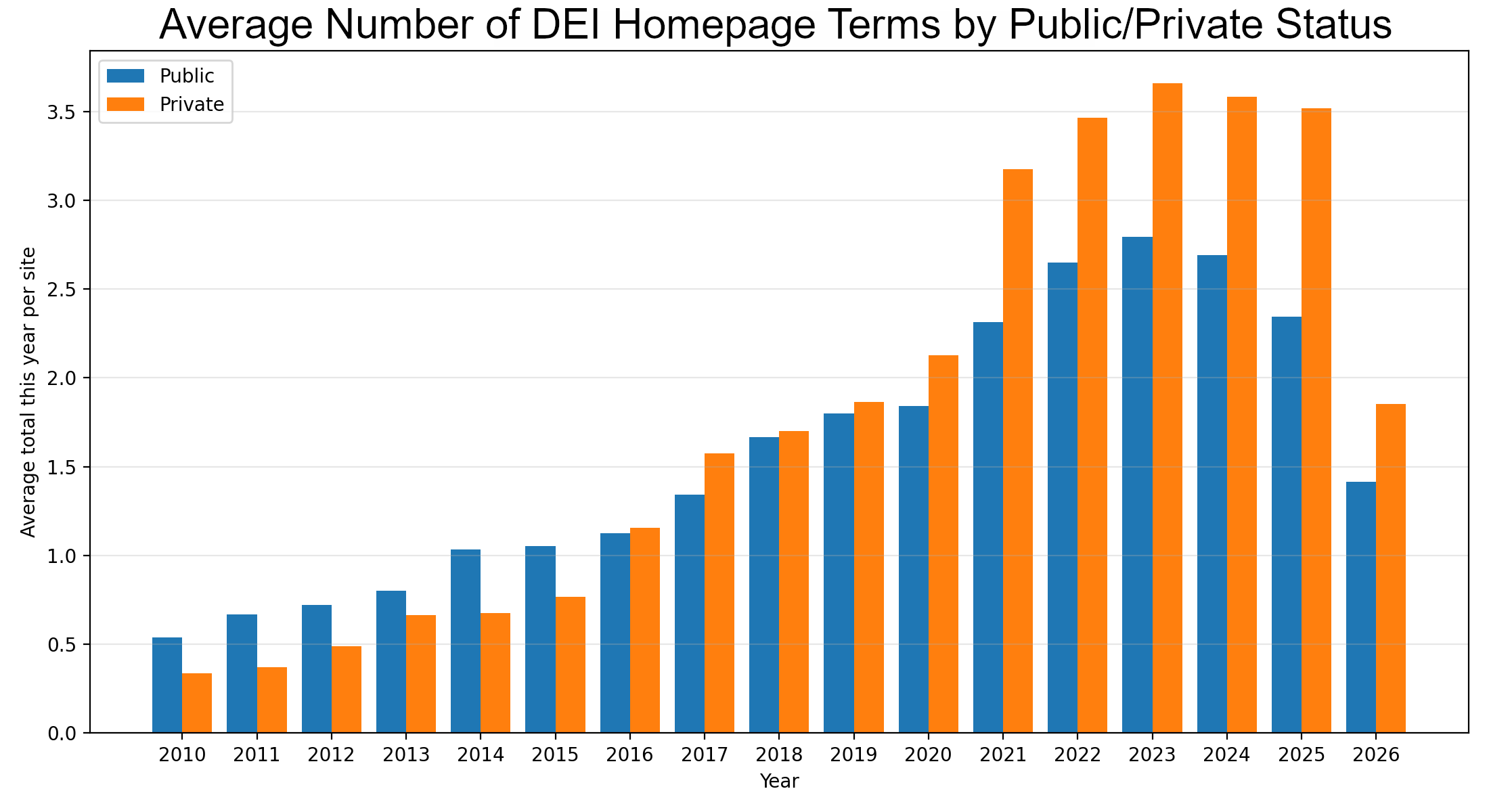
According to data assembled by this computer program, these 510 universities had just over 800 total occurrences of these four words on their home pages in the first quarter of 2026 — only half of what was found at their peak in 2023, but approximately the same level found in 2017.
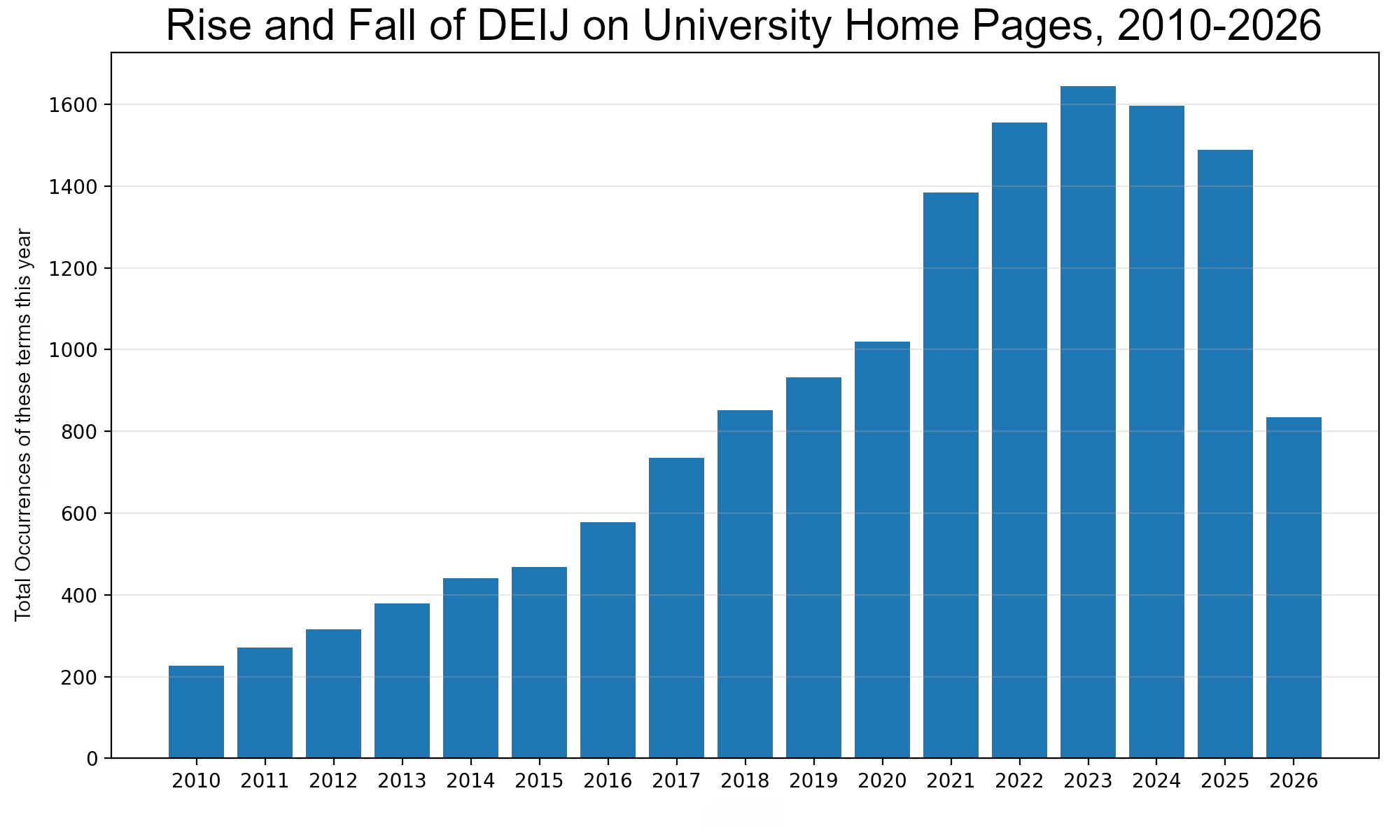
All four keywords rose from 2020 to 2021. After that, “diversity,” “equity” and “inclusion” continued to climb, while “justice” tapered off immediately, as seen in Figure 7. This could indicate universities aligning with the Biden administration policy promoting equity. However, the continued rise of those three terms may simply reflect which combination of words became standard.
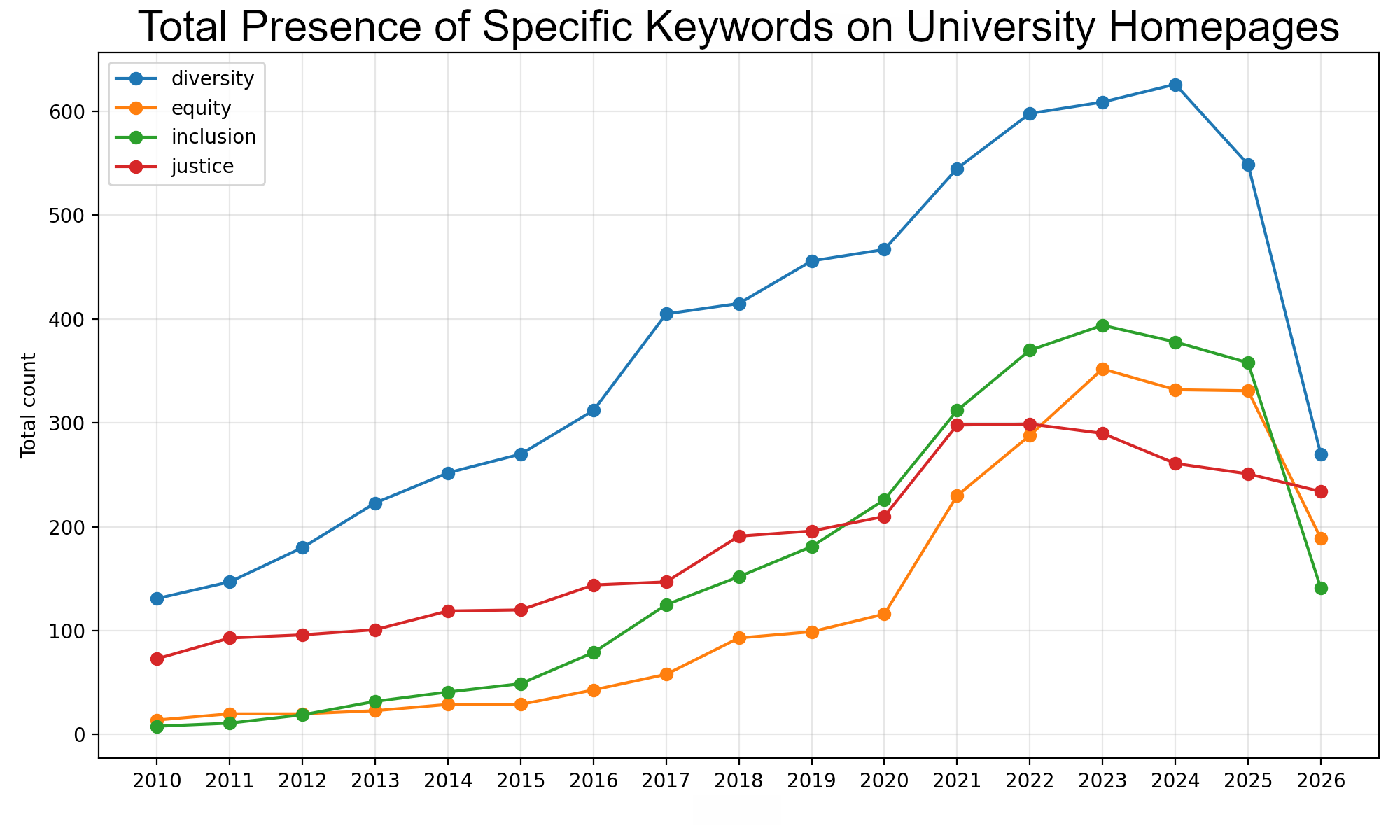
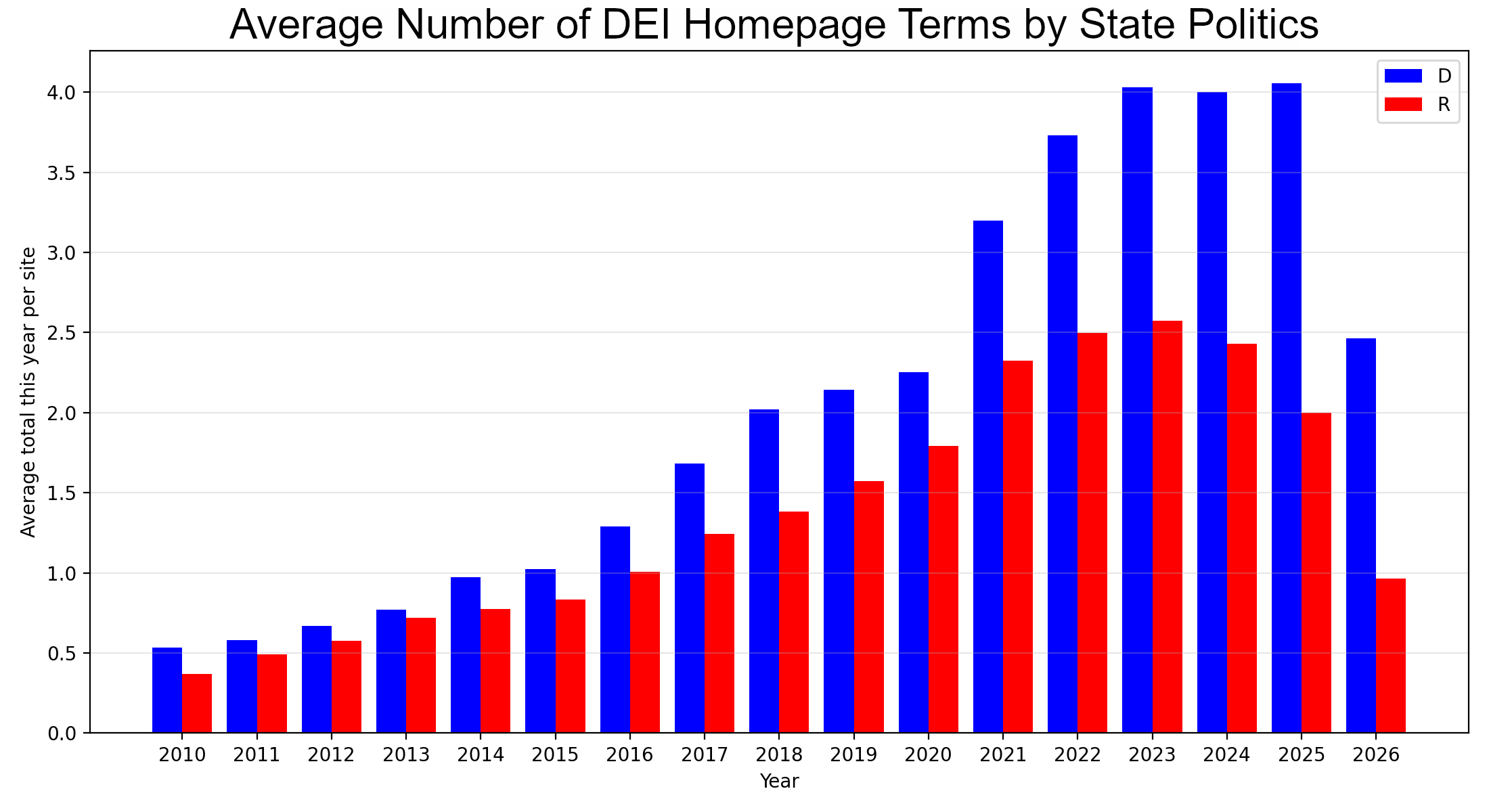
A few segments within this group of universities show interesting contrasts. First, as shown in Figure 8, universities in Democrat-leaning states employed more of this language on their home pages, and increased the use more quickly, while those in Republican-leaning states hardly increased their use after 2021 and decreased the use by 2024.
Second, private institutions employed these words on their homepages less than public universities until 2016. Private institutions had a much sharper increase in use of these words from 2020 to 2021, as seen in Figure 9.
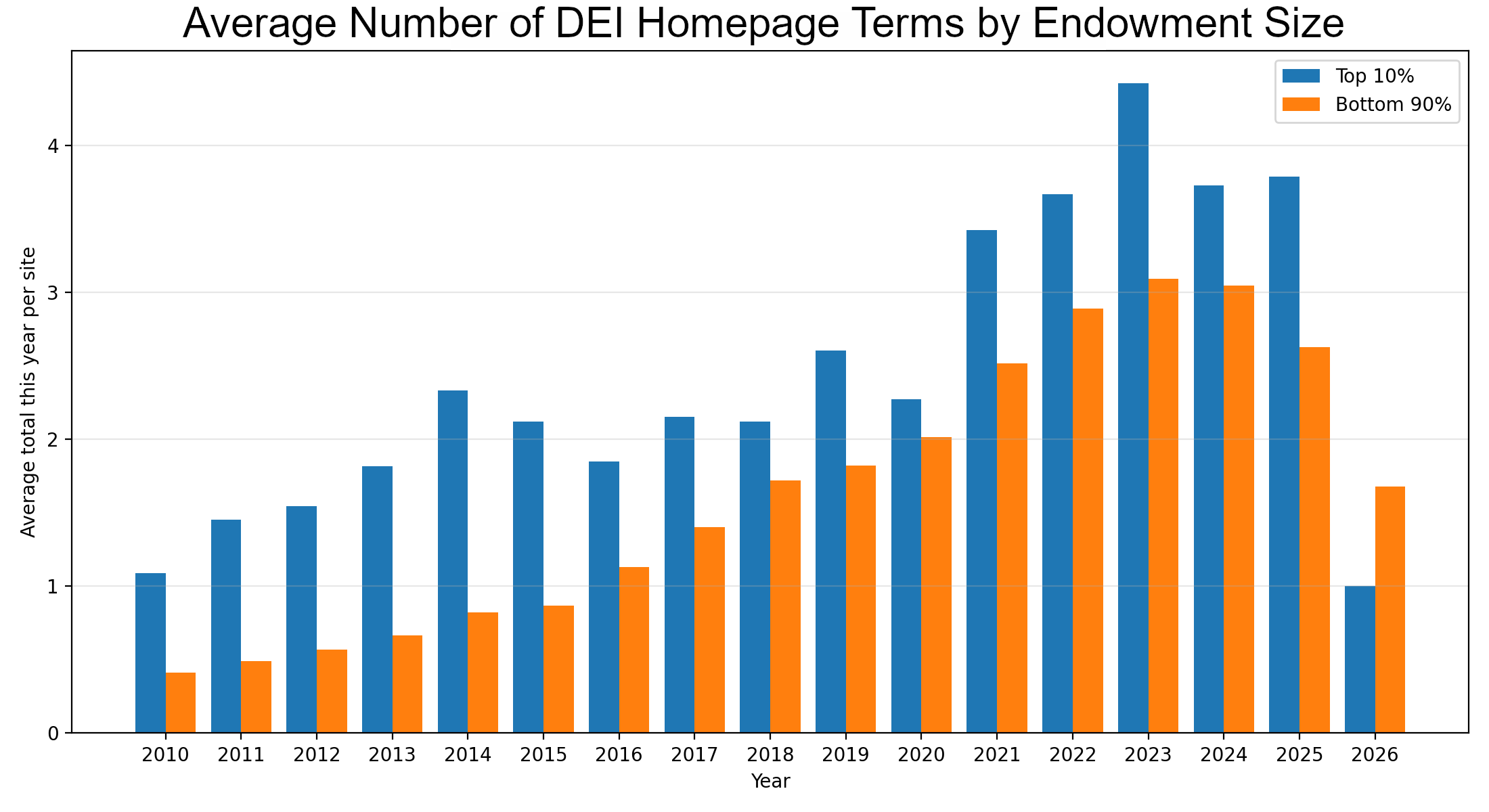
Third, schools with endowments in the top 10%43 of this sample consistently employed more DEI keywords on their homepages than schools with endowments in the bottom 90%, as shown in figure 10. But from 2025 to 2026, the wealthiest universities eliminated almost all of these keywords from their homepages. As the Trump administration threatened to cut off federal funding for universities, a high endowment turned a university into a target.
5.2.3 Implications of DEI Language and Website Changes
Although universities used DEI language more often during the period when public trust fell, this correlation does not mean that DEI language caused the public to turn against universities. In fact, in Gallup’s 2024 poll, only 2% of low-trust respondents said that “too much emphasis on diversity, equity and inclusion” caused their lack of trust. Another Gallup survey shows that the majority of Americans see diversity as good for business, with nearly two-thirds saying diversity improves innovation.44
Therefore, this analysis does not mean that universities should not have used DEI-related language or that they should have censored employees who discussed DEI. But some trends in the data suggest that the rise and fall of DEI language might have contributed to the perception of political activism.
First, universities’ use of DEI-related language varied by the political context of the university’s state. If the likelihood that a university discusses DEI on its website reflects the politics surrounding the university, it invites questions about whether universities were presenting themselves as sources of unbiased scholarship or echoing the opinions of the public they serve.
Second, the rise and fall of this language can affect the morale and confidence of people regardless of what they think of DEI. Will opponents of DEI actually trust that universities are complying with anti-DEI requirements solely because websites were edited? Multiple hidden-camera reports suggest the answer is no.45 Can those who trusted in DEI-related commitments made in the 2020 social justice moment have confidence in their universities, or will they see their universities as political puppets whose word cannot be trusted? The rapid change in messaging gives both opponents and supporters of DEI reason to doubt universities’ motivations.
Third, the data raises questions about how concepts and policies are communicated. Some of the language tracked in these studies took on political connotations and has proven divisive. For example, the phrase “white privilege” has been shown to do little to actually make people thoughtful about racial privilege46 and may actually reduce support for and discourse about DEI proposals.47 Not that concepts of racial privilege should be discouraged in the classroom; that is exactly where they should be discussed and debated. But including this language in university communications signaled to conservatives that universities were taking sides.
That is not a comfortable proposition — the idea that universities must abandon an idea or policy simply because it becomes politicized flies in the face of the vision of a university as a center for independent thought. But it reflects a reality that universities must navigate in their public relations.
One possible solution to this is to think carefully about how to communicate policies and ideas more directly, without couching them in buzzwords that might become popular with one political side but anathema for another. For example, research has shown that complex or judgmental terms helped alienate some DEI opponents.48 Also, using specialized, unfamiliar words and phrases has been shown to raise people’s mental defenses such that they trust a message less.49
In an interview, COMMUNICATOR J shared how his university had found support from conservative donors when discussing DEI activities without politicized buzzwords:
We … developed a language that seemed to work for people who were both committed to the work, but also to people who thought that DEI was a horrible thing. … The people who were most against DEI in terms of our donor bases, when we told them things we were doing, without using that [DEI] language, they were like, well, that’s really great.
By communicating more clearly and appealing to widely held values, this communicator’s university won appreciation and support for its DEI practices, even from critics of DEI in general. Perhaps some of the disappearance of DEI language results from universities finding new ways to talk about activities that support student success and belonging. Regardless, the rise and fall of DEI language on university websites suggests that universities can do better at considering the full range of their publics and communicate without language that becomes polarized.
6. Communicating for Trust: Discussion and Policy Recommendations
The communicators interviewed for this report and the data analyzed suggest several ways to move forward and strengthen university public relations efforts. A common thread through each of these could be summarized as “Principles before PR.” A public relations approach needs to be grounded in the university’s mission, not the latest request to issue a certain statement or use certain language.
Recommendation 1: Educate university communicators on free speech, academic freedom, and communicating across disagreement.
Some of the university communicators interviewed for this report spoke about free speech as a legal requirement. But a few spoke with passion about free speech and academic freedom, connecting these topics to the university’s core mission and an important message to convey to the public. These communicators eager to support free speech also were the most likely to specifically advocate that universities need to engage positively with people of diverse political views — a necessary step in rebuilding trust among the groups where trust has slipped the most.
That makes it unfortunate that free speech, academic freedom, and communicating across disagreement are rare in professional development opportunities for university communicators. Workshops and other training opportunities should be developed on these topics with specific applications to the work of university communicators. Such training will help communicators share the university’s work in ways that engender understanding and trust from politically diverse audiences, with less polarizing outcomes. And because free-speech restrictions at universities have harmed public trust, communicators who can better defend these principles on campus and in university public communications can help reverse the trust trend.
Recommendation 2: Empower communications to make communications decisions, even when pressure is high.
Multiple communicators described either not being consulted about whether to issue statements, or providing advice that was not taken. Later, they led their campuses to more politically neutral communications, but only after the practice of making statements had become unmanageable.
Ensuring that communicators can provide strategic advice, rather than simply receive instructions, about politically sensitive communications can help keep a university’s messages on-mission. Especially when they have been educated in communications across disagreement, they can ensure broader perspectives are taken into consideration and help universities maintain nonpartisan reputations. Because university communicators do not have tenure protections, they may sometimes feel less power or authority to speak up. Presidents and other senior administrators should make a point to insist that communications leaders be heard and play a role in making communications decisions.
Recommendation 3: Develop a strategic vision for university public relations that encompasses all constituents and is resilient to pressures from any one group.
Universities hold a special place in society that requires them to serve a broad constituency, not only the most vocal, such as students and faculty, or the most powerful, such as their legislators. COMMUNICATOR H described how having campus locations throughout his state, both in liberal urban centers as well as conservative rural regions, helped the institution keep people of all backgrounds in mind:
When we think about our constituencies, it’s not just our state legislators, it's not just [this] metro area, it's everyone, everywhere. … The challenge around communication and engagement is thinking about how to explain a decision that is connected to our mission in a way that our audience can see themselves reflected in it, or can understand, even if they don't agree with the outcome. … It is not acceptable for us to not engage a particular political viewpoint, because they are our constituents, the entire state, which is actually quite politically diverse.
This is not quite a please-the-public approach; he acknowledges that some stakeholders will disagree with university decisions. But thinking of all constituents can help communicators choose messages and language more likely to bridge divides and win support from a broader array of people. This insulates university communications from too much influence from any one constituent group and decreases the likelihood that the university’s message will become tied to any single faction of public opinion.
By considering all constituents and their perspectives, universities are more prepared to take the next recommendation.
Recommendation 4: Focus on universal values and ideals, not polarizing topics.
Advice from marketing consultants and pressure from constituent groups can tempt a university, or any brand, to embrace specific political values to earn a positive response from those that share those values. Such messaging can be effective when polarization and political identity make it easy for online content to spread rapidly. But universities have goals much larger than a viral social media post with supportive comments from those who agree. They should insist on emphasizing more universal themes, values and topics that relate to people regardless of their political views.
There is much a university can discuss in its communications without striving to appeal to any one group by adopting a political viewpoint. For example, surveys of prospective students consistently show that students are interested in academic program options, dorms, dining hall foods, athletics, financial aid, career outcomes and many other topics that do not divide the audience by political ideology.50
When discussing curriculum or research that may touch on polarizing topics, communicators can describe the material in ways that even someone who disagrees with a professor’s or student’s conclusion can understand or have confidence in the process. For example, research has shown that an “honest broker” approach toward science communication, which acknowledges room for good-faith disagreement about the policy implications of science, can reduce distrust.51 Professional development for university communicators can teach such techniques.
Recommendation 5: Show critical thinking, free speech and dialogue in action.
Multiple surveys cited earlier show that Americans doubt that college students are exposed to diverse views or given the tools needed to think critically. Other surveys show that college students support free expression, want to be exposed to diverse viewpoints, and hope to develop the skills needed for constructive dialogue.52 Universities could highlight how they foster dialogue and help students think critically, hear from a wide range of views, and disagree constructively.
Recommendation 6: Choose supportive action rather than institutional speech.
Universities may find that “actions speak louder than words,” especially when words may become politicized or taken out of context. Several communicators interviewed for this report shared that even as they publish fewer statements about issues, they have found other ways to support students who feel affected by issues. For example, they may provide targeted support or outreach to specific students affected by a situation. Several indicated that this is less performative and more effective than mass emails were.
Another form of action is to engage in the political process directly when it relates to university business, rather than publicly trying to influence politics. Several communicators noted that building relationships with legislators and regulators allows universities to make their voices heard as corporate citizens without exciting opponents or creating a perception of politically driven education. As some states consider restrictions on academic freedom, universities that take sides publicly may invite a harsher crackdown than those that work through relationships with legislators.
Recommendation 7: Resist political pressure on communications from any side.
It can be easy to accommodate communications requests when they align with the prevailing politics of a campus or even a communicator’s personal political views, only to then push against pressure from an opposite party. When universities get political for one side of the aisle, they may face backlash from the other. The rise and fall of DEI-related language and political/social issue statements exemplifies this.
Sian Leah Beilock, president of Dartmouth College, referred to this idea in a New York Times Dealbook Summit53 discussion, encouraging universities to take a stronger stand:
We shouldn’t as institutions be political footballs, over-rotating when Democrats put in requirements about how we get grants and the kinds of statements we write, or over-rotating when the Republicans do the same thing. And that is where higher education will shine, when we can be independent institutions pushing on our values and not falling prey to one leadership or another.
Only by asserting independence under one administration can universities rightfully claim independence under the next. Many universities raced to edit language on their websites to signal compliance with the Trump administration’s restrictions on DEI, seeing it as a matter of survival. As they rebuild social capital and public trust through other public relations efforts, universities will need to lay the groundwork for political independence.
7. Conclusion
Universities aspire to offer intellectual freedom to society by both providing a place, a method and guidance for developing such freedom. While individual scholars may benefit from this freedom, society enjoys its fruits through scientific progress and the development of new ideas. As the AAUP Declaration of Principles argues, these benefits require academic freedom, which requires public confidence that universities are fulfilling the responsibilities that come with such freedom — that they are neither censoring nor unduly favoring any one view.
This report highlights how university public relations and communications can help or harm the public’s perception of universities. It presents two philosophies of university public relations, one focused on pleasing the public, even when that requires limiting academic freedom, and one that champions radical independence. Both philosophies have important concepts universities must weigh, but pleasing the public tends to be a stronger influence because universities rely so much on public support.
But pleasing the public can backfire. This report explored how universities yielded to some public pressures that jeopardized the perception of universities as nonpartisan institutions. As the public saw rapid growth in polarizing language and university-issued political statements, public confidence fell.
This correlation does not prove that university communications caused the crisis in trust, nor does it imply that there has not been much to celebrate about university communications in the past 10-15 years. However, university communicators should firmly rededicate themselves to the mission of universities, the value of free expression, and the importance of communicating to serve all of a university’s constituents.
Robert M. Hutchins, the University of Chicago president who championed the radical independence philosophy, remarked, “The university should be the symbol of the highest powers and aspirations of mankind. … The universities should dedicate themselves to their great symbolic task. Upon their performance of this task rests their claim to freedom.” University communicators help to show the public how universities live up to this charge. Doing so, they can support their institutions in fostering and defending intellectual freedom while rebuilding trust with the public.
- 1915 Declaration of Principles on Academic Freedom and Academic Tenure. American Association of University Professors, 1915, https://www.aaup.org/NR/rdonlyres/A6520A9D-0A9A-47B3-B550-C006B5B224E7/0/1915Declaration.pdf ↩︎
- Reck, W. Emerson. ACPRA's First Half Century, 1917–1967. American College Public Relations Association, 1967. ERIC, ED058822, https://files.eric.ed.gov/fulltext/ED058822.pdf. ↩︎
- The organization merged with the American Alumni Council in 1974 to create the modern Council for the Advancement and Support of Education. (Evolution of CASE.) See “The Evolution of CASE.” Council for Advancement and Support of Education, https://www.case.org/about-case/evolution-case. ↩︎
- Reck. ACPRA's First Half Century. ↩︎
- Colleen Flaherty. “Presidents Puzzled on Rebuilding Public Trust in Higher Ed.” Inside Higher Ed, 9 Apr. 2026, https://www.insidehighered.com/news/governance/executive-leadership/2026/04/09/presidents-puzzled-rebuilding-public-trust-higher. Accessed 9 July 2026. ↩︎
- Young, Jeremy C., Kathryn A. E. Enke, Felicia Fullilove, and Scout Meredith Best. The Trust Agenda: A Framework for Advancing Public Trust in Higher Education. American Association of Colleges and Universities, June 2026. ↩︎
- “What Is Public Relations?” Public Relations Student Society of America, Public Relations Society of America, https://www.prsa.org/prssa/about-prssa/learn-about-pr. Accessed 9 July 2026. ↩︎
- Titus, Charles H. “The University and Its Public Relations.” The Journal of Higher Education, vol. 6, no. 1, 1935, pp. 13–16. JSTOR, https://doi.org/10.2307/1974283 ↩︎
- Titus, Charles H. “Faculty Public Relations.” The Journal of Higher Education, vol. 16, no. 2, 1945, pp. 79–87. https://doi.org/10.1080/00221546.1945.11774204 ↩︎
- Titus mentioned attempts to establish peace studies departments as well as “intolerant agencies.” The latter may have referred to attempts by the Ku Klux Klan to influence universities. ↩︎
- Hutchins, Robert M. “The Freedom of the University.” Ethics, vol. 61, no. 2, 1951, pp. 95–104. JSTOR, http://www.jstor.org/stable/2378553 ↩︎
- Hutchins, Robert Maynard. “The University and the Multiversity.” The New Republic, vol. 156, no. 13, 1967, pp. 15–17. ↩︎
- Kwestel, Melanie, and Elizabeth Fitzpatrick Milano. “Protecting Academic Freedom or Managing Reputation? An Evaluation of University Social Media Policies.” Journal of Information Policy, vol. 10, 2020, pp. 151–183. https://doi.org/10.5325/jinfopoli.10.2020.0151 ↩︎
- Eren, Colleen. “Chilling Effects? The Impact of Political Statement-Making on Faculty at R1 Universities.” Journal of Open Inquiry in the Behavioral Sciences, vol. 5, no. 3, 2026. https://doi.org/10.58408/issn.2992-9253.2026.05.03.0001 ↩︎
- “Marketing to College Students.” Refuel Agency, 5 Apr. 2026, https://www.refuelagency.com/blog/marketing-to-college-students/ ↩︎
- Rowe, David, and Kylie Brass. “‘We Take Academic Freedom Quite Seriously’: How University Media Offices Manage Academic Public Communication.” International Journal of Media & Cultural Politics, vol. 7, no. 1, 2011, pp. 3–20. https://doi.org/10.1386/mcp.7.1.3_1 ↩︎
- Volk, S.C. et al. (2023) ‘Role conceptions of university communicators: A segmentation analysis of communication practitioners in Higher Education Institutions’, Public Relations Review, 49(4), p. 102339. doi:10.1016/j.pubrev.2023.102339. ↩︎
- Elken, M., Stensaker, B., & Dedze, I. (2018). The painters behind the profile: The rise and functioning of communication departments in universities. Higher Education, 76(6), 1109–1122. https://doi.org/10.1007/s10734-018-0258-x ↩︎
- Wilson, John. “Freedom of the Press on Campus.” University of California National Center for Free Speech and Civic Engagement, 2020, https://freespeechcenter.universityofcalifornia.edu/fellows-19-20/wilson-research/ ↩︎
- Other purposes communicators mentioned include raising awareness, recruiting prospective students, fundraising, increasing reputation, and building community. ↩︎
- Saad, Lydia. “Confidence in U.S. Higher Education Slips Back Slightly.” Gallup News, 16 July 2026, https://news.gallup.com/poll/712322/confidence-higher-education-slips-back-slightly.aspx ↩︎
- Environmental groups were the second most-trusted source of information about pollution, with 47% of respondents expressing a high level of trust. Other information sources rated were television and radio (25%), newspapers (25%), government (20%) and businesses (10%). ↩︎
- The 2021 question used a scale of 0 (no trust) to 10 (complete trust). For this analysis, the numerical scores were converted to the categorical scale used in the 2000 question. Each category was assigned two numbers on the 0-10 scale except for “Some trust,” which contains scores 4-6. Few people chose 4 or 6 but 22% chose 5, making this a defensible way to convert the survey results to this scale. ↩︎
- Santoro, Lauren Ratliff, and Emily Sydnor. “Blind Trust, Blind Skepticism: Liberals’ & Conservatives’ Response to Academic Research.” American Politics Research, vol. 52, no. 1, 2024, pp. 52–66. https://doi.org/10.1177/1532673X231206136 ↩︎
- Attitudes About American Colleges 1990: A Survey Commissioned for National Higher Education Week. Gallup Organization, Inc., 1990, https://eric.ed.gov/?id=ED325025 ↩︎
- The American Public on Higher Ed Survey. American Council of Trustees and Alumni, 7 Aug. 2011, https://www.goacta.org/resource/the_american_public_on_higher_ed_survey/ ↩︎
- Gallup. “Perceived Importance of College Hits New Low.” Gallup News, 11 Sept. 2025, https://news.gallup.com/poll/695003/perceived-importance-college-hits-new-low.aspx ↩︎
- Jones, Jeffrey M. “U.S. Public Trust in Higher Ed Rises From Recent Low.” Gallup News, 16 July 2025, https://news.gallup.com/poll/692519/public-trust-higher-rises-recent-low.aspx ↩︎
- Jones, Jeffrey M. “Confidence in U.S. Higher Education Slips Back Slightly.” Gallup News, 13 July 2026, https://news.gallup.com/poll/712322/confidence-higher-education-slips-back-slightly.aspx ↩︎
- Parker, Kim. “Growing Share of Americans Say the U.S. Higher Education System Is Headed in the Wrong Direction.” Pew Research Center, 15 Oct. 2025, https://www.pewresearch.org/short-reads/2025/10/15/growing-share-of-americans-say-the-us-higher-education-system-is-headed-in-the-wrong-direction/ ↩︎
- Parker, Kim. “The Growing Partisan Divide in Views of Higher Education.” Pew Research Center, 19 Aug. 2019, https://www.pewresearch.org/social-trends/2019/08/19/the-growing-partisan-divide-in-views-of-higher-education-2/ ↩︎
- A review of GSS data showed that partisan differences in trust in media appeared in the early 1990s. ↩︎
- Wilson, John K. “Trust Is Not an Academic Value: The Mistakes of the Yale Report.” Inside Higher Ed, 28 Apr. 2026, https://www.insidehighered.com/opinion/columns/debatable-ideas/2026/04/28/trust-not-academic-value-mistakes-yale-report ↩︎
- Other respondents said the trust crisis results from cost and return-on-investment concerns, reluctance to be seen as a vocational school, and communications that are too nuanced to appeal to the public. One blamed university communicators for not knowing how to communicate to conservative audiences. ↩︎
- Zahneis, Megan, Christa Dutton, and Garrett Shanley. “When Trump Was First Elected, College Leaders Wrote Statements About It. And Now?” The Chronicle of Higher Education, 6 Nov. 2024, https://www.chronicle.com/article/when-trump-was-first-elected-college-leaders-wrote-statements-about-it-and-now ↩︎
- One survey respondent mentioned their institution (a women’s college) wished to align with the liberal, feminist views of its graduates. ↩︎
- For example, the free speech rankings by the Foundation for Individual Rights and Expression and the Campus Expression Survey by Heterodox Academy. ↩︎
- Institutional Neutrality. Heterodox Academy, https://heterodoxacademy.org/issues/institutional-neutrality/ ↩︎
- Goad, Mason D., and Bruce R. Chartwell. Ideological Intensification: A Quantitative Study of Diversity, Equity, and Inclusion in STEM Subjects at American Universities. National Association of Scholars, Dec. 2022, https://www.nas.org/reports/ideological-intensification ↩︎
- As one example, a state program leader told ProPublica, “We were required by the Biden administration to write a statement around equity.” While not a university program, it does echo some conversations held on background with university faculty. See Cohen, Jodi S., and Jennifer Smith Richards. “Programs for Students With Hearing and Vision Loss Harmed by Trump’s Anti-Diversity Push.” ProPublica, 10 Sept. 2025, https://www.propublica.org/article/trump-dei-students-education-deaf-blind-grant-funding ↩︎
- DEI Ban & Restrictions Tracker. Council on Social Work Education, https://www.cswe.org/advocacy-policy/dei-ban-and-restrictions-tracker/ ↩︎
- This includes the 100 top research universities included in the 2010 study plus 410 others randomly selected. Universities were only included if Archive.org had at least one archived copy of its home page from the first quarter of each year from 2010 through 2026. ↩︎
- My sample included 378 institutions with endowment figures published in IPEDS, including 260 public institutions. The top 10% included institutions with endowments over $3.97 billion. ↩︎
- Ray, Julie. “Fewer Americans See Diversity as a Business Priority.” Gallup News, 23 Oct. 2025, https://news.gallup.com/poll/696221/fewer-americans-diversity-business-priority.aspx ↩︎
- Butler, Regan. “Undercover Reporters Behind UNC Asheville DEI Video May Release Similar Clips from UNC-Chapel Hill.” The Daily Tar Heel, 6 June 2025, https://dailytarheel.com/article/university-dei-compliance-undercover-breaking-20250606 ↩︎
- Lapierre, Matthew A., and Jennifer Stevens Aubrey. “Resisting Privilege: Effects of a White Privilege Message Intervention and Conservative Media Use on Freedom Threat and Racial Attitudes.” Mass Communication and Society, vol. 25, no. 3, 2022, pp. 407–433. https://doi.org/10.1080/15205436.2021.1996610 ↩︎
- For example, the phrase “white privilege” has been shown to reduce online discourse. See Quarles, Christopher L., and Lia Bozarth. “How the Term ‘White Privilege’ Affects Participation, Polarization, and Content in Online Communication.” PLOS ONE, vol. 17, no. 5, 2022, e0267048, https://journals.plos.org/plosone/article?id=10.1371/journal.pone.0267048 ↩︎
- Shift Terms, Not Values: Reaching Persuadable Audiences on Diversity, Equity & Inclusion in Higher Education. Lumina Foundation, Dec. 2024, https://www.luminafoundation.org/wp-content/uploads/2024/12/Shift-Terms-Not-Values.pdf ↩︎
- Bullock, O. M., Colón Amill, D., Shulman, H. C., & Dixon, G. N. (2019). Jargon as a barrier to effective science communication: Evidence from metacognition. Public Understanding of Science, 28(7), 845-853. https://doi.org/10.1177/0963662519865687 (Original work published 2019) ↩︎
- 2025 E-Expectations Trend Report: Examining the Online Experiences, Expectations, and Behaviors of College-Bound High School Students. Ruffalo Noel Levitz, 2025, https://files.eric.ed.gov/fulltext/ED675519.pdf ↩︎
- Post, S., & Bienzeisler, N. (2024). The Honest Broker versus the Epistocrat: Attenuating Distrust in Science by Disentangling Science from Politics. Political Communication, 41(5), 763–785. https://doi.org/10.1080/10584609.2024.2317274 ↩︎
- College Student Views on Free Expression and Campus Speech 2024. Knight Foundation, July 2024, https://legacy.knightfoundation.org/reports/college-student-views-on-free-expression-and-campus-speech-2024/ ↩︎
- “The Education of Higher Education.” DealBook Summit, The New York Times, 7 Dec. 2025, https://www.nytimes.com/2025/12/07/podcasts/dealbook-summit-stanford-nyu-dei-title-ix.html ↩︎