
SHOULD FREE SPEECH BE ABSOLUTE ON COLLEGE CAMPUSES IN THE 21ST CENTURY? A Lesson Plan for College Students
Rationale:
Since the 2016 presidential election, Americans have been exercising their First Amendment rights to Free Speech in astonishing numbers. Donald J. Trump’s ascendance to the presidency has inflamed the electorate on the right, the left, and the far fringes of the political spectrum. Immediately following President Trump’s inauguration, UC Berkeley was in the crosshairs of controversy and the unfolding story consumed the Berkeley community, the nation, and was even the topic of a late-night, presidential tweet.
Timing, setting, characters were all critical to this story:
Berkeley College Republicans (BCR) invited Milo Yiannopoulos to campus for an early February, 2017 speaking engagement. Yiannopoulos had a documented track record of saying and doing crude and cruel things: he referred to women as “cunts;” mocked a liberal sociologist on the campus in which he was speaking as a “fat faggot;” used a video camera to humiliate a trans student by projecting the student’s image on the screen in the lecture hall and to a right wing media outlet’s website. Yiannopoulos frequently baits religious and racial minorities, and has written sympathetically of white supremacist Richard Spencer. Many students and faculty members were opposed to his appearance at Cal.
This Yiannopoulos speaking engagement was to occur in the aftermath of a polarizing election that candidate Trump kicked off by suggesting that many Mexicans immigrating to the US were rapists and criminals, and Trump lost the popular vote but was nonetheless elected president by the electoral college. The Yiannopoulos appearance at Berkeley also came on the heels of Executive Order 13769, a realization of Trump’s campaign promise to ban immigration of Muslims to the US. This was also a time when anti-Trump protest was surging as evidenced by the massive women’s march on Washington and other major cities in protest of President Trump’s inauguration. Milo Yiannopoulos was beloved by the alt-right for his nasty and incendiary comments about women, immigrants, and the LGBTQ community: offending a sizeable proportion of Berkeley’s student-body.
UC Berkeley is famed for the 1964 Free Speech Movement, a milestone in the struggle for student rights and free speech on campus. In the midst of the Civil Rights Movement and student mobilization in support of that movement, the UC administration banned political advocacy on campus. Through civil disobedience, knowingly violating campus rules, Berkeley students successfully challenged restrictions on student speech, paving the way for an era of vibrant student protest during the socially and politically turbulent era of the late 1960s and early 1970s – and making Berkeley a center of student activism and free speech ever since.
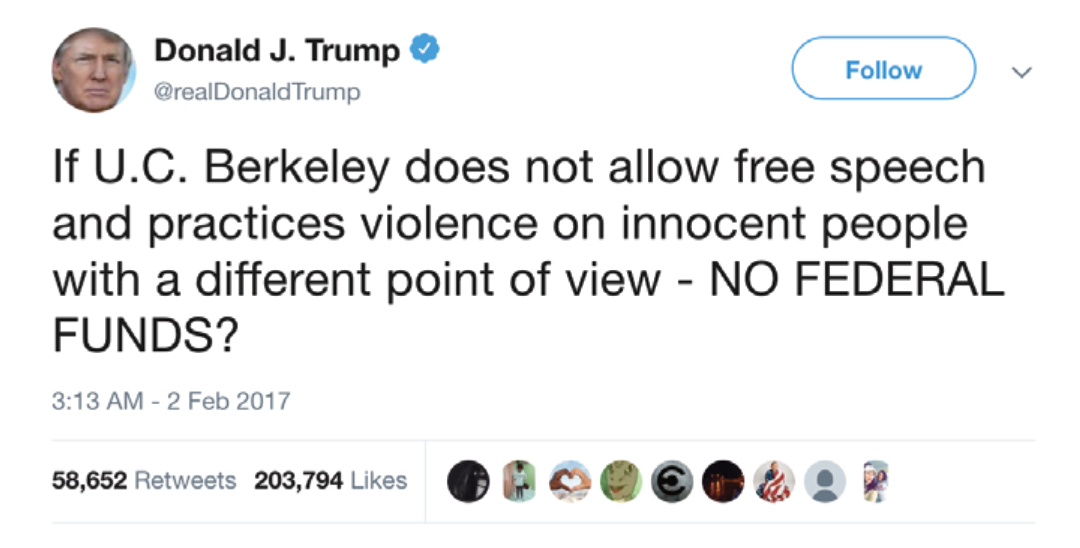
In 2017, however, a small but vocal group of student and faculty at Berkeley, convinced that Yiannopoulos was both hateful and guilty of using campus podiums to harass vulnerable minority students, urged Berkeley Chancellor Nicholas Dirks to cancel Yiannopoulos’s speech. Dirks instead insisted that Yiannopoulos be allowed to speak since the First Amednment protected the right of even the most offensive speakers .When Yiannopoulos arrived on campus in February, 2017, violence ensued. The event was canceled as $100,000 of campus property was damaged, 150 masked Antifa from off campus rioted in protest of Yiannopoulos (only one or two Berkeley students were identified among the rioters), and student and faculty safety was compromised. The BCR claimed that Free Speech was under threat at Berkeley and later sued the university; media was laser-focused on Berkeley. Ignoring the facts that the UC Berkeley administration had defended free speech and that the Yiannopoulos talk had only been cancelled after the riot posed a danger to public safety President Trump tweeted:
Not only was this initial invitation at issue. Leading Berkeley student conservatives wanted Yiannopoulos to return to campus in the Fall of 2017 despite the scandal over his crude joking about pedophelia. Yiannopoulos claimed he would hold a “Free Speech Week” at Cal, in which he and other far right celebrity speakers (deemed bigoted and offensive by many students and faculty) appeared. Chancellor Carol Christ permitted his appearance, despite widespread opposition at Berkeley, but the other celebrities did not appear with Yiannopoulos – who had lied about inviting them. Explaining his motivations for returning to Berkeley, Yiannopoulos told Playboy, “I believe the challenge for us [the fringe right wing] is to create something so attention grabbing that it produces another U.C. Berkeley and I can sell another 100,000 copies of the book [he had just published]... Hopefully, God comes out and smiles on us and Antifa fire-bombs the entire university.”
What is the role of Free Speech during your college years?:
In this simulation, you will pick up this story and play the roles of Berkeley principals. You will determine how you envision the scope of free speech at Berkeley during your college years and beyond.
Members of the Berkeley Community, 2017
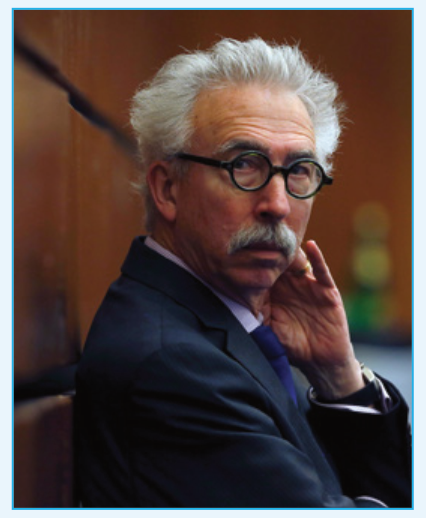
You are Chancellor Nicholas Dirks, UC Berkeley. Your thinking points are:
- Berkeley’s fame over free speech
- Do you have the free speech right, as chancellor, to criticize a bigoted guest invited by a student group?
- What resources should you devote to this issue when you are running the campus on a tight budget?
- “It’s a terrible inconsistency. Real tensions… exist between the [university’s] values of inclusion and the values of free speech. I think for kids it is a genuine confusion. The truth is that students by virtue of being… member[s] of a student community are often constrained in ways that outside people are not… They are subject to student [conduct codes]. Students for saying things can be held accountable by the rules of student conduct that actually are not about freedom of speech because they are community values.”1
- Your defense of free speech makes you a target for Antifa rioters (who want to shut down the Yiannopoulos speech)
- “In our present political moment, we need more than ever to cleave to the laws that protect our fundamental rights. The First Amendment is unequivocal in its almost unfettered protection of speech with which many might disagree… . We cannot support free speech selectively.”2
- Do you think I was right to have allowed Yiannopoulos to speak at Berkeley in February, 2017?
And/Or
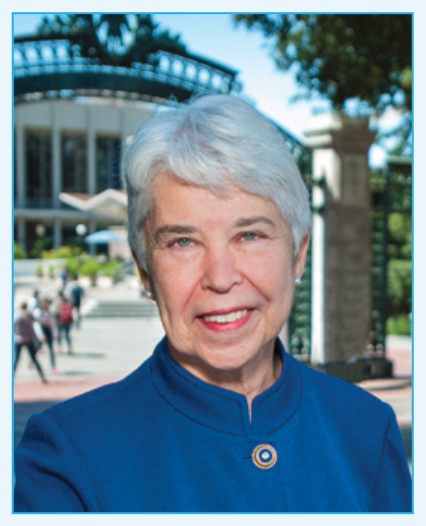
You are Chancellor Carol Christ, UC Berkeley. Your thinking points are:
- Berkeley’s fame over free speech
- Do you have free speech right, as chancellor, to criticize a bigoted guest invited by a student group?
- What resources should you devote to this issue when you are running the campus on a tight budget?
- After you assume the chancellorship following Dirks’ term you will declare your first term as “Free Speech Year” and hold forums examining the complexity of this issue
- You are “aware of how some of the [bigoted] speakers made constituencies on campus feel that they didn’t belong, that they were threatening their sense of place in the community. Even though I wish our students were more resilient, I realized that I came from a [different] place… 73 years old, successful, I have a powerful position so it is easy for me to be resilient. It is not so easy for someone who feels that she may not belong at Berkeley in the first place, and [then to have a vitriolic speaker comes to campus] telling her she doesn’t belong.”3
- Do you think I was right to have allowed Yiannopoulos to return to Berkeley’s campus in the Fall of 2017, as well as allow other far right celebrity speakers that many students and faculty deemed bigoted and offensive?
You are President of the Berkeley College Republicans. Your thinking points are:
- You feel alienated and are fed up how BCR events garner little attention and participation
- You claim you do not feel welcome on a largely liberal campus because of your political right wing views
- You are hoping that when speakers like Yiannopoulos come to Berkeley, they will spark debate and dialogue
- “We invited Yiannopoulos precisely because he raises taboo political topics that our club believes are necessary for, and essential to a complete political debate - and he uses humor and satire while doing so.”4
- “In order to fully develop intellectually, we must not hear solely from those with whom we agree and those who make us feel good - we must have our views challenged. BCR are in fact the real thinkers on this campus precisely because they have the courage to stand up to Berkeley’s reigning political orthodoxy… [ie] liberal thought.”5
- You say that Yiannopoulos “gives a voice to repressed conservative thought on college campuses…”6
- “... we know that it is right that people’s feelings should take a back seat to open discourse and free speech… The BCR believe that we should err on the side of more speech instead of less… It is time [for liberals] to mature and realize that you will encounter people with whom you may not agree.”7
- After the riot with Yiannopoulos’ visit to Berkeley, you will be a frequent guest on national TV programs
You are a faculty member, 2017, UC Berkeley. Your thinking points are:
- Accommodating speakers like Yiannopoulos will disrupt the academic function of the university
- In August, 2017 violence in Charlottesville, VA by alt-right extremists and Nazis left an ant-racist protester dead. You are concerned that outsider extremists will descend on Berkeley’s campus (again) and you fear for the safety of all your students, students of color, and those who may be undocumented
- Should you cancel your own classes if Yiannopoulos returns to Berkeley?
- While Berkeley is a public university which is obligated to protect the First Amendment as opposed to private universities (hence President Trump’s threat to withhold federal funds), you have been following the scholarship. Have First Amendment protections been misapplied to college campuses? Berkeley is not a public space in the sense of a park. It has an educational function and a responsibility to uphold this mission. If a speech interferes with education, by forcing the closing of academic buildings, should the university cancel the speech to restore its academic work even if the courts might rule it unconstitutional to prevent the speech?
- Security measures have inconvenienced you when these alt-right speakers come to campus: you can’t meet with students because buildings are closed, you can’t conduct campus business. Also, as a professor of color, you do not feel safe with the heavy police presence while on campus at night
- Concerns about the “mental health impact” on your students who may find Yiannopoulos and his ilk’s rhetoric directly offensive and see themselves as targets of the hostile speech
You are a Berkeley student, 2017, UC Berkeley. Your thinking points are:

- You are uncomfortable with the rhetoric of Yiannopoulos and the other far right celebrity speakers that many students and faculty deemed bigoted and offensive who want to come to your campus. You see them as bullies and everything you have learned starting in elementary school has taught you to take a stand against bullies.
- You are a part of the three-quarters of your freshman class that entered Berkeley after the February, 2017 riots who agree that ‘the University has a responsibility to provide equal access to safe and secure venues for guest speakers of all viewpoints - even if the ideas are found offensive by some or conflict with the values held by the UC Berkeley community.”8
- On the other hand, you worked really, really hard to get to Berkeley, you are paying a lot of money and also feel that, “Students have a right to go to their classes and feel safe in their classrooms, and you’re [the administration] ready to compromise that for, like, the First Amendment that you’re trying to uplift?”9
- Is your campus being hijacked for the sake of placating the ghosts of the Free Speech Movement from 1964 at a cost to your education?
- Security measures have inconvenienced you when these alt-right speakers come to campus: you can’t meet with professors because buildings are closed and some of them have cancelled classes.
You are Mario Savio (1942-1996), leader of Berkeley’s 1964 Free Speech Movement. Your thinking points are:
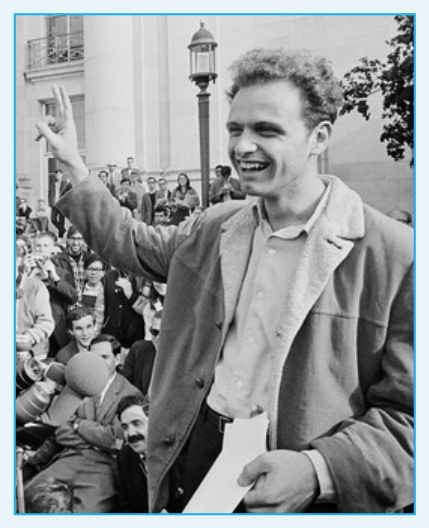
- Your passionate but measured leadership led to codifying Berkeley’s rules about political speech or activity. Among these resolutions are prohibitions against the university to restrict such speech but does allow the university to regulate when speeches happen, where they take place and how, “to prevent interference with the normal functions of the university.”10 (These are called Time, Place, and Manner regulations.)
- The technology in 1964 was far limited from today where hostile speakers film and broadcast audience members to harass and intimidate
- Regarding Free Speech: “The most beautiful thing in the world is the freedom of speech… those words are…burned into my soul, because for me free speech was not a tactic, not something to win for political [advantage].… To me freedom of speech is something that represents the very dignity of what a human being is.… It is the thing that marks us as just below the angels. I don’t want to push this beyond where it should be pushed, but I feel it.”11
- And after Berkeley students won Free Speech protections you will say: “We are asking that there be no, no restrictions on the content of speech save those provided by the courts…. And people can say things in that area of freedom which are not responsible…we’ve finally gotten into a position where we have to consider being responsible, because we now have the freedom within which to be irresponsible. And I’d like to say at this time…I’m confident that the students and the faculty of the University of California will exercise their freedom with the same responsibility they’ve shown in winning their freedom.”12
- “We will never intentionally bring disgrace upon this our university. By our words and actions we will endeavor to honor the ideals of those who have come before us, and to deepen and strengthen this community in which we are privileged to speak.”13
Group Task
Step one: Get to know your character by reading: “You are…. Your thinking points are… .
Step two: Read UC Berkeley’s Principles of Community, 201814:
These principles of community for the University of California, Berkeley, are rooted in our mission of teaching, research and public service. They reflect our passion for critical inquiry, debate, discovery and innovation, and our deep commitment to contributing to a better world. Every member of the UC Berkeley community has a role in sustaining a safe, caring and humane environment in which these values can thrive.
We place honesty and integrity in our teaching, learning, research and administration at the highest level.
We recognize the intrinsic relationship between diversity and excellence in all our endeavors.
We affirm the dignity of all individuals and strive to uphold a just community in which discrimination and hate are not tolerated.
We are committed to ensuring freedom of expression and dialogue that elicits the full spectrum of views held by our varied communities.
We respect the differences as well as the commonalities that bring us together and call for civility and respect in our personal interactions.
We believe that active participation and leadership in addressing the most pressing issues facing our local and global communities are central to our educational mission.
We embrace open and equitable access to opportunities for learning and development as our obligation and goal.
UC Berkeley’s “Principles of Community” statement was developed collaboratively by students, faculty, staff, and alumni, and issued by the Chancellor. Its intent is to serve as an affirmation of the intrinsic and unique value of each member of the UC Berkeley community and as a guide for our personal and collective behavior, both on campus and as we serve society.
Step #3: Discuss as the assigned members of the Berkeley community during 1917:
- What is the purpose of the university?
- To what extent is free speech important on a college campus? How important is it to you (in your role)?
- How did the function of the media affect Berkeley and the events of 2017?
- Did Chancellor Dirks on 2/17 and Chancellor Christ in the Fall of 2017 make the right decisions to provide Milo Yiannopoulos (et. al) the resources and accessibility to Free Speech at UC Berkeley?
- Why do you think Trump criticized Dirks in his Tweet for suppressing speech and practicing violence when the opposite was true?
- Should free speech be absolute on college campuses in the 21st century? Why? Why not?
Teaching materials designed by Robert Cohen, Stacie Brensilver Berman, and Debra Plafker of the NYU Social Studies/History Curriculum Collaborative.
- Robert Cohen, “”Free Speech is Who We Are”: The University of California and the Struggle to Preserve Berkeley’s Free Speech Tradition in the Trump Era,” 2018, in author’s possession ↩︎
- Ibid. ↩︎
- Ibid. ↩︎
- Robert Cohen, “Why Berkeley Conservative Student Leaders Fell For Milo Yiannopoulos and Fed the False Fox News/Trumpist Narrative that the University of California Suppresses Conservatism,” 2018, in author’s possession. ↩︎
- Ibid. ↩︎
- Ibid. ↩︎
- Ibid. ↩︎
- Robert Cohen, “”Free Speech is Who We Are”: The University of California and the Struggle to Preserve Berkeley’s Free Speech Tradition in the Trump Era,” 2018, in author’s possession. ↩︎
- Ibid. ↩︎
- Ibid. ↩︎
- Robert Cohen, “What Might Mario Savio Have Said About the Milo Protest at Berkeley?,” The Nation, February 7, 2017, https://www.thenation.com/article/what-might-mario-savio-have-said-about-the-milo-protest-at-berkeley/ ↩︎
- Ibid. ↩︎
- Mario Savio’s Free Speech Movement monument design, 1989. This is discussed in Robert Cohen, “The Berkeley Rebellion: Mario Savio’s Design for a Free Speech Movement Monument,” Cal Alumni Association/UC Berkeley, accessed February 13, 2019, https://alumni.berkeley.edu/california-magazine/spring-2010-searchlight-gray-areas/berkeley-rebellion. ↩︎
- “Principles of Community,” Berkeley Diversity, accessed February 13, 2019, https://diversity.berkeley.edu/principles-community. ↩︎